Figures
MECHANISM FIGURE 18-6 Some amino acid transformations at the carbon that are facilitated by pyridoxal phosphate
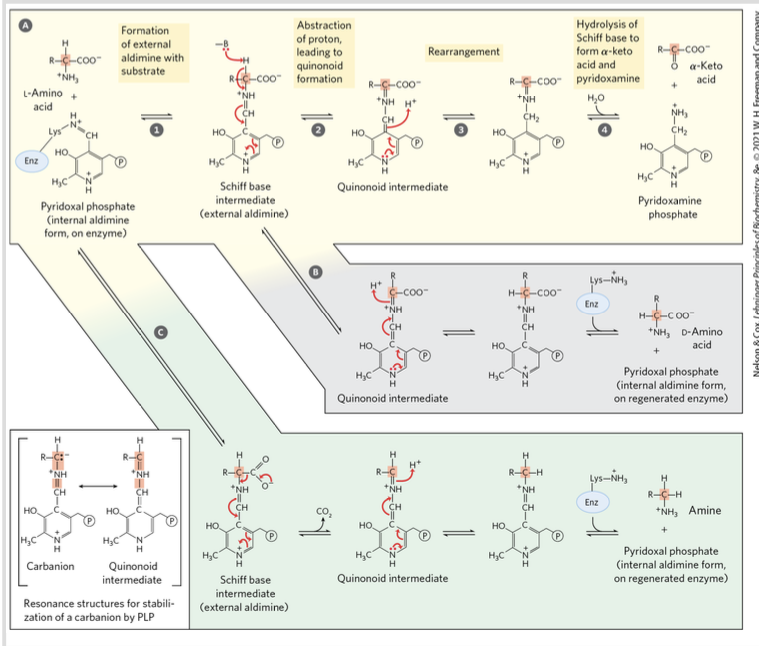
Explanation and flow chart - PLP Mechanism Flow Chart
PLP Binds to Enzyme
↓
Internal Aldimine (Schiff Base): PLP forms a Schiff base linkage with an enzyme lysine residue.Amino Acid Substrate Binds
↓
External Aldimine Formation: The amino acid’s α-amino group displaces the enzyme’s lysine, forming a Schiff base with PLP.Three Possible Pathways from External Aldimine
Pathway 1: Transamination
↓
Quinonoid Intermediate (PLP stabilizes negative charges)
↓
New α-Keto Acid Formation: Amino group is transferred, producing a new α-keto acid and a new amino acid.Pathway 2: Racemization
↓
Quinonoid Intermediate (allows rotation around the α-carbon)
↓
Stereochemistry Change: Converts an L-amino acid to a D-amino acid (or vice versa).Pathway 3: Decarboxylation
↓
Quinonoid Intermediate (stabilizes carbanion after CO₂ removal)
↓
Amine Formation: Removal of CO₂ produces an amine from the amino acid.
Role of PLP as an Electron Sink
↓
Stabilization of Intermediates: PLP’s structure enables electron delocalization, preventing unstable intermediates.