Week 7: What is Colour
What is Colour part 1.
Overview
Color perception must be understood as subjective and varies across species.
The visual systems of different animals process color information differently based on evolutionary adaptations.
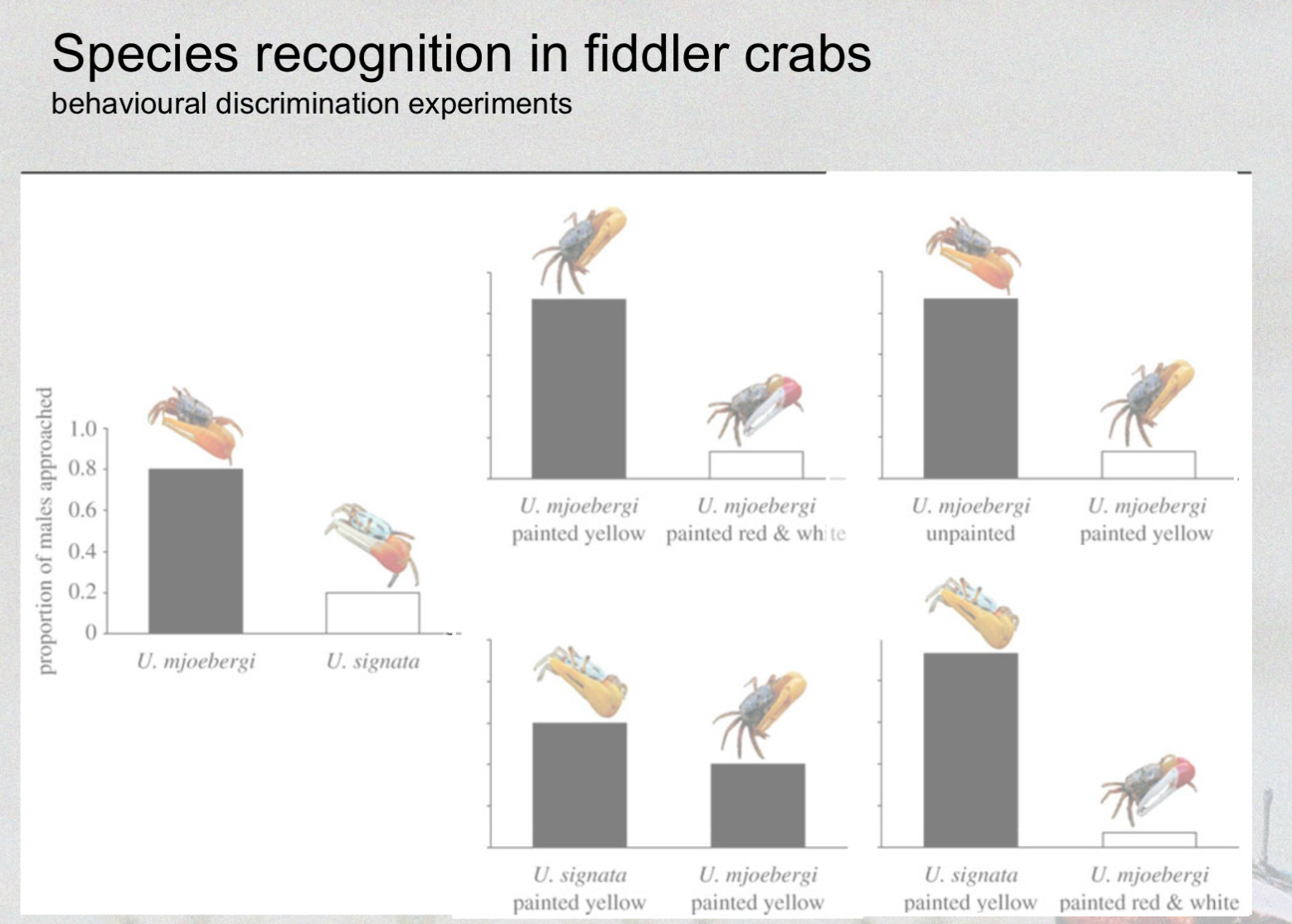
Example: Fiddler Crabs
Species Focus: Male fiddler crabs (Miavergi, Uchka miiwergi) exhibit yellow claws that are waved to attract females.
Each species has distinct waving patterns, recognized by females, and different color signals (yellow, red, etc.).
Significance of Color:
Females can identify males of their species from a distance using color even if they can’t resolve details due to poor spatial resolution (only perceive crabs as points).
Experiment with Male Fiddler Crabs
Experimental Setup: Two male crabs of different species (Myobergi - yellow, Cygnata - red/white) were tethered, and a female was placed 30 cm away to observe her preference.
Observations: Females predominantly approached the yellow male of their species.
If the Cygnata male was painted yellow, the preference diminished.
When a Myobergi was painted red/white, the female still preferred the unpainted yellow one.
Unpainted Myobergi claws had a UV component that females could distinguish, which was not visible to humans.
Definition and Complexity of Color
Color is related to wavelengths of light.
While each wavelength corresponds to a color, natural colors often combine various wavelengths.
Ultraviolet <—-> Infrared
Illumination and surrounding contexts alter color perception significantly.
Color Calculation: The observer’s neural system processes colors and is influenced by light sources and backgrounds.
Human Color Perception
Photoreceptors: Humans possess rods and three types of cones (short, medium, long wavelength) that absorb different wavelengths of light.
Short wavelength cones respond best to approximately 420 nm light, while longer wavelengths are absorbed less.
Signal Processing:
Photoreceptors provide signals based on the intensity of light they receive, not direct color information.
The signal received is a result of the interaction between illumination and an object’s reflectance properties.
Color Signal Processing
Color Signals: Created by the combination of illumination and reflectance.
Processed through multiplication of spectral components.
Principle of Univariant: A single photoreceptor cannot discern colors; it only counts light photons, leading to confusion between light intensity and color.
Two photoreceptors can help differentiate colors through their relative responses (difference in sensitivity to colors).
The Role of Multiple Photoreceptors
More photoreceptors allow for greater color distinction:
Dichromats (2 photoreceptors) have a linear color perception, lacking the ability to perceive hues distinctly.
Trichromats (3 photoreceptors) can assess color using hue and saturation, shaping a broader color space than dichromats.
Tetrachromats (4 photoreceptors) have an added dimension in color perception yet remain frustratingly enigmatic in how this is experienced.
Chromaticity Diagrams: Illustrate how different animals perceive colors and reveal the limitations and capabilities of their visual systems.
Implications and Conclusion
Color is not solely a property of light but also significantly influenced by the variation in visual systems across species.
The ability to discriminate colors relates directly to the number and types of photoreceptors an organism has, shaping its unique color experience.
What is Colour part 2.
Measuring Colors in Animals
Introduction
This lecture discusses how to measure color vision in animals. It covers testing methods, important considerations, and experimental design implications.
Training Animals for Color Distinction
Tamar Wallaby Experiment: A wallaby was trained using a dual force paradigm to distinguish colors. The animal received food rewards for selecting the white color correctly. If it made a wrong choice, the panels turned black, prompting a wait for the next trial.
Encouraged to maximize food, wallabies often played the task continuously even when satisfied, achieving over 1000 trials in one night.
This illustrates their engagement and natural behavior in a calm, familiar environment, away from stressors.
Color Vision Challenges in Dichromats
Wallabies, as dichromats, struggled to distinguish certain colors. An experiment demonstrated this by showing that blue-green light closely matched white light for these animals.
Key Observation: Despite being clear distinctions to humans, the wallabies could not differentiate between colors that activated their two photoreceptors similarly.
Key elements of a good experimental design
Critical Components:
Replication: Essential for estimating measurement errors and variability in animal responses. Conducting multiple repetitions enhances precision and generalisability.
estimation of errors
Increase in precision
Larger range of observations (i.e. larger sphere of inference)
Randomisation: Crucial to avoid bias in experimental results. Treatments must be assigned randomly to eliminate confounding variables.
assigning treatments to experimental units at random
Appropriate sampling of experimental data
Avoiding bias and other sources of variation that cannot be controlled
Basis for any valid statistical test
Control: Necessary to isolate the independent variable and ensure that observed effects are due solely to the treatment. A control group or sham treatments helps validate experimental outcomes.
placebo, sham injections, etc
The main purpose of a control is to isolate the independent variable from other associated effects
Conducting Color Vision Experiments
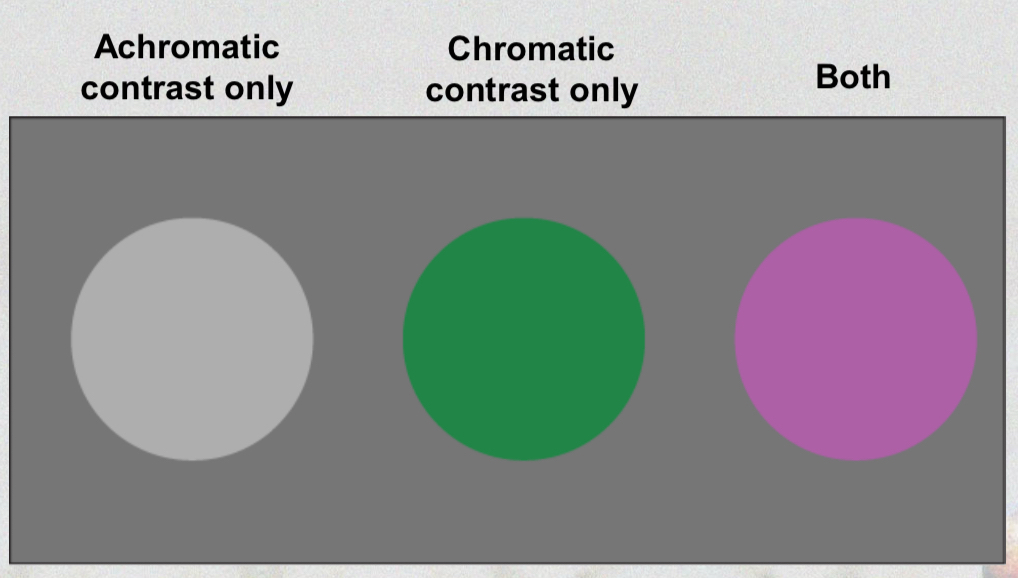
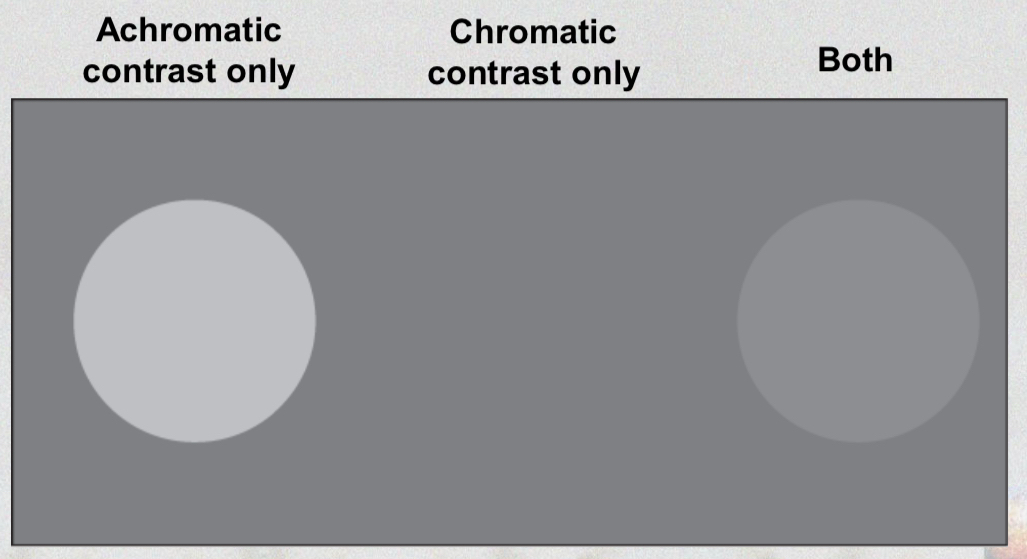
Different types of contrasts in visual perception:
Achromatic Contrast: Difference in brightness.
Chromatic Contrast: Difference in colou r per se.
Both
In experiments, it's paramount to control for intensity, ensuring that color distinctions are not influenced by brightness levels.
Questions to Explore in Colour Vision
The most basic questions are:
Does the animal have colour vision?
How many color channels does it possess? (Dichromat, Trichromat, or Tetrachromat)
Monochromacy (colour blind)
Dichromats: Have two photoreceptors, often limited in color distinction. (E.g. dogs/cats)
Trichromats/Tetrachromats: More advanced systems, such as birds and reptiles, which allow for richer color perception. (E.g. humans)
Tetrachromacy (e.g. many birds and reptiles)
Experimentation Example: Tamar Wallabies
Experiment Goal: Prove wallabies can distinguish colors regardless of brightness.
Presented colors (blue and green) at varying brightness levels.
If animals could differentiate regardless of intensity, it would confirm color vision.
Results: Animals distinguished correctly between stimuli at different brightness, confirming that their ability was based on color perception, not intensity.
Randomisation and Replication in Experiments
Colors were assigned randomly to left or right panels during testing to avoid bias.
Results were replicated across multiple trials to increase validity.
Identifying Dichromacy
To prove that an animal is dichromatic, one need to show that their spectral sensitivity has a neutral- (or null-) point. This is the point along the wavelength spectrum where a dichromatic cannot distinguish a single monochromatic colour from a broadband of light (usually white). Trichromats do not have such a point.
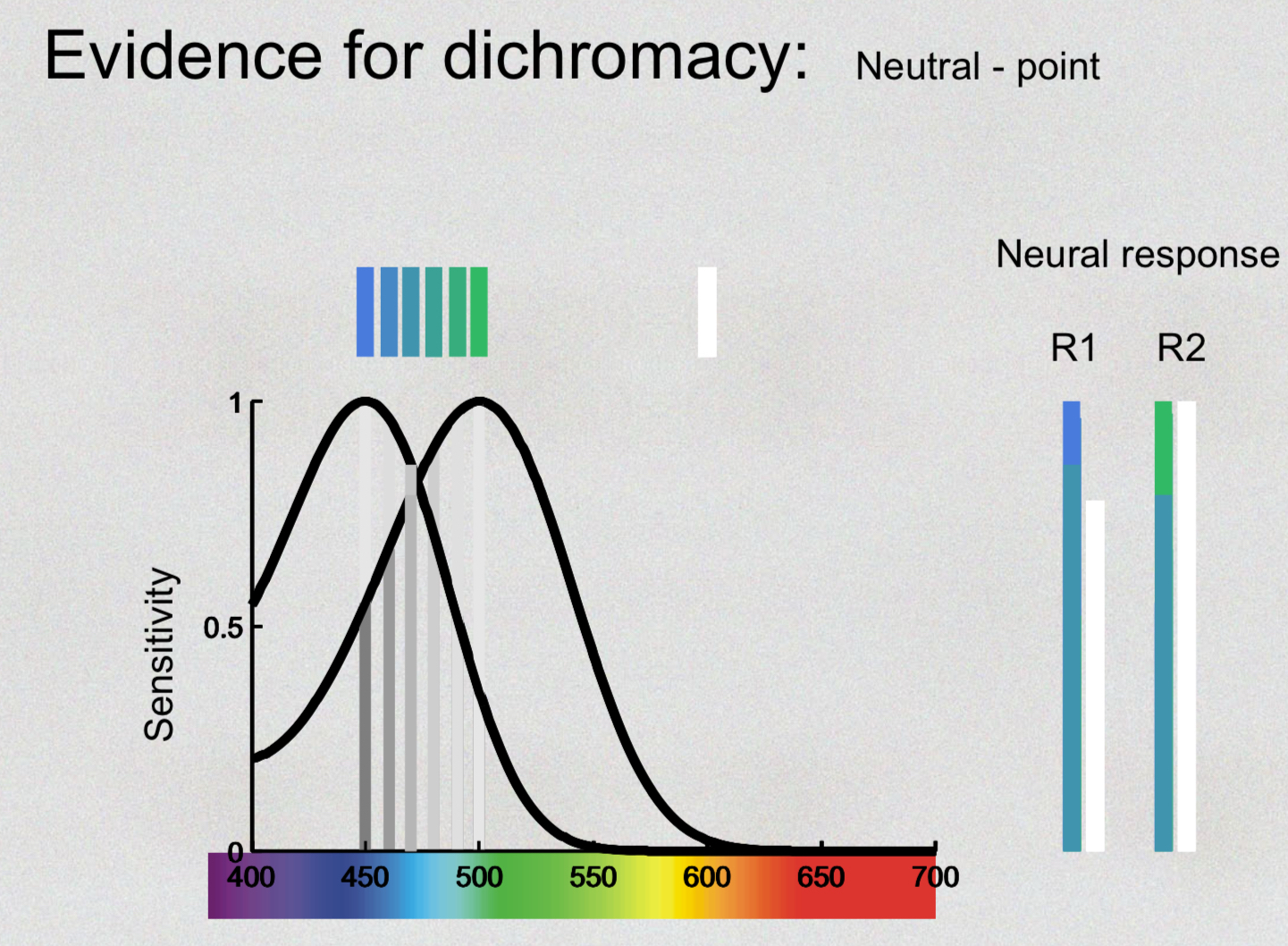
Null Point Observation: A point where white light appears similar to a coloured light due to receptor response ratios.
Trained animals to recognize white versus monochromatic colors. Results indicated that wallabies could not differentiate around 480-490nm, confirming their dichromatic vision.
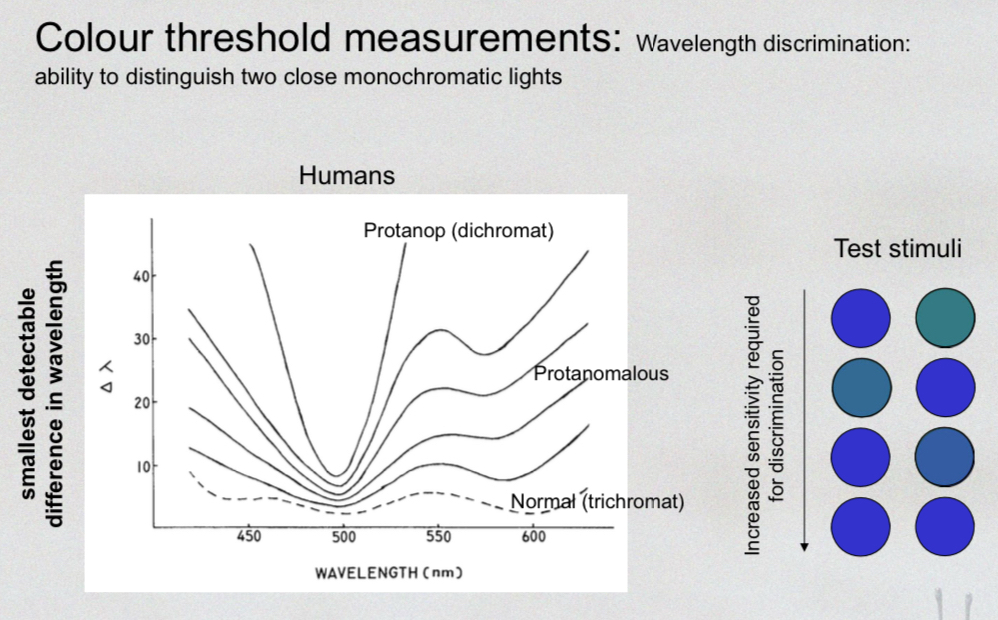
Color Threshold Measurements: Method for identifying sensitivity to color differences. Adjust colors until they are indistinguishable and determine the minimum threshold.
Outcome: Trichromats distinguish colors even when very close, while dichromats have a limited range effective for color detection.
Behavioural Experiments Limitations
Common mistakes in color experiments stem from insufficient control of luminance. Accurate color assessment requires managing brightness impacts.
Conclusion: Understanding animal color perception can become complex with more photoreceptors. Always ensure proper control to validate your findings effectively.
The main concepts
behavioural colour vision experiments are all about luminance! To show colour vision, one needs to eliminate brightness contrast.
The null-point or neutral-point experiment is a conclusive way to show that an animal is a dichromat.
Colour threshold experiments and colour mixing experiments (of which the null-point experiment is a special case), can be used to infer some of the underlying colour vision mechanisms e.g. the dimensionality of an animal’s colour space
Don’t forget the control!
What is Colour part 3.
Color Vision Conclusion Notes
Subjectivity of Color
Color perception is subjective due to several factors.
Each observer's visual and neural systems process color differently.
Environmental and lighting conditions significantly affect how color is perceived.
To understand a "core" color, it is crucial to isolate it from its viewing conditions.
Reflectance vs. Color Signal
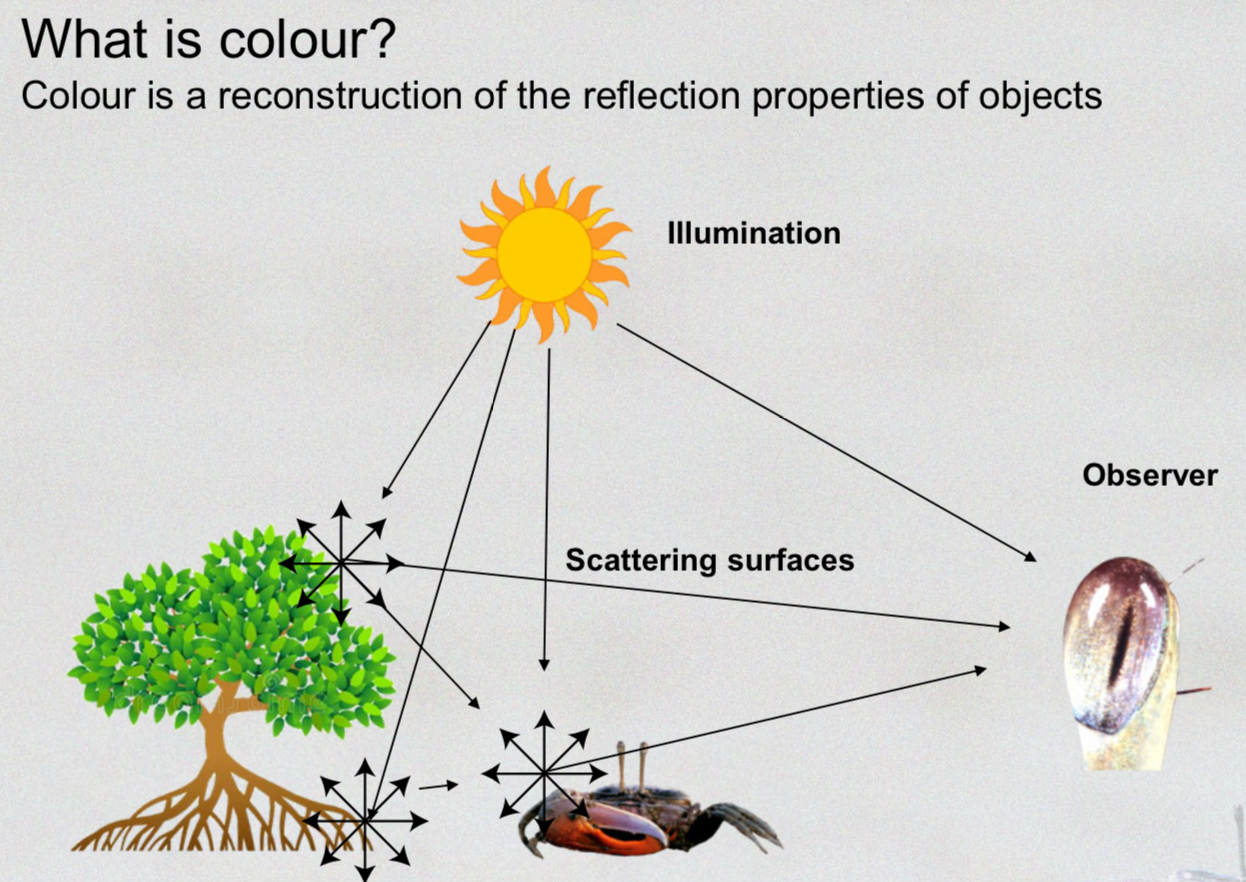
There is a distinction between the reflectance of an object and the color signal perceived.
Reflectance: An object's inherent property that determines how it reflects light.
Color Signal: The information that reaches our eyes, which can be influenced by external factors such as illumination.
Remember: Reflectance is not equivalent to the color signal.
Colour Constancy
The visual system's ability to maintain consistent color perception despite changes in illumination is called color constancy.
Color constancy allows us to recognize an object’s true color regardless of the artificial light under which it is viewed.
Empirical Example: Training Butterflies
Butterflies can be trained to recognize colors independently of lighting.
Example: A butterfly can be trained to identify yellow paper under different lighting conditions.
When lighting changes, the yellow may appear green based on the color signals.
Despite this, butterflies maintain the ability to correctly identify yellow, demonstrating their capacity for color constancy.
Artistic Example: Colour Perception in Art
Claude Monet's painting "Haystacks" illustrates variations in color perception during different times of the day.
The painting showcases how lighting conditions affect color discrimination.
This variation in perception does not indicate a failure of the visual system but rather demonstrates its adaptability and features.
Our perception can indicate the time of day based on color variation, which is a critical clue in our visual processing.
Conclusion
Understanding the subjectivity of color and the concepts of reflectance and color constancy is essential in grasping how we perceive color in different environments.
The ability to adapt our perception of color based on lighting nuances is a valuable characteristic of our visual system.
Feel free to reach out online with any questions regarding this topic!