Correlation Analysis
Correlation analysis is a statistical method that identifies the strength of a relationship between two or more variables.
The correlation coefficient measures the relationship between two quantitative variables measured on the same entity.
Pearson correlation coefficient
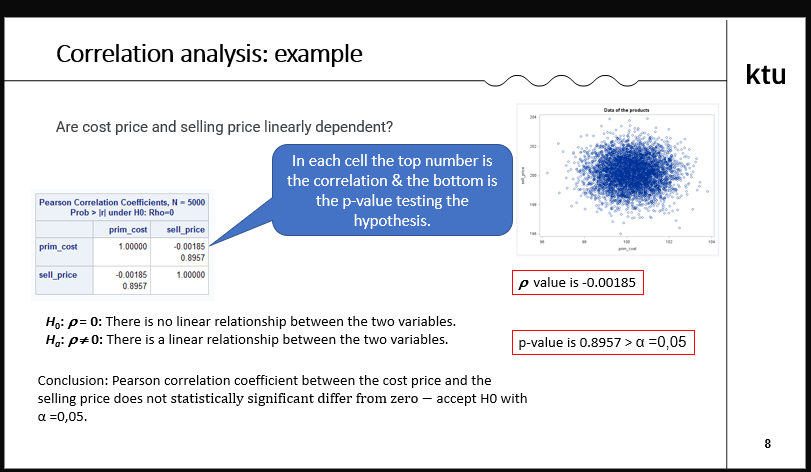
The Pearson correlation coefficient estimates the strength of the linear relationship. It can be used when the observed random variables X and Y have normal distribution.
correlation = -1, perfect negative linear relationship
correlation = 1, perfect positive linear relationship
correlation = 0, no linear relationship
Pearson product moment correlation coefficient
The PPMCC is a measure of the linear relationship between two variables that have been measured on interval or ratio scales.
Correlation analysis results
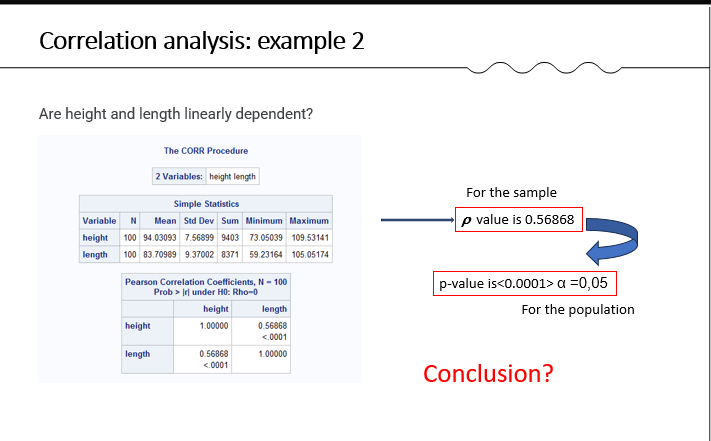
Conclusion: The p-value < 0.05 implies rejecting null hyp. There is significant evidence of a positive linear relationship between height and length in the population.
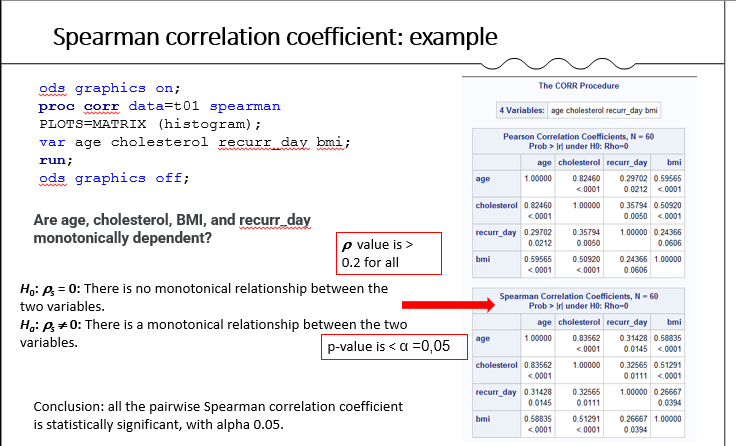
Spearman correlation coefficient
Spearman's correlation coefficient measures the strength of the relationship between variables on ratio, interval, or ordinal scales.
It is useful when the distribution of variables is unknown or not normal.
Spearman's coefficient evaluates monotonic relationships, meaning as one variable increases, the other either consistently increases or decreases (not necessarily linearly).
It works by ranking observed values and is distribution-independent.