Postmortem burial environments
Bone degredation
Soft tissue preservation
Intrinsic determinants of bone taphonomy
Age
Infant v adult bone
Mineral/collagen ratio
More mineral for adults
more collagen for juveniles
Density
Cortical/ trabecular ratio
cortical depth
Pathology
Osteoporosis
Extrinsic determinants of bone taphonomy
Terrestrial
Soils
Water table
Weathering
Plants/Insects
Post-mortem preservations
Soils →
Naturally occuring
Differently sized mineral particles (sand, silt, and clay) and organic matter
+
Manufactured materials
Fertilizers, artifacts, asphalt, brick fragments
=
Different colors, consistency, texture, and minerals
Impacts to the soil:
Climate- Rate of physical weathering, chemical reactions and biological activity
Precipitation/ Moisture and temperature
Plants and animals/insects
Certain insects will move the soil (aerate)
Certain plants are drawn to nitrous areas
Topography
Time: Wraps up how all of the factors work and how quickly
Soils
Chemical compositions
Surface layer. decomposing accumulated plant matter
Topsoil, majority of biotic activitu (MOST ACIDIC GENERALLY)
Determinant of Skeletal Preservation
Soil acidity
Acidic v alkaline
ALKALINE SOILS
White ‘bleached’ bones
Outer cortical layer removed
Rough granular surface
Not smooth like normal bone
ACIDIC soild
Remove the hydroxyapatite
Corrosion
‘Windows’, holes in bone
Clothing
A shielding effect
Leather boots
Weathering
Sun bleaching
Grey white
Cracking
Interior cortical bone intact → cracking → fragmentation
Accelerants:
Cyles of rain and sunshine
Freeze- thaw cycle
drought
seasons
Plants
Root Etching
Bones as nutrients
Markings meander
Different than:
Sharp Force Trauma
Linear
Well-defined edges
Flat, smooth edges
Non-pathological human skeletal vatiation
Metopic suture
Accessory grooves
Insect colonization
Tends to happen when bone is recently burried and still has a high organic content
Leaves channels within the bone
Water Table
Can result in poor preservation
Softening bone
Accelerate erosion
Water moves skeletal elements
Causes them to hit against coffins
Can move the skeletal remains around
Ex: NOLA
Staining (Terestrial)
Partial burial
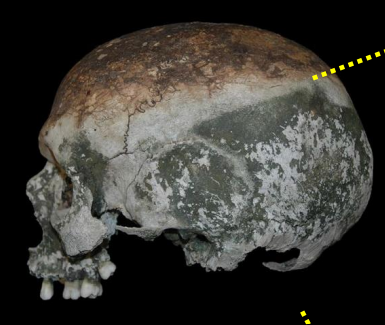
Chemical staining

Metal staining

Marine Taphonomy
Skeletal preservation- marine
Tidal action, currents (inshore/offshore)
Sand, shells, rocks
Bone transport in multiple directions
Encrustations colonizing
“acorn barnacles”

*Dead Man’s Island
Skeletal preservation- fluvial (river)
Silt, clay, rounded rocks, and occasionally fast moving water
Fast/Slow moving
Bone transport one main direction
Marine v Fluvial
Marine
Smoothing
Bleaching
Rounded
Scalloping
Fluvial
Perforation of thin plates
Scratching, gouging, and chipping
Soft Tissue Preservation and Burial Environments
Fresh → bloat → putrefaction → skeletonization
Factors affecting preservation
Organic material - body
Decomposer organisms
Environment
Water
Oxygen
pH
Temperature
Degree of protection
Mumification
Preservation of soft tissue, such as skin, muscle, fat, ligaments, or organs
Rapid dehydration and desiccation of human tissue
Skin becomes fixed to the bone
Extreme environments preserving soft tissue
Bactericidal conditions such as bogs and salts
Fixation by mineral salts
Freezing
Hot/cold desiccation
Humic acides
Natural Mumification
Arrested decay by moidture loss and tissue desiccation
Egypt
Humidity absorbing soils such as hot sands
“Salt men”
Crypt mummification
Steady warm air passage
Rate of Mumification
Several weeks to more than 12 months
Exposed hot arid environment < 2 weeks
Enclosed hot arid environment 1-3 months
Central Italy - Case study (4 weeks)
UK Peat Bogs and Fens
Arrested decay
Ombrotrophic sites (high moor peat bogs)
Recieves water from precipitation
Typically acidic (pH 3.2-5)
Well- preserved soft tissue
Demineralised bone
Sphagnum moss- compresses
Freeze-drying, Frozen
Freeze-dried (desiccated)
Includes wind (dried
Freezing
Decomposition halted (water still there)
Natural environments
High altitudes
Artic/Antarctic
Circumpolar regions
Clothing
Speed of decomposition
Clothing finish impacts rate of decomp