Myers 19: Auditory only
Definitions
Audition
the sense or act of hearing
Pitch
a tone’s experienced highness or lowness; depends on frequency
Long waves = Low Freq / Low pitch
Short waves = High Freq / High pitch
Middle ear
the chamber between the eardrum and cochlea containing three tiny bones—hammer (malleus), anvil (incus), and stirrup (stapes)—that concentrate the vibrations of the eardrum on the cochlea’s oval window.
within a space filled with just air (they sit in air)
Malleus (Hammer)
Incus (Anvil)
Stapes (Stirrup)
Cochlea
a coiled, bony, fluid-filled tube in the inner ear
sound waves traveling through the cochlear fluid trigger nerve impulses.
part of the inner ear
responsible for converting sound vibrations into electrical signals that the brain can interpret. (where the hair cells and Tectorial membrane are)
Inner ear
the innermost part of the ear, containing the cochlea, semicircular canals, and vestibular sacs.
within a space filled with fluid (fluid filled cochlea )
Basilar Membrane
Different regions of the basilar membrane respond preferentially to specific frequencies
creates a tonotopic map for frequency discrimination in auditory processing.
thin, delicate structure within the cochlea
As the basilar membrane vibrates, it causes the hair cells to bend on the tectorial membrane which then leads to transduction)
hair cells on the basilar membrane
Sensorineural hearing loss
the most common form of hearing loss, caused by damage to the cochlea’s receptor cells (hair cells) or to the auditory nerve; also called nerve deafness
Inner Ear problems
Conduction hearing loss
a less common form of hearing loss, caused by damage to the mechanical system that conducts sound waves to the cochlea.
Middle and outer ear problems
Cochlear implant
a device for converting sounds into electrical signals and stimulating the auditory nerve through electrodes threaded into the cochlea.
Characteristics of Sound Waves:
Amplitude
Determines the perceived loudness of sound waves.
Height of the sound wave
Frequency, this is measured in what?
The number of complete wavelengths that pass a point in a given time (for example, per second)
Measured in hertz (Hz), it determines the pitch of sound waves
Long waves = Low Freq / Low pitch
Short waves = High Freq / High pitch
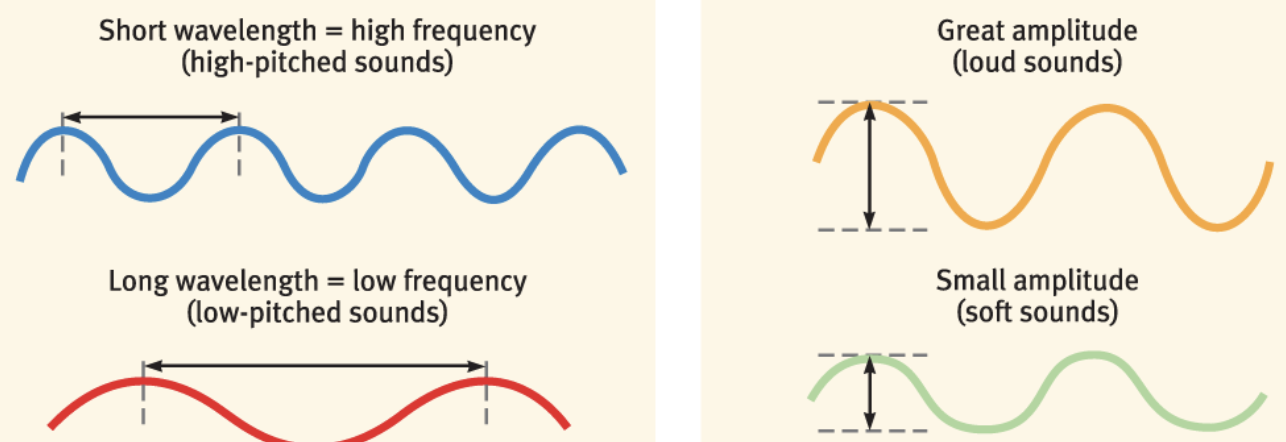
Comparison in Singing between a Soprano and a Baritone singer
Sound waves produced by a soprano are much shorter and faster than those produced by a baritone singer.
Soprano = High pitched singer » Short, faster Waves
Baritone = Low pitched singer » Long, slow waves
How can instruments of different frequencies be heard at the same time?
High frequency instruments = must play louder
this is because high frequency is perceived as less prominent or quieter since our ears are less sensitive to high frequencies
Low frequency instruments = must play quieter (why is this?)
Low frequency can be more easily detected by our ears.
This is the only way for both types of instruments to be heard at the same time (if the same volume, both CANT be heard at the same time)
How the placement within the Band room be used to if the instruments do play at the same volume?
If the instruments need to be at the same volume, then the instruments with the Higher frequency have to be placed closer to the audience (listener)
This closeness will allow for higher frequency instruments to be louder than the low frequency instruments behind them, completing the requirements for both to be heard at the same time (high freq = must be louder and low freq = must be quieter)
Measuring Sound Intensity:
Unit of Measurement for Sound intensity
Decibels (dB) are used to quantify sound intensity.
Absolute Threshold and Range for human hearing (Hz)
Zero decibels represent the absolute threshold for hearing. (1,000 kHz)
the range for human hearing is 20Hz - 20,000 kHz
Incremental Increase in sound intensity happens every…
Every 10 decibels correspond to a tenfold increase in sound intensity.
At what decibel does hearing loss happen?
Prolonged exposure to sounds above 85 decibels can produce hearing loss.
Ear's Transformation of Sound into Neural Messages:
1) Outer Ear:
The outer ear consists of the pinna (visible part of the ear)
Air vibrations create waves (high or low pressure)
The pinna (outer ear) helps in capturing sound waves and directing them into the ear canal.
These waves then strike the eardrum, causing it to vibrate.
2) Middle Ear:
When sound waves reach the end of the ear canal, they strike the eardrum, causing the eardrum to vibrate.
Three tiny bones (malleus, incus, and stapes) in the middle ear amplify and relay the vibrations from the eardrum
This piston-like mechanism transmits vibrations to the cochlea in the inner ear (oval window)
eardrum is a thin, membrane-like structure
3) Inner Ear - Cochlea (oval window)
The cochlea is a snail-shaped tube in the inner ear.
Vibrations reach the cochlea's opening (oval window), causing the fluid inside the cochlea to jostle.
Oval window is where the sound will get bigger 30x bigger (louder, amplifies sound)
Cochlea = Amplification of Sound
4) Transduction Process
The tectorial membrane that overhangs the hair cells plays a crucial role in the auditory transduction process.
When sound vibrations enter the cochlea and cause the basilar membrane to flex, the hair cells are stimulated
The cilia on the hair cells come into contact with overhanging tectorial membrane
Bending of the hair cells against the tectorial membrane generates neural electrical signals that are then transmitted to the auditory nerve (how transduction happens for sound stimuli)
Generally tho, Transduction happens through hair cells
Stimulation of Hair Cells
Vibrations cause the fluid in the basilar membrane of the cochlea to jostle, creating ripples
Hair cells are bent and touch the tectorial membrane, all due to the ripples from the basilar membrane
6) Auditory Nerve to Thalamus and Auditory Cortex:
The auditory nerve carries neural messages to the thalamus.
From the thalamus, messages are sent to the auditory cortex in the brain's temporal lobe
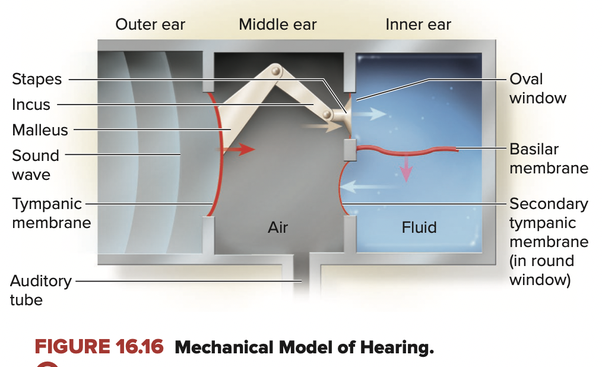
Air vibration (sound) difference as one goes from the Oval window to the Round window. What conclusion can we make of the Auditory system from this?
Difference
difference in air vibration as one goes from the Oval Window to the Round Window
Start — Oval window = Where vibrations enter, have the highest frequency response (15-20,000. Hz)
End — Round Window = Tail End, have the lowest frequency response
Conclusion
the fact that the vibrations decrease in frequency as they travel from the Oval Window to the Round Window indicates that mechanical movement is involved in the process (vibrations die down as you travel along, travel over basilar membrane)
Where does the concept of the ear being like an elongated triangle come from?
Related to the transition from the oval window to the round window.
Base of the Triangle = (Oval Window)
located at the base of the cochlea
Apex of the Triangle = (Round Window)
situated at the apex or the narrow end of the cochlea
The analogy of an elongated triangle help illustrate the path of sound transmission from the oval window to the round window
The tapering shape of the cochlea contributes to its ability to process different frequencies along its length
(close to oval window = high freq) (close to round window = low freq)
How is Transduction different with the auditory systems hair cells, then the visual systems rods and cones? What is a conclusion we can make about the auditory system, from this?
Mechanical vs. Chemical Transduction:
In the auditory system, the transduction is primarily mechanical, directly converting mechanical vibrations into electrical signals.
In the visual system, the transduction is chemical, involving the conversion of light energy into a chemical signal before generating electrical signals.
Conclusion: The auditory system and how we hear is all about Mechanical Movement. Mechanical Movement = vibrations and their movement
How does the 3 tiny bones (malleus, incus, and stapes) sit in the middle ear, why?
The three tiny bones in the middle ear—malleus (hammer), incus (anvil), and stapes (stirrup) play a crucial role in the transmission of sound vibrations from the eardrum to the inner ear.
These bones are housed in a small, air-filled space in the middle ear cavity (bones sit in air)
Air is much less dense than other mediums, and it allows the bones to move more easily (allows for these bones to freely vibrate)
Equalization of Pressure within this space
Maintaining equal air pressure crucial for the proper functioning of the middle ear.
The air pressure within this space is the same as the outside world
to make sure that the ear drum can freely vibrate, which cant happen if the pressure is too low or too high
How is the liquid (fluid) within the cochlea important?
helps transmit these sound waves through the various compartments of the cochlea.
helps maintain the proper shape and integrity of the cochlear structures
preventing damage that could occur due to mechanical stress.
The movement of the fluid plays a role in transmitting and amplifying these vibrations (in ripples) facilitating the mechanical movement essential for transduction
Contribute to the tuning of the auditory system — allows for the discrimination of different frequencies of sound.
Hair Cells' Sensitivity and Responsiveness:
Hair Cells Quantity, and its Qualities
quivering bundles" responsible for hearing.
A cochlea has around 16,000 hair cells.
Despite their smaller number compared to photoreceptors in the eye, hair cells exhibit extreme sensitivity and speed.
The Transducers
Are Hair cells good at picking up sound in the 10,000 to 15,000 KHz range?
in the range of 10,000 to 15,000 Hertz, our ears (hair cells) aren't good at picking up or responding to sounds in that specific high-frequency range
As a result, our ears aren't as sensitive to very high-pitched sounds
as people age, they may find it harder to hear sounds in this range.
Frequencies between 20 Hz and 20,000 Hz, are the sounds that humans can typically hear (range)
How does Hair cells create a response?
The hair cells bend down »»»»» Creates a Stimulus
Bending of hair bundles in response to the movement of the basilar membrane leads to the generation of electrical signals and the transmission of auditory information to the brain
Essential for Transduction = As the hair cells bend, they come into contact with the overlying tectorial membrane.
Sensorineural Hearing Loss and Causes:
What does Sensorineural Hearing Loss mean? What is good prevention?
damage to the cochlea's hair cell receptors or the auditory nerve.
hair cells can spring back from normal activity but may suffer permanent damage from prolonged exposure to intense noise.
Avoiding prolonged exposure to loud noises is crucial for preventing sensorineural hearing loss. (above 85 dB = hearing damage if exposed for an extended period)
What about Auditory Nerve Damage (what may happen to people)
People may hear sounds but struggle to discern speech
also called nerve deafness
What is Tinnitus
Ringing in the ears (tinnitus) after exposure to loud sounds »» potential damage to hair cells
Ringing = hearings equivalent of bleeding
Causes:
Heredity: Mutations in genes like WFS1 (main culprit)
Aging: Biological changes linked with aging (main culprit)
Noise Exposure: Prolonged exposure to loud noises, may harm hair cells
Sensorineural Hearing Loss Comparison with Conductive Hearing Loss:
Conductive Hearing Loss:
problems in the outer or middle ear that prevent sound waves from reaching the inner ear.
Can result from issues such as earwax buildup, fluid in the middle ear, problems with the eardrum, or issues with the middle ear bones (ossicles).
sound waves are unable to reach the cochlea
also seen with damage to the cochlea
travel = conducts
Comparison:
Sensorineural hearing loss is typically more prevalent than conductive hearing loss.
Conductive hearing loss is related to issues in the mechanical system that conducts sound waves to the cochlea, such as problems with the eardrum or middle ear bones.
Sensorineural hearing loss can also be associated with damage to the cochlea, but it primarily involves issues with the inner ear or the auditory nerve pathways.
Gender Differences in hearing Loss
Teen boys, and more broadly men, tend to expose themselves to greater noise levels, contributing to potential hearing loss.
Men's hearing may be less acute than women's due to increased noise exposure
Cochlear implants and how they work
How they work and its Benefits
Cochlear implant = a device for converting sounds into electrical signals and stimulating the auditory nerve through electrodes threaded into the cochlea.
Sensorineural hearing loss is typically irreversible, but cochlear implants offer a way to restore hearing.
Electronic devices translating sounds into electrical signals stimulate the cochlea's nerves, conveying sound information to the brain.
Benefits: Cochlear implants can enhance oral communication skills, reduce social isolation, and lower the risk of depression.
Critical Period for Cochlear implants
most effective when introduced during childhood, triggering brain development related to sound processing
Detection of Loudness and Pitch Perception:
Loudness Perception comes from….
your brain interprets loudness from the number of activated hair cells
Soft, pure tones activate specific hair cells attuned to their frequency
louder sounds = neighboring hair cells also respond
Loss of Sensitivity comes from….
A hair cell may lose sensitivity to soft sounds but still respond to loud sounds.
Sound Compression in Hearing Aids:
Compression = a feature of today’s digital hearing aids
Amplifies harder-to-hear sounds more than loud sounds, a common feature in digital hearing aids.
Preference for Compression: Hard-of-hearing individuals often prefer sound compression in hearing aids.
Who is Georg von Békésy
Vibration Discovery: Nobel laureate Georg von Békésy discovered cochlear vibrations, correlating high frequencies with near-membrane vibrations.
he discovered that the cochlea vibrated
Hz stands for what?
Hz = # of cycles per second
commonly used to describe the pitch of a sound
Higher frequencies = higher pitches
Lower frequencies = lower pitches.
Pitch Discrimination Theories
Explains how pitch perception and discrimination happens using 3 types of coding
Frequency Theory (Temporal Coding):
Explains how we sense low pitches (low freq) easier than high freq
The rate of nerve impulses traveling up the auditory nerve matches the frequency of a tone, thus enabling us to sense its pitch.
Pitch perception involves monitoring the frequency of neural impulses traveling up the auditory nerve.
Basilar Membrane's Role in Frequency Theory: critical for the process of frequency analysis in the auditory system. basilar membrane's response to frequencies of sound is translated into the frequency of the action potentials.
Transmission to the Brain: These action potentials travel along the auditory nerve to the brain. The brain processes the frequency of the action potentials and perceives it as the pitch of the sound
Why Low Frequency? Is there a limit for frequency perception?
Frequency coding will fail if the frequency if too fast, so low frequency is better
If the frequency of the sound wave is too fast, the firing rate of neurons may not be able to match it accurately.
Low frequency = allows action potentials to match sound
the basilar membrane will vibrate at a rate that allows the firing rate to match the frequency of the sound.
Individuals neurons cannot fire faster than 1000 times per second (limits frequency perception)
Volley Principle: (Volley Coding)
helps us understand how we sense pitches in the intermediate range of sound frequencies.
Neural cells alternate firing rapidly (Take turns firing rapidly) achieving a combined frequency above 1000 waves per second (1000 Hz)
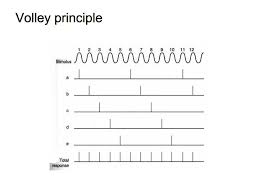
What does this faster alternating fire rate do?
individual cells can't fire faster than 1000 times per second
so by taking turns, the combined frequency goes above this limit
This fast Volley also allows for recovery while others still shoot (Faster fire rate = allows for recovery)
Place Theory (Place Coding):
How exactly we sense (determine) pitches, specifically in High Frequency
Links the pitch we hear with the place where the cochlea’s membrane is stimulated.
Different pitches result from sound waves triggering activity at different places along the cochlea's basilar membrane.
Determines a sound’s pitch by recognizing the specific place (on the membrane) that is generating the neural signal. (where from the cochlea are we getting input)
What is its Limitation? What is it good at?
Explains high-pitched sounds well
Does not explain low-pitched sounds well at all (we use Frequency/Temporal coding for that)
Within Myers above explanation of the Pitch Discrimination Theories and the three types of coding, what does he get wrong?
Myers calls this the Pitch Discrimination Theories
defining these as different theories is wrong
These 3 types of coding are different mechanisms that operate on different kinds of frequency
Temporal (Freq) Coding = Low Frequency
Volley Coding = Intermediate Frequency
Place Coding = High Frequency
Stereophonic Hearing
Stereophonic Hearing
Refers to "three-dimensional" hearing, made possible by the placement of our two ears.
What is its Advantages
Directional Hearing: The time delay it takes for a sound to reach each ear due to placement of the ears, provide the brain with information to determine the direction from which a sound is coming — Allows for accurate localization of sounds in space.
Enhanced Spatial Awareness: allows individuals to differentiate between sounds coming from the left or right, above or below, and in front or behind them
Challenges with Single Ear Hearing
Difficulty Locating Sounds - no more 3D hearing
brain relies on the input from both ears to determine the direction and distance of sounds.
The loss of this binaural input can result in difficulties in spatial awareness
Sound Localization Mechanism:
Visual-Auditory Integration
Understanding where a sound is coming from involves combining auditory (sound) and visual cues
This process usually occurs unconsciously, aligning with the idea of direct perception proposed by Gibson. (no inference)
Our brain integrates auditory information with visual cues for a more accurate perception of sound location (visual cues helps us localize sounds more precisely)
Sound localization can either be what 2 types?
Monaural or Binaural
Monaural: Localization using only one ear. Limited in accuracy compared to binaural.
Binaural: Involves both ears = more precise localization. The Brainstem synapses compare the signals from each ear (from each ear, it extracts information about the direction or location)
Can be seen used in movies — provides a more immersive and realistic auditory experience
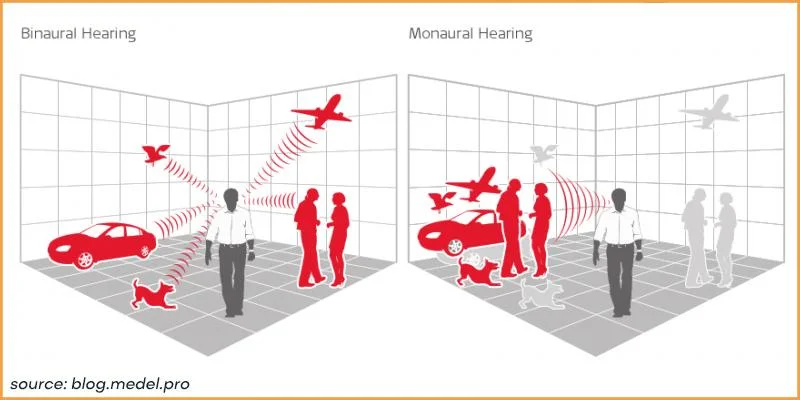
Similarity to Visual System
The distinction between monaural and binaural localization parallels the visual system's monocular (one eye) and binocular (two eyes) cues.
Importance of the shape of the ear for sound localization
The shape of our ears is what helps sound localization as it acts like a funnel — pinna
Time and Intensity Differences in hearing happens how? why is it important
Sound waves reach one ear sooner and more intensely than the other (there is a delay for one ear over the other)
Localization relies on these differences in arrival time and intensity.
Due to the fast travel of sound and the proximity of human ears, the time difference and intensity variations is extremely small.
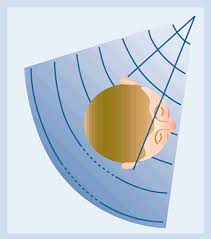
The Sound Localization brain computation is done how?
The brain processes the time lag and intensity differences to compute the sound's location
Localization relies on these differences in arrival time and intensity.
Time Lag
Arrival time = phase of analysis (inter-aural time difference)
ITD Definition: Interaural Time Difference is the tiny difference in the time it takes for a sound to reach each ear.
Intensity
Level of vibrations = loudness difference (interaural amplitude difference)
High freq = loud
Low freq = quiet
We know that Occlusion (depth cue) with its T junctions, can explain gaps in vision, why is this? AND how does the auditory system explain gaps in hearing?
We know that Occlusion (depth cue) with its T junctions, can explain gaps in vision, why is this?
When there is a gap in our visual field, T junctions assist in perceptual grouping and completion
Our brain tends to fill in the missing information, assuming that the occluded part of the object continues behind the occluding object.
Gaps in vision can lead to ambiguous scenes where objects may seem disconnected. T junctions help resolve this ambiguity
How does the auditory system explain gaps in hearing?
if there is a silent moment (gap) among noise, the brain will fill it in
the system needs something within the gaps to make it complete (can be any noise at all)
will fill in gap and make whatever word sound that makes it complete
The brain has a strong tendency to expect continuity. During a silent gap, the brain engages in predictive processing,
How is the way the auditory system fills in gaps of noise related to Top Down processing?
Top-down processing, influenced by our expectations and prior knowledge, plays a crucial role in filling in the missing auditory information.
Top down processing = The influence of higher-level cognitive processes (expectations, knowledge, and context) on the interpretation of incoming auditory information.
The brain fills in the gap with whatever word sound that makes it complete — This must then be a word you already know
Because you know the word, this allows you to know what sound of that word can fill in the silent gap part (knowledge of word allows you to fill in gap)
How is this top down processing connected to the phonemic restoration process
Phonemic restoration process = a person listening to speech recordings in which phonemes have been replaced by white noise or have otherwise been made inaudible does not notice the interruption
when your brain fills in missing sounds in speech, like filling in a cough in a sentence, using context and expectations to make speech sound complete even when parts are replaced by noise or interruptions.
this means that top-down processing is intricately connected to the phonemic restoration process, since it involves the use of higher-level cognitive functions (knowledge, contextual cues, and past experiences)