3.2 Managers, leadership and Decision making.
The distinction between management and leadership
MANAGERS: A manager is someone who makes decisions based on the conclusions drawn from data and other decisions.
make decisions based on conclusions of other decision = analyse the decisions and interoperates data = make business decisions based on conclusions of other decisions - decision making more effective
persuade their staff that their decisions are the right one = lead their staff = apprise their staffs strengths and weaknesses
senior management = lead by CEO
middle management = run business functions and departments
junior management = day to day management tasks
LEADERS: A leader is someone who commands and controls a business
set objectives of the business = objectives to meet business decisions = rapid change in the business - constant feature of business life
inspire and motivate people = build relationships = motivate people and inspire them to do things - do this by coaching or supporting employees.
Types of management and leadership styles and influences:
MacGregor - theory x and theory y
McGregor believed that managers have two different views of workers in terms of attitudes to work and motivation
Theory x
do nothing/ lazy / not motivated to do anything - only motivated by money
don’t progress their personal work
avoid responsibility
Theory y
want to work/ want new challenged
want promotions and help develop
want to feel valued
Leadership styles should include:
autocratic/authoritarian style:
a management style where one leader makes decisions unilaterally, without input from team members.
Advantages:
Fast Decision-Making: Decisions are made quickly by the leader without consulting others - crucial in time/ sensitive situations - react quickly and in time
Clear Direction: The leader provides clear objectives and expectations - reduce confusion among team members - workers work with less mistakes and more efficiently - boosts productivity
Increased Control: The leader retains tight control over the processes and procedures - lead to a more organized and efficient workflow - boosts productivity
Minimized Conflict: decisions are made unilaterally by the leader - no tension between what decisions the business should make - reduces any time wasted on decision making - leads to business reacting more quickly to problems
Disadvantages
Limited Input: Team members have little to no influence on decision-making, which can lead to a lack of diverse perspectives - could make business decisions less effective due to only one decision being considered
Reduced Morale: no decision making power - Employees may feel undervalued and demotivated since their contributions are not considered. - low staff retention.
Increased Turnover: The lack of empowerment - leader/ manager takes credit for the work done by employees - employees who are able and intelligent are demotivated - may choose to work somewhere else where their work is recognised
paternalistic style:
a leader who acts as a parental figure, guiding and supporting employees while retaining the ultimate decision-making authority.
Advantages
Supportive Environment: Paternalistic leaders create a nurturing and supportive workplace - employees feel cared for and valued - increased loyalty.
Strong Relationships: This leadership style promotes strong personal relationships between leaders and team members - their suggestions and intelligence are being used in the business - fosters a sense of belonging
Employee Development: Paternalistic leaders often focus on the personal and professional development of their staff - providing guidance and resources for growth. - allows employees to improve their skills. - more accurate work and consistent production
High Retention Rates: employees are more likely to stay in an environment where they feel valued and supported - able to take credit for their skills - lead to lower turnover rates
Disadvantages
Limited Autonomy: decisions are ultimately made by the leader, - reducing their ability to think and act freely. - disagree with the ultimate decision made by leader
Dependency: Employees may become overly reliant on the leader for decisions and direction - hindering their ability to work independently or take initiative. - wont be able to improve decision making skills
Lack of Diverse Perspectives: lead to a homogenous decision-making process where only the leader's views are considered, potentially overlooking valuable insights from the team.
democratic style:
leaders make decisions based on the input and feedback of their team members.
Advantages
Inclusive Decision-Making: Team members feel valued as their input is considered, - lead to more diverse perspectives. - business decisions more effective as different ideas are being taken into account - improves decision making - Decisions made collectively are often well-informed - enhancing the quality of outcomes.
Higher Employee Morale: Involvement in decision-making - increases job satisfaction and motivation among employees. - increases staff retention
Improved Collaboration: Encourages teamwork and open communication, fostering relationships within the team.- good relationship with team will all them to feel motivated (leaders succeed in the social level according to Maslows hierarchy of needs)
Increased Accountability: employees choice/ a part of their decision so more motivated to achieve it - Team members are more likely to take responsibility - improve productivity.
Disadvantages
Time-Consuming: The process of gathering input and feedback from all team members - lead to slower decision-making. - unable to react in time during urgency/ crisis in management - Conflict -
Diverse opinions may lead to disagreements , which can hinder progress.- also slow decision making
Risk of Inefficiency: Too much input can complicate decision-making,- confusion and difficulty in reaching a consensus. - reduce productivity
Dependence on Group Dynamics: The effectiveness of democratic leadership heavily relies on the team's ability to communicate and collaborate effectively. - conflict could disrupt - decision making can become difficult
Potential for Poor Decision Quality: If team members lack the necessary knowledge or expertise - their input might not lead to optimal decisions. - may put the business is a strain
laissez-faire style:
leaders provide minimal direction and allow team members to make their own decisions
Advantages
High Autonomy: Team members have the freedom to make their own decisions, - - allow them to pitch their own ideas in and make their own decisions and Development of Decision-Making Skills - Team members improve their problem-solving and decision-making capabilities through hands-on experience. fostering creativity and independence.
Increased Job Satisfaction: Employees may feel more satisfied and valued, - have control over their work and processes. - staff retention increases
Encouragement of Innovation: allowing freedom - employees are more likely to experiment and propose new ideas - Effective for Skilled Teams - Works well when team members are highly skilled and knowledgeable - requiring little guidance to perform effectively - enhancing innovation.
Faster Decision-Making: employees do not have to wait for managerial approval for every decision.
Disadvantages
Lack of Direction: Team members may feel lost without guidance, - decreases motivation and productivity - leading to inconsistencies in work output.
Inefficient Communication: Minimal oversight - result in misunderstandings and lack of information sharing. - may lead to confusion in communication.
Variable Work Quality: Without direction, the quality of work may differ among team members - affecting overall results - may effect business performance.
Potential for Conflict: Reduced management involvement might allow personal conflicts to fester- tension between workers - disrupting team cohesion.
The Tannenbaum Schmidt continuum:
A model showing the relationship between the level of authority you use as a leader and the freedom this allows your team
Describe the Tannenbaum Schmidt continuum
At one end of the continuum are managers who simply tell their employees what to do. At the other end of the continuum are managers who are completely hands off and have high automation . As you move from one end of the continuum to the other, the level of freedom you give your team will increase and your use of authority will decrease. This continuum helps leaders understand how to balance guidance and autonomy within their teams, adapting their leadership style based on the context and specific needs of their
Example of a Tannenbaum Schmidt continuum:
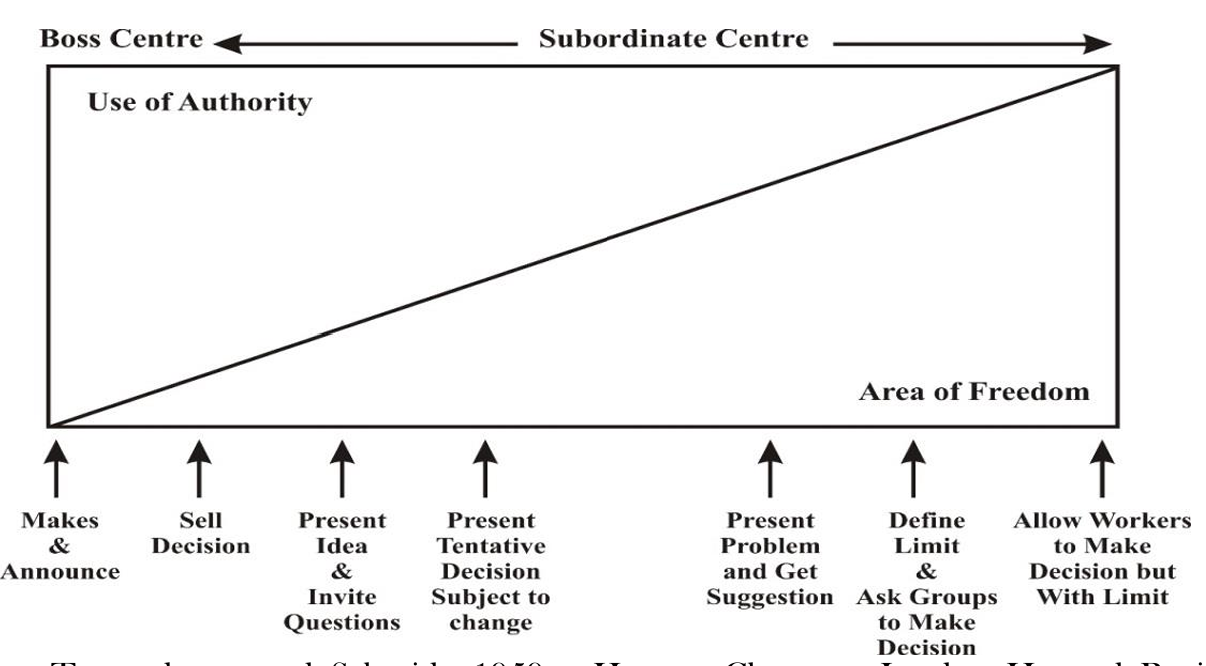
Tells: The manager identifies a problem, chooses a decision and announces it to the subordinate an opportunity for participation. - along the lines of an autocratic leadership
Sells: persuading team members and highlighting the benefits of the decision to gain their support. It's a collaborative step that falls between telling and involving, promoting a degree of employee buy-in while still retaining control over the final decision. - paternalistic leadership
Consults: The manager identifies the problem but does not choose a decision. He presents the problem to the group and listens to the advice and solution suggested by the subordinates. The decision is taken thereafter. - democratic style of leadership
Joins: Here, the manager defines the problems and the limits within which the decision has to be taken. He passes to the group the right to make the decision with the manager as a member. - Laizzez-faire style of leadership
EXAM NOTE: the Tannenbaum Schmidt continuum is linked with the theory x and y workers and the styles of leadership (autocratic, paternalistic, democratic and leizzez faire)
The value of decision making based on data:
Scientific decision making:
using the scientific method to evaluate potential solutions or courses of action, aiming to minimize biases and subjectivity.
How does it work:

if you review your decision and realise that it isn’t working you go back to step 1
Advantages of making decisions based on scientific data
Increased Accuracy: decisions are based on reliable data and evidence- Data analysis can uncover insights and root causes of issues - more accurate outcomes.
Reduced Bias: Scientific decision-making minimizes personal biases that can influence choices - ensures objectivity - reliable
Consistency: Data-driven decisions follow consistent methodologies, making outcomes more predictable over time. Continuous Improvement: Scientific decision-making encourages regular review and adjustment based on data feedback, fostering a culture of continuous improvement
Disadvantages of Making Decisions Based on Scientific Data:
Complexity of Data Interpretation: Requires expertise to interpret data correctly, which can lead to misinterpretation and poor decisions if the data is complex. - unreliable. Time-Consuming: The process of collecting, analysing , and verifying data can be time-consuming- potentially delaying important decisions. - cant use it for quick decisions.
Over-Reliance on Data: neglecting intuitive or experiential knowledge - which can be valuable in decision-making.
Data Availability Issues: Decisions may be limited by data that is outdated, incomplete, or inaccurate, leading to flawed conclusions.
Cost - Gathering and analysing data can involve significant costs, especially if specialized tools or personnel are needed.
Intuition:
intuitive decision making meaning making decisions based on a hunch or gut instinct
Advantages of using intuitive decision making in a business
Faster Decision Process: Intuitive decision-making allows leaders and employees to act quickly - It helps avoid overthinking or becoming bogged down in excessive data - intuition helps leaders rely on their experience to make sound decisions.- Effective Under Pressure: - beneficial in fast-paced environments where timing is critical.
Experience and Expertise - Deep Knowledge - Experienced professionals often have a wealth of knowledge and past experiences that help them recognize patterns - make informed judgments without going through lengthy analysis. - less time consuming
Creative Solutions - Encourages Innovative Thinking: Intuition often leads to novel ideas and out-of-the-box solutions that might not be evident through data analysis alone. - Fosters Visionary Decisions: Business leaders sometimes need to make decisions based on future trends or unseen potential, which may not yet be supported by hard data.
Enhanced Personal and Team Confidence - Builds Trust in Leadership: Teams can gain confidence in leaders who make decisive, intuitive choices, especially if these decisions are proven successful. Empowers Decision-Makers: Trusting one’s instincts can lead to increased confidence in personal judgment, fostering a proactive approach to problem-solving.
Disadvantages of using intuitive decision making in a business:
Bias and Subjectivity- Personal Bias: Intuitive decisions are influenced by an individual's past experiences and inherent biases,-decision-maker might focus on information that supports their instinct and ignore data that contradicts it.- lead to one-sided outcomes.
Lack of Data Support
Insufficient Evidence: Decisions based purely on intuition often lack solid data or evidence to back them up. - Evaluating the success of intuitive decisions can be challenging without clear, measurable criteria. - This can make it difficult to justify the decision to stakeholders.
`
Inconsistency
Varied Outcomes: Intuitive decisions can lead to inconsistent results, as they depend heavily on the individual making the choice rather than a repeatable process.
- Non-standard Processes: Without a structured approach, different managers may reach different conclusions for similar problems, leading to a lack of uniformity in company policies or practices.
### 4. Risk of Overconfidence
- Overreliance on Experience: Individuals who rely on their intuition may develop overconfidence in their decision-making skills, which can lead to poor outcomes if their judgment is flawed.
- Ignoring External Factors: An overconfident decision-maker might fail to consider important external factors or changes in the business environment.
### 5. Limited Scalability
- Not Suitable for Complex Problems: Intuition alone is often insufficient for handling complex or multi-faceted business problems that require detailed analysis and comprehensive evaluation.
- Difficult to Teach: Intuitive decision-making is hard to transfer as a skill, making it challenging for organizations to scale effective decision-making across teams.
### 6. Potential for Poor Risk Assessment
- Underestimation or Overestimation of Risk: Intuition might lead to an underestimation or overestimation of risks, as it’s not as thorough as analytical risk assessment methods.
- Emotional Influence: Emotions can heavily influence intuition, potentially leading to overly cautious or overly risky decisions.
### 7. Reduced Credibility
- Hard to Communicate: Explaining intuitive decisions to teams or external stakeholders can be difficult since there is no clear rationale or analysis backing them up.
- Lower Trust: Team members may trust data-driven decisions more than those based solely on someone's instinct, which can affect morale and alignment.