Thermal physics
Temperature: Is directly proportional to the average KE of particles. Measured with thermometers.
Heat: Type of energy that objects have. Heat always travels from hot to cold, the bigger the temperature difference, the faster heat travels. Larger object has more heat energy.
Absolute temperature
Measured in Kelvin, it starts at absolute zero (0K) which is the coldest possible temperature. Particles at 0K have 0 KE.
0°C = 273K
-273°C = 0K
Celsius to K add 273
Remember, Kelvin cannot be negative.
Thermometers comparison
Mercury
similar to alcohol, but if it breaks, poisonous mercury needs to be cleaned, which can be dangerous
Alcohol
Not toxic, very simple, does not need battery, measures continuously. Only measures to the nearest degree, takes a minute to adjust
Digital
measures to 0.1 degree, faster than alcohol, needs power, cannot be left under rain
Clinical
very accurate for body temperatures, cannot measure temperatures outside of 34-42C.
Temperature sensor
can record temperatures over long time, plot a graph
Thermal expansion
All objects (solids, liquids and gases) expand when temperature increases. As temperature increases, particles gain KE, move around faster and take up more space. Particles DO NOT get bigger. Solids expand least, and gases most when temperature increases.
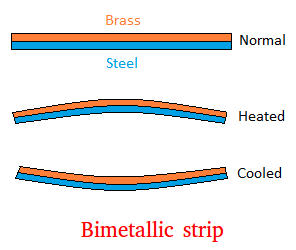
Bimetallic strip
2 different metals stuck together, which expand at a different rate when heated. Below brass expands more when hot, and also shrinks more when cold.
Uses: thermostat, fire alarm
 Conduction
Conduction happens when hot particles (so particles with high KE) pass on their KE to neighbouring particles, making them vibrate faster and thus heat up. Only happens in solids. Metals are good conductors, because they have free electrons. Good insulators are plastics, silicon, wood, liquids + gases.
Convection
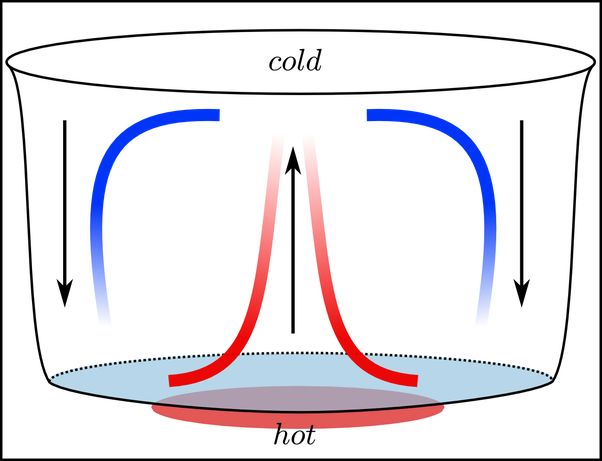
Liquid or gas particles near the heat source get hot, these particles have larger KE, so they need more space. So hot water expands, hence becomes less dense, and rises. Eventually the hot air cools down, becomes more dense and sinks ( on the other side of the container). The cold water will replace the hot water that has risen. This happens continuously, forming convection currents.
For this to work, heat source should be near the bottom, and cooling sources (AC) near the top.
Convection only takes place in liquids or gases, it cannot happen in solids, since particles cannot move in solids.
Infrared Radiation
All objects emit infrared radiation, the hotter the object is, the more infrared radiation it emits. Infrared thermometers/cameras can measure this and record the object's temperature.
Black, matt objects emit the most IR radiation, so they are best emitters, and also absorbers.
White, and shiny surfaces are worse emitters, and absorbers of IR radiation, they are very good reflectors of IR radiation.
The difference in infrared emission between white and black is so small that many will get a result that does not support the theory. Any small variation in starting temperature, tightness of the bung, etc. will distort the result.
House Insulation
Cavity wall insulation : Two walls with cavity filled with fibre glass. The fibre glass traps the air, preventing it from forming convection currents. Air is a poor conductor of heat (good insulator, since it is not a solid), so conduction is reduced.
Loft insulation: Thick layer of insulating material, which contains pockets of air. The air is trapped preventing it from forming convection currents. Air is a poor conductor of heat (since it is not a solid), so conduction is reduced.
Double glazing: Reduces conduction since it cannot conduct through the gap between the window panels. The inside is filled with inert gas to slightly reduce convection.
Draught excluders: Prevent hot air from escaping through convection
Carpet: Decent insulator, reduces conduction of heat to the outside ground
Reflective foil behind radiators: Reflects Infrared radiation back to the room.
Note radiators do not actually heat up the room through IR radiation, instead they use convection.