Psych Unit 2- Sensation and Perception
Relating the Psychological and Physical World
Sensation: The detection of stimulus
Perception: The processing, interpretation, and organization of sensory information
Psychophysical research: Studies the conscious, psychological experience of stimuli
Sensation
We know about visual the most, then auditory, then the rest much less
Vision: Light rays bounce off an object → Cornea (outer part of your eye (makes things sharp and clear)) → Pupil → Lens → Retina (back of the eye, turns light into electrical signals (by rods and cones) → Visual cortex
Hearing: Sound waves travel through the ear canal → make the eardrum vibrate → Rattles the cochlea (produces waves) → Hair cells in the cochlea move, create electrical signal → auditory complex
Perception
Why do people respond the way they do to stimuli?
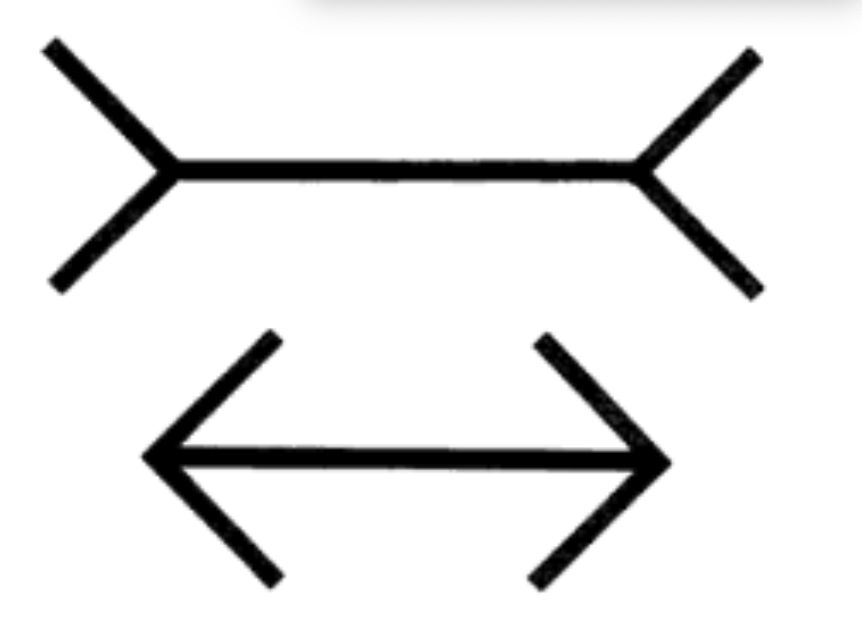
Visual illusion: Two objects produce the same image on the back of the retina, they look different when our brain processes it
Top-down processing: Focuses on concepts, expectations, memories
Use pre-existing knowledge of the world
Ex.: A song was staticky and you can’t make it out but once you know the song, the lyrics are more discernable
Ex: Stereotypes
Bottom-up processing: No pre-existing ideas, perception based on senses and stimuli taken in
Figure-ground: Differentiating between an object and background
Top-down processing/bottom-up processing are a spectrum
As you get more knowledge, you do more top-down processing
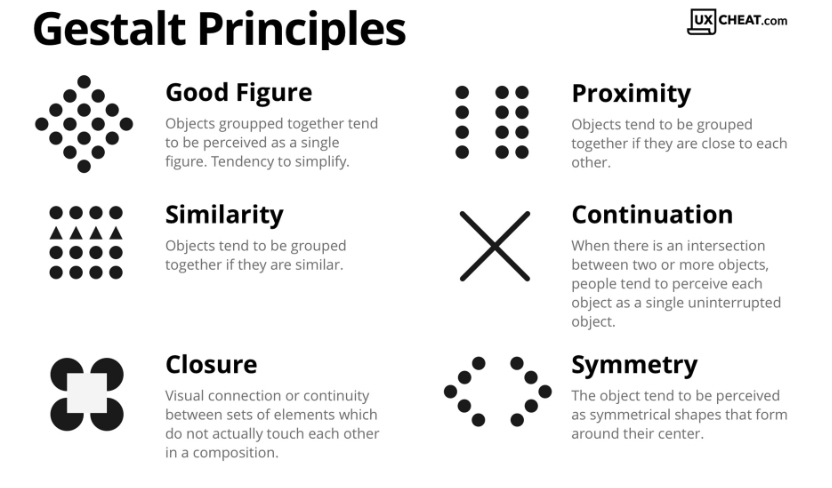
Gestalt principle: Grouping things together
Infants do this
Laws of similarity, good figure, proximity, continuity, closure, common region
Carpentered-world hypothesis: Since we live in a world with many straight lines and right arrows, we were likely to fall for the illusion below. People who live in huts were not likely to fall for it
Detection question
Absolute threshold: The minimum amount of energy needed to dect a stimulus 50% of the time
Subliminal: Below threshold but also below the unconscious
Difference question
Difference threshold: The minimum difference between two stimuli that can be detected 50% of the time
Weber’s law: For each type of sensory judgement, the difference threshold is a constant fraction of the standard stimulus
The constant changes for different types of sensory stimuli
The smaller the constant, the less change needed for it to be noticeable
Depth perception
Binocular clues: Visual perception coming from two eyes
The closer the image, the more retinal disparity
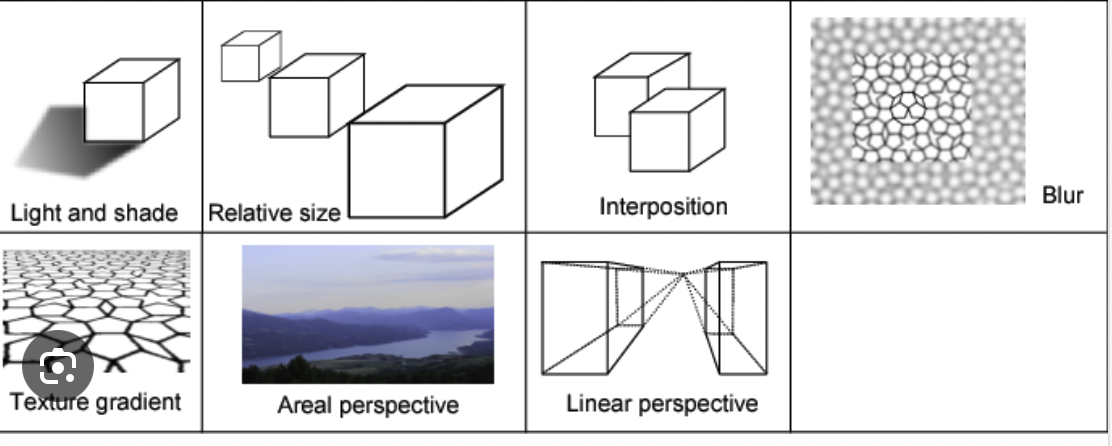
Monocular clues: Help us perceive depth and distance
Relative size, interposition, relative clarity, texture, gradient, linear perspective, relative motion
Attention
Attention: The allocation of mental resources
Selective attention: When you zero in on one stimulus
Inattentional blindness: A failure to notice seemingly observable stimuli because your attention is engaged elsewhere
The lady walking with the umbrella, the gorilla
Change blindness: The inability to notices even significant changes when they’re right in front of your face
In-class example: Two images were switched between on the board with an intervening grey screen and we had to spot the difference
Divided attention: Simultaenously paying attention to multiple stimuli
Cocktail party phenomenon
Proves awareness comes after the initial processing stage
New and German: The visual system attends to stimuli of evolutionary importance
Study: There was was a fixation point with a cross at the center and sometimes a surprising object (spider, weird-looking spider, fly, needle) would pop up
Participants were much more likely to notice the spider than other things
The spider is what they’re more biologically prepared to fear
Motivated Seeing: Virtual Perception
Asked if people perceive the external environment as how it is or how they want it to be
Causes of motivated seeing
Categorization: Identifying something based off desired outcome
Ex.: B vs 13
Observers don’t consciously misrepresent
Representation: Desire influences size/length/slope/proximity estimates
Ex.: Underthrowing a bean bag when trying to land it on a gift card
Perceptual sets: Mental associations before an object is originally viewed
Ex.: Activate thoughts of farm animals when it’s the desirable category, water when you’re thirsty
Attention: Narrows when focused on a desirable thing
Magic and the Brain
The curved hand trick diverted attention from what the Gentleman Thief was stealing
Due to smooth pursuit, where your eyes stay focused on a moving target
In the visionary cortex, one cell detects motion and another supresses the background
In Penn and Teller’s trick, the magician’s face distracted participants from the trick
ADHD and Inattentional Blindness
Attentional Deficit Disorder
The three proposed models of ADHD:
1. The Neurological Model: ADHD is a disorder/deficit
Inattention/impulsivity are global distractibility impairments
High-perceptional load IB task experimental hypothesis: Noticing the gorilla would be at the expense of counting passes
2. The Perceptual Load Theory: Perceptual load influences selective attention
Spare capacity “spills over” and causes distractions
High-perceptional load IB task experimental hypothesis: The high perceptual load would cause ADHD and control participants to perform similarly
3. Hunter in a farmer’s society: People with ADHD are hungers prepared for action, able to tarck moving targets
High-perceptional load IB task experimental hypothesis: ADHD individuals would perform better at noticing the gorilla
Low-perceptional load CPT (Continuous Performance Task)
The farmer task
Attention and hyperactivity were significant in ADHD individuals
Implicit (not conscious)
High-perceptional load IB task
Count bounce/aerial/total passes
Gorilla coming in, member wearing black leaving, curtain changing color
Explicit (conscious)
See hypotheses above
HUNTER METHOD PROVEN!
Limitations:
Single study with specific tasks
Need replication
Not including students with self-reported disorders limits generalizability
Memory
Distinguishing long-term and short-term effects
Serial position effects: How the position of items in a sequence affects recall
1. Primacy effect: Better recall for items at the beginning of a task
2. Recency effect: Better recall for items at the end of a task
Process involved with memory
Encoding: Putting into memory
Storage: Keeping in memory
Retrieval: Pulling from memory
Culture’s Effects on Memory
Eastern cultures are more likely to pick up on things happening in the background
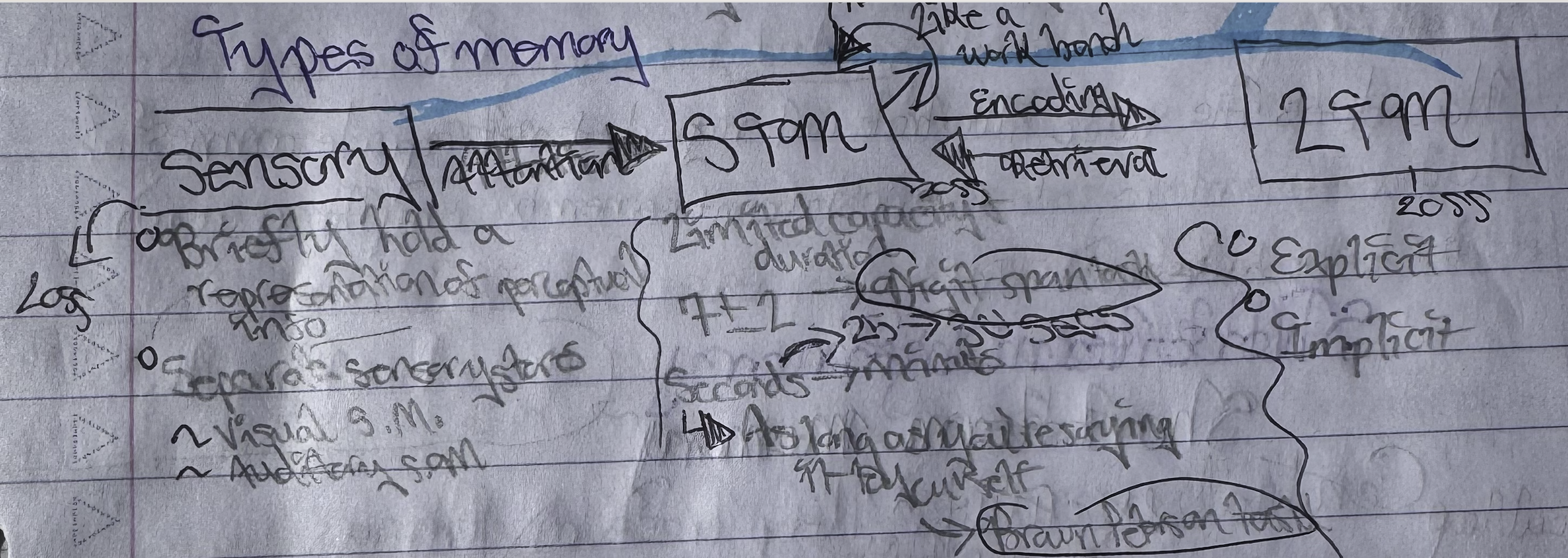
Types of memory: The Structural Model
Long-term memory
Declarative (Explicit): Conscious recall
Episodic memory: Personal experimences
Semantic memory: Factual knowledge
Nondeclarative (Implicit): Doesn’t require conscious recall
Classical conditioning
Procedural memory: Motor and cognitive skills
Mr. Clive Wearing still had this though he had no long-term memory
Priming: How the response to an earlier stimulus affects a later one
Anterograde amnesia: The inability to form new long-term memories following surgery or trauma
Related to the hippocampus’ inability to convert short-term memories to long-term
Retrograde amnesia: The disruption of past memories
Encoding
Semantic: Meaning
Acoustic: How it sounds
Visual: What it looks like
Models of memory
Structural: The boxes in the picture above
Process models:
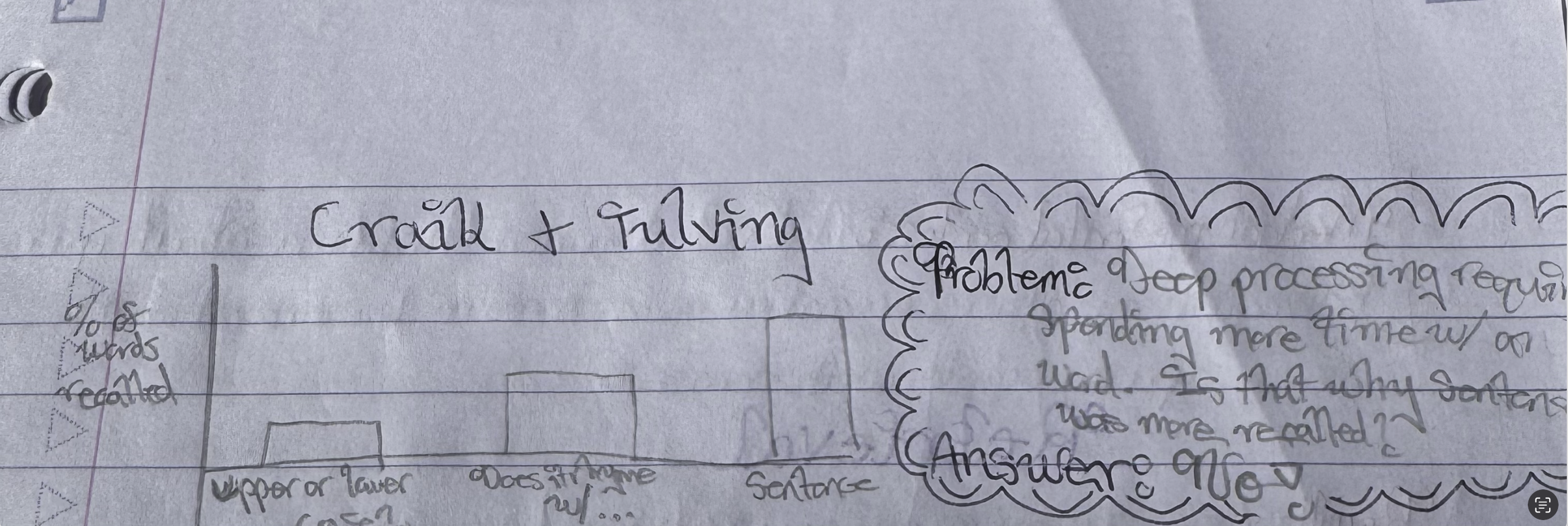
The deep vs shallow continuum (How semantic it is)
Memory persistence and deep-processing
Elaboration: Issue-relevant thinking, integrating new information to old
Craik and Tulving
You can spend a lot of time studying but not process the information because you’re copying or reading notes
Deeper-level processing required
Retrieval process
Memory is not like a camera
It is more reconstructed than retrieved
Ex.: Use of schemas (script)
Making omissions or normalizations: When retrieving memories, you’ll omit irregular things
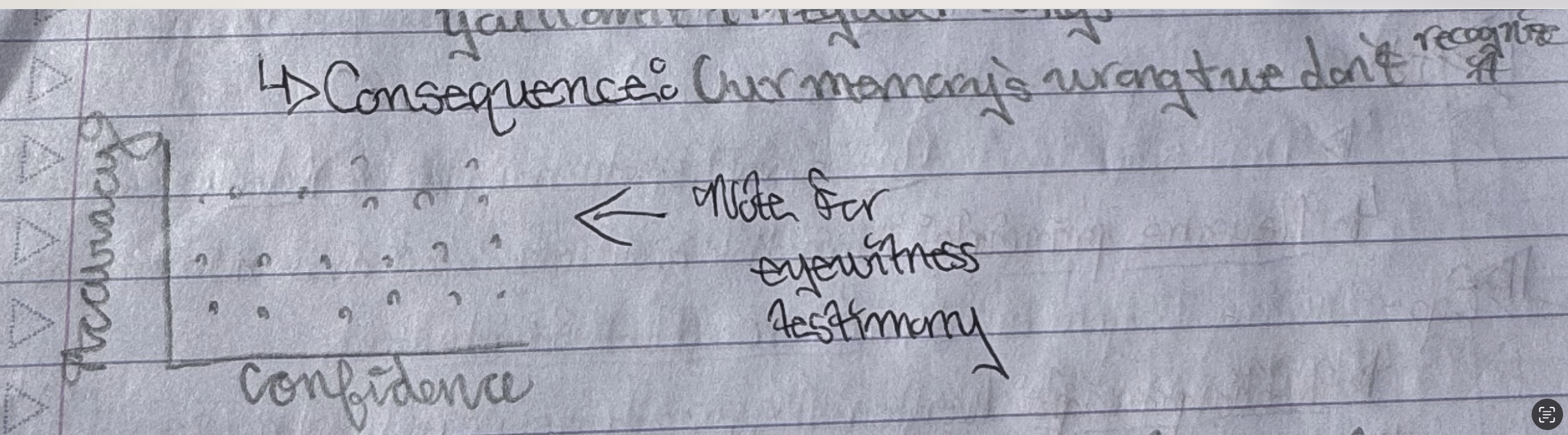
Flashbulb memories: Detailed and with high emotion meaning we have high confidence in them
Doesn’t make them more accurate
Ex: Challenger Event
Proactive interference: An old memory interferes when trying to learn a new memory
Retroactive interference: A new memory interferes when trying to recall old memories
Short-term memory
A domed workbench where things will fall off in 25-30 seconds if it’s not repeated
Central executive: Allows you to keep track of things
Phonological loop: Repeating something to oneself
Episodic buffer: Understand the context and blend information
Visualspacial sketchpad
Dual-task paradigm: When performing two tasks simultaneously, you can better divide your attention when the tasks are less similar
Brown-Peterson task: Presenting participants with a string of letters then making them recite it backwards to avoid cheap memorization
Unconscious
Freud, psychoanalysis, and the unconscious
Freud’s book was called “The Interpretation of Dreams”
Psychoanalysis: Freud’s theory on psychology
Subliminal: Below the threshold of consciousness
If you were given a word with no preceeding one, you’d be likely to forget it
Three elements:
Three levels of awareness
Three parts of personality
Psychosexual stage theory of personality development
Erogenous zone and fixation
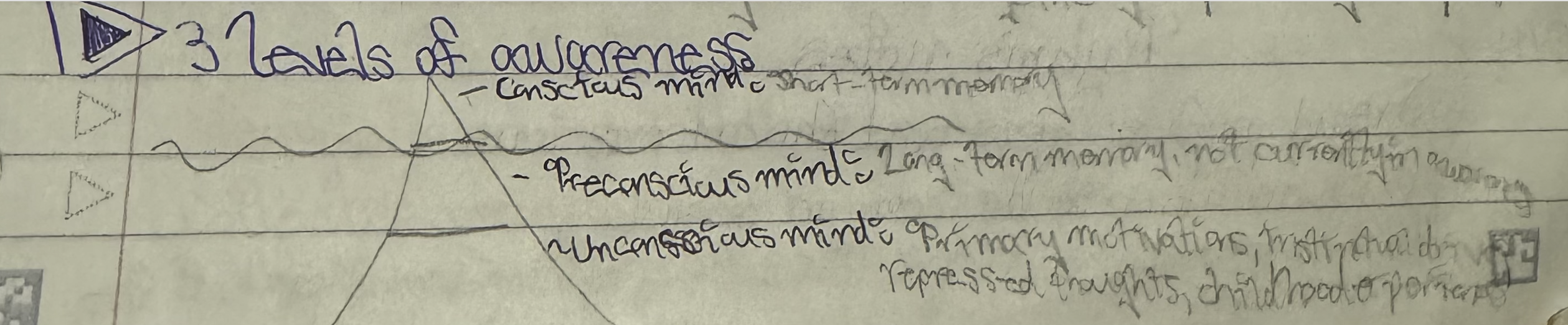
Three levels of awareness
Conscious mind
Short-term memory
Thoughts and perceptions
Preconscious mind
Holds the long-term memory → not currently in awareness but accessible
Holds stored information
Unconscious mind
Primary motivations instinctual drive, repressed thoughts, childhood experiences
Fears, violent/immoral urges, selfish needs
Analyze to help with mental issues
If you weren’t sure if you had a feeling, Freud would say it was in the unconscious
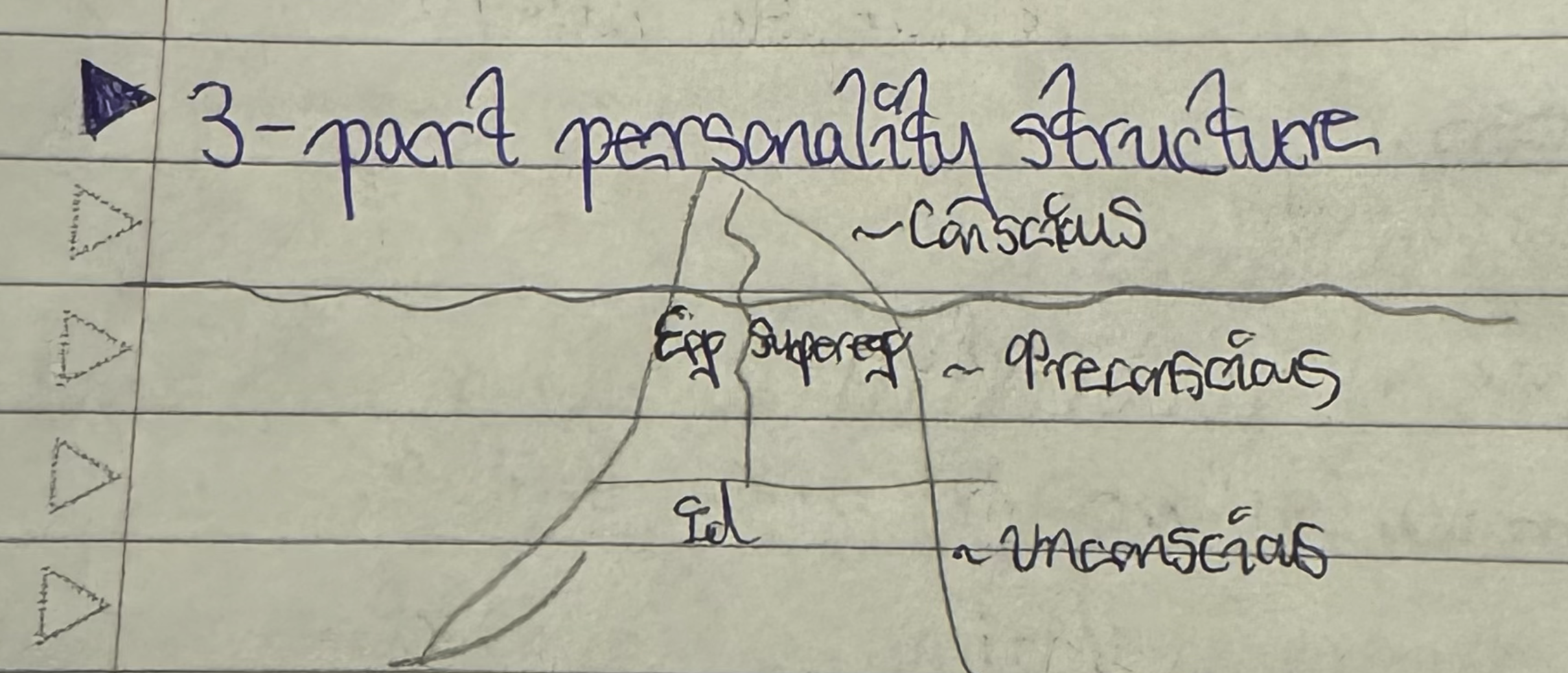
Three-part personality structure
Personality comes from dynamic interaction between the three systems
Disorders arise when a person is unable to effectively manage the three parts
Id: Original personality which drives instincts (Life- surivival/reproduction/pleasure), (Death- destruction and aggression)
Pleasure principle: Immediate gratification without concern for the consequences
Ego: A realistic outlook for the Id’s needs
Created during the 1st year of life
Reality principle: Weighs risks and pairs drives with reality and norms
The executive!
Superego: Conscious and idealized standard of behavior
Emerges during childhood
The moral compass, telling the ego how one should act
Repression
Repression: Pushes unnaceptable thoughts back to the unconscious
Use therapy to undo
Oedipus complex: Attraction toward the parent of opposite sex, hostility/envy toward the same-sex parent
Repressed because you fear the same-sex parent
Freudian slip: When you mean to say “x” but accidentally say “y”
Gives insight into what you really want
Free association: Saying whatever comes to mind
Freud hated this shit
Dream analysis: Boundaries are broken when you’re asleep, releasing ideas and memories
Manifest content: Stored memory
Latent content: Underlying meaning
Carl Jung
Disagreed with freud on the unconscious because he believed it was too sex-focused and did not focus on the collective
Personal unconscious: Unique fears/urges/desires
Collective unconscious: Shared/universal, basic sense of right/wrong
Diverse cultures have similar ideas
This theory is murky in content
Projective tests
Projective tests: Analyzing an individuals’ interpretation of an ambiguous stimulus
Rorschach inkblots
Thematic apperception tests: Ask an individual to create a story based on an image they’re presented with
A contemporary look
Early work on the unconscious lacked in science and was always negative
The unconscious was defined as “Mental processes that are inaccessible to consciousness but that influence judgement, feelings, or behaviors”
In reality, the unconscious isn’t secret but hidden and our workbench simply doesn’t have the space to focus on it
4 Horseman of automaticity

Intention: Did you intend for it to happen?
Awareness: Were you aware of it?
Control: Can you stop it?
Efficiency: How much effort does it take?
Typing on a keyboard has gone from controlled → Automatic
Knowing the process vs knowing the result
Development across the lifespan
The three sections of development: Physical, social, cognitive
Teratogens: Environmental agents that impair prenatal development
Look at the mother to find them
Look at a specific time and the specific result of the action
Look at patterns of postnatal development tp determine the teratogen
Research Issues
Measuring constructs
You need subjects to take the same test because what you’re measuring is a construct
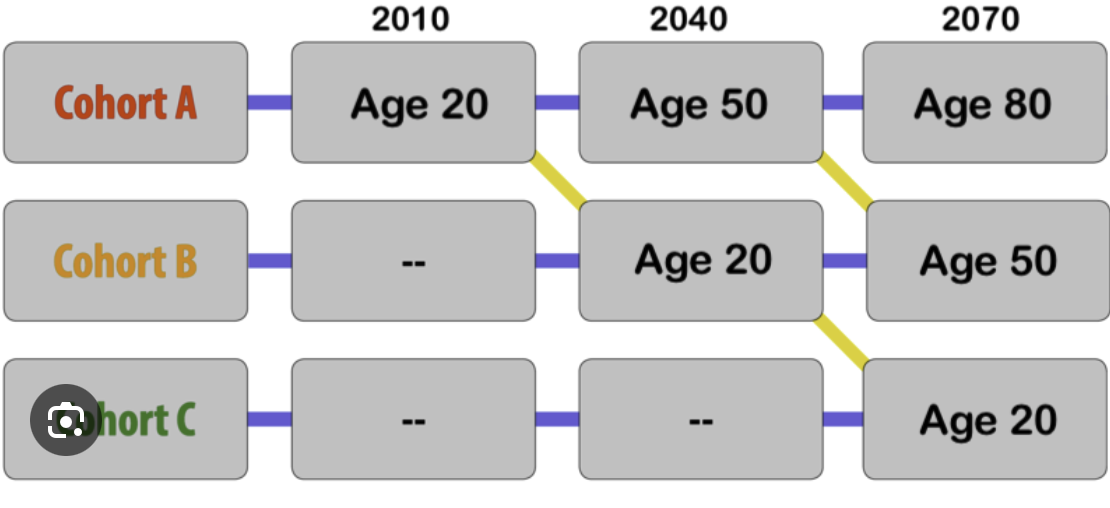
Cross-sectional vs longitudinal method
Longitudinal: Track the same people over time
Pro: You control for outside factors by using the same subjects in the test
Issue: Takes a long time to complete
Cross-sectional: Track different people at different points in their life
Pro: Quick results
Issue: Possibility that you’re looking at cohort/generational effects rather than age effects
Cross-sequential
Both longitudinal and cross-sectional
Ethical concerns
Safety concerns: Infant swimming or testing infant strength
Consent: Someone may be incapable of making the best decisions for themselves
An aspect of social development
Erikson’s Theory of Psychosocial Development
Each stage of life has a different crisis that will be resolved healthily or unhealthily
How a person deals with the crisis affects their personality
First crisis: Basic trust vs. Mistrust
Young adult: Theme- Affiliation and love
Crisis: Intimacy vs. Isolation
When you resolve a crisis, you move on to the next stage
An aspect of cognitive development
Piaget’s theory of cognitive development
Operational: How you represent amounts, ideas, abstract oncepts
Changes in memory, thoughts, reasoning
Schemas: (Categories we create to make sense of the world)
Assimilation (Adding on to an existing schema) or accomodation (changing how you think of something because it doesn’t fit your pre-existing schema)
Stages:
1. Sensorimotor (0-2):
Explore through sensory and motor contact
2. Preoperational (2-6):
Use symbols to represent objects, able to play pretend, lack theory of mind, egocentric
3. Concrete operational (7-12):
Think logically about concrete objects, conservation
4. Formal operational (12+)
Think hypothetically
Milestones:
Sensorimotor: Object permanence
Preoperational: Conservation- Recognize that just because things look different doesn’t mean they’re not the same size
Video: Child couldn’t comprehend that quarters/sticks are the same size/amount if they’re presented differently
Attachment style
Types of attachment
Secure: 70%. Caregiver is a safe home base to observe
Insecure:
Resistant: Ambivalent. No stress whether the caregiver’s there
Avoidant: Stressed whether or not the caregiver’s there
Disorganized: Insecure but doesn’t fall intoo the two categories
Strange situation paradigm:
How attachment type is discovered. Different combinations of stranger/mom in/out of the room
If there issecure attachment, the child will be okay when the caregiver is there and cry when the caregiver’s gone