Extensions of Mendel
Vocabulary:
Lethal allele: An allele that has the potential to cause death of the organism in certain combinations, can be dominant or recessive. Typically a result of mutations in essential genes, or combinations of other genes
Dominant lethal allele: A lethal allele that will impact heterozygotes (like Huntington’s), quite rare as to persist the organism must survive long enough to reproduce
Huntington’s disease: Caused by a dominant lethal allele, H. Onset is around 40, characterized by progressive degeneration of the nervous system which leads to early dementia and death
Recessive lethal allele: A lethal allele that needs to be homozygous to have effect, may also impact a separate phenotype like in yellow mice
Epistasis: When the expression of one gene depends on a presence of particular genes at a different locus
Heterogenous trait: Involves mutations in different genes all leading to the same phenotype
Epistatic Gene: The gene in epistasis that does the masking
Hypostatic Gene: The gene in epistasis that is masked
Complementary gene interaction: Leads to a 9:7 ratio, epistasis where both alleles must be dominant to display one phenotype, if not the other is displayed
Novel phenotypes: Epistasis where there are new phenotypes in F2 not present in the parents, 9:6:1 ratio
Complementation analysis: Screens a number of individual mutations resulting in the same phenotype, and can predict the total number of genes that may determine a trait
Complementation group: All mutations present in any single gene (allelic variations) will produce the same phenotype
Pleiotropy: The expression of a single gene has multiple phenotypic effects, example being marfan syndrome or porphyria variegata
Sex chromosomes: Can be either X or Y in humans, females are XX and males are XY typically for both human and drosophila. They contain short regions of homology in order to synapse and segregate during meiosis
Y Chromosome: Lacks many of the genes found on the X chromosome, and instead carries information for male-specific genes
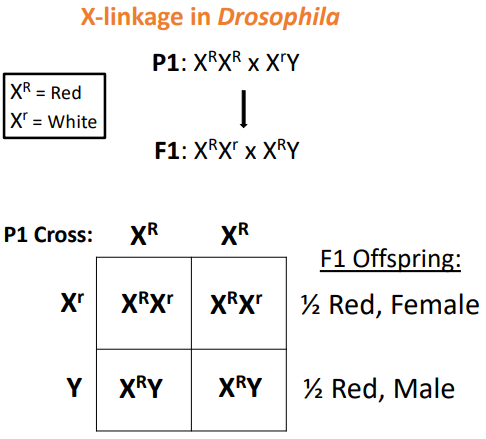
X-linkage: Describes traits that are inherited on the X chromosome rather than Y
Criss cross inheritance: How males only transmit X to daughters, and receive X from mothers. Males exhibit only the traits from their mothers, and females exhibit the dominant trait
Hemizygosity: The possession of only one copy of a gene in an otherwise diploid cell, for example males being XY
Sex-limited inheritance: The expression of a specific phenotype is absolutely limited to one sex. Occurs when a train is autosomal but expression is regulated by hormones only present in one sex
Sex-influence inheritance: The sex of the individual influences expression of the phenotype, not exclusively limited to one sex but has a higher penetrance in one sex over the other. Tends to occur when the genotype is autosomal but expression is limited by hormones
Environmental influence: Can change the expression of a gene, particularly common in humans. Can include things like physical environment, temperature, nutrient availability, and chemical exposure
Complete penetrance: When a given genotype always leads to an expressed phenotype
Penetrance: The percentage of organisms with a particular genotype that display the expected phenotype. Found via the equation P=(# expressing/# with genotype)*100%
Incomplete penetrance: When not all individuals with a given genotype display the associated phenotype
Expressivity: The degree to which a trait is expressed phenotypically, always there but at different levels of severity amongst individuals with the same genotype. Can be environmentally influenced
Heterochromatin: Certain areas of the chromosome that are condensed and genetically inert, for example telomeres or centromeres
Position effect: The physical location of a gene may influence its expression due to this, for example translocation may bring a gene by a heterochromic region and the expression may be modified
Translocation: Chromosomal rearrangement
Temperature-sensitive mutations: Mutations whose expression is affected by temperature
Conditional mutations: Mutations where phenotypic expression is determined by environmental conditions
Permissive conditions: Allow a temperature-sensitive mutant gene product to be functional
Restrictive conditions: Allow a temperature sensitive mutation to be expressed to a point where the essential product is required and the organism arrests
Nutritional mutation: A mutation that prevents the synthesis of nutrient molecules in microbes
Phenylketonuria (PKU): A loss of enzyme which metabolizes Phe, can cause problems unless on a low Phe diet
Galactosemia: A condition where galactose cannot be produced
Lactose Intolerance: A condition where lactose cannot be metabolized
Mitochondria: An organelle found in all eukaryotic cells, does cellular respiration (oxygen to ATP essentially), contains its own DNA and replicated independently
Chloroplasts: Organelle found in plants, has its own DNA and replicates independently, undergoes photosynthesis to produce energy from sunlight
Mitochondrial DNA (mtDNA): Many copies of a circular plasmid, has 37 genes, 22 tRNAs, and modified genetic code. Encodes for oxidative respiration functions. Inherited almost exclusively from the female parent in animals
Chloroplast DNA (cpDNA): Has variable genes, 120 depending on species, 30-35 tRNAs, encode for photosynthetic reactions
Endosymbiotic theory: The theory that explains the origin of eukaryotic cells, one organism is living inside of another, namely mitochondria and chloroplasts. Has evidence due to them self replicating and having their own DNA, and other similarities to prokaryotes
Uniparental: When a trait only comes from one sex of parent
Maternal inheritance: Partly a function of gamete size, a form of uniparental influence. Traits are passed from the mother to all children, regardless of sex. A male with the trait will not pass it to their offspring
Fertilization: When sperm and egg come together to form a diploid zygote from 2 haploid gametes, most sperm organelles are tagged for destruction and maternal organelles are not
Cytoplasmic genes: Unevenly and randomly distributed, exhibit extensive phenotypic variation, expression of traits depends on the proportion of mutant and wild-type organelle genomes present in each cell
Delayed onset: A trait may experience this if it is only demonstrated later in life or at varying life stages
Genetic anticipation: Genetic disease has earlier onset and increased severity with each succeeding generation, occurs due to expansion of an unstable region of DNA from generation to generation
Notes:
Certain lethal allele disorders only occur in males due to their X-linkage. Females tend to be carriers, but live to reproduce and pass on the allele. Males will only inherit the one lethal X allele, and thus show the disorder. If a female was recessive for the allele, she would have the disorder and wouldn’t live long enough to reproduce to transmit it to the next generation
Pictures: