APUSH Quick Notes
#f6c854 #53daff
Period 1 (1491-1607)
1491: One year before Columbus’ arrival
1607: Establishment of Jamestown
Society/Politics of Indigenous Peoples
* Geography plays a big role in cultural variances
Maize: Cultivated in Mexico but spread via trade and migration
Drives economic growth (trade)
Enables permanent settlement (need to stay to cultivate)
Society stays in one location → Creation of political systems
Advanced irrigation techniques
Northeast Societies
Iroquois: Farmers living in long, communal houses (long house)
Relied on Maize
Three Sisters Farming: Growing corn, beans, and squash simultaneously (more sustainable and high-yielding)
Southeast Societies
Cahokia/Mississippian: Farmers utilizing distinct waterway irrigation
Tobacco economy
Mound builders
Traded extensively due to access to waterways
More advanced due to access to waterways
Cherokee: Agricultural society
Men hunted, women grew crops
Migrated with the seasons
Northwest Societies
Chinook: Relied on whaling and animals
Several families living in same house
Not very agricultural
Southwest Societies
Pueblo: Farmers
Corn, beans, squash (three sisters)
Cliff dwellings
Martime Technologies
Portugal was the first to being maritime exploration w/ Prince Henry the Navigator–generates a trading post empire
Caravel: Fast and navigable ship
Astrolabe: Gave latitude
(1494) Treaty of Tordesillas: Line demarcating territory for Spain and Portugal (Portugal gets East)
Sextant: Navigational instrument used to measure angles to determine latitude and longitude
Joint-Stock Companies: Distributed the risks of economic opportunities
European Contact
Gold: Zero-sum economy
Europeans believe there was a fixed amount of currency in the world and they must all compete for it
Ottomans seized Constantinople–we need a different route yo
Feudalism replaced with capitalism
Capitalism: Owning means of production = Wealth
Feudalism: Land = Wealth
God: Europe was in a period of religious crisis and confusion
Show off religious superiority through colony conversion
Glory: Became a competition between European powers to claim land to shift balance of power
Effects
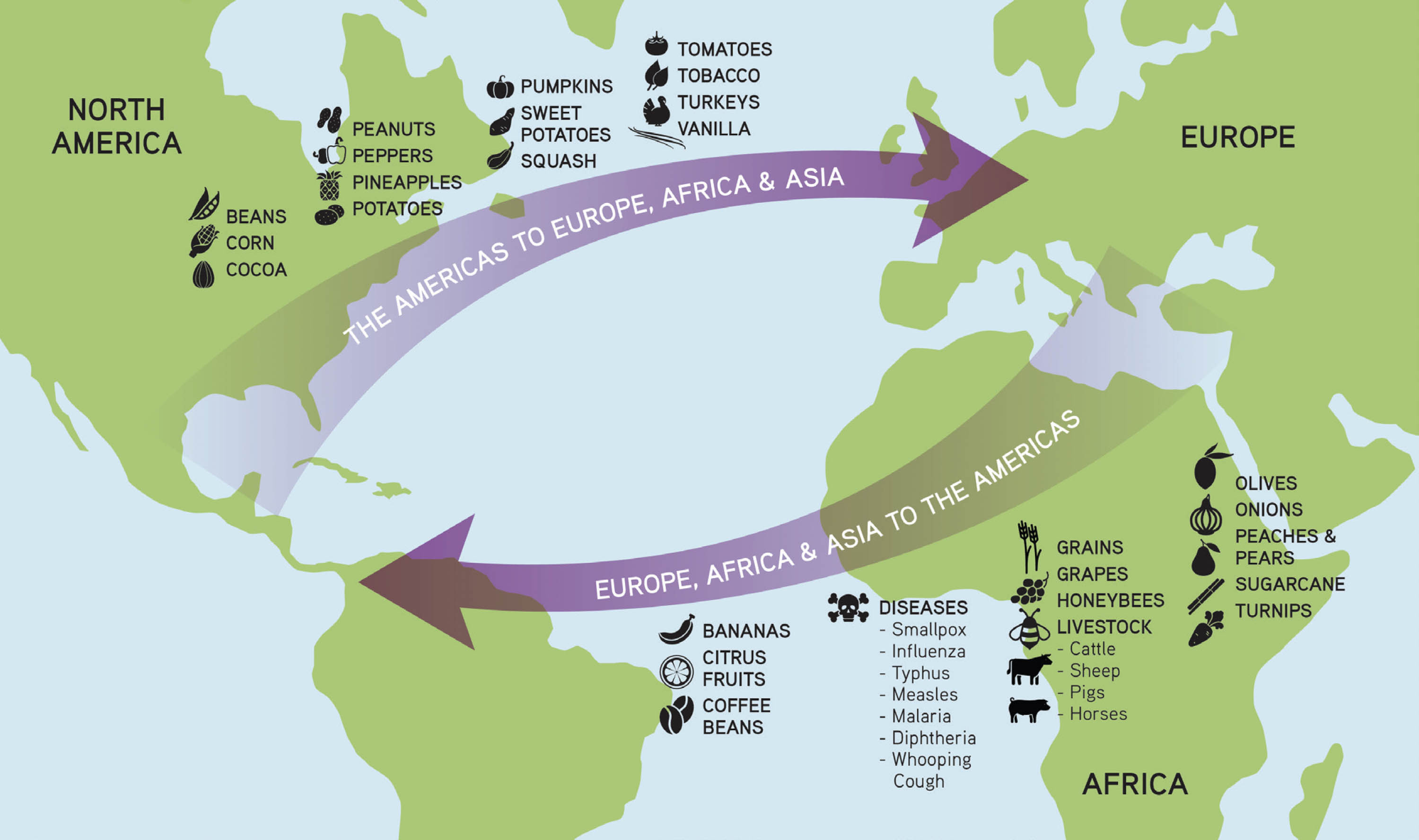
+ Columbian Exchange: Exchange of materials from old to new world
DIFFERENT from Triangular Trade which was an established economic system
Eurasia were already connected–immune to each other’s cooties
Introduced diseases (e.g., Smallpox)
Nutrient-rich food options → healthier Europeans
Introduction of horses by Spain fundamentally changed Native lifesyles
(1501) Enslaved Africans arrive
Conflicting Worldviews
Land Use
Natives: Land does not belong to a singular person, adapt to environment
Europeans: Make the land submit
Religion:
Natives: Belief in multiple Gods
Europeans: Monotheistic
(Some Natives began to include Jesus in their list of Gods to worship)
Gender Roles
Natives: More egalitarian
Europeans: Patriarchy
Family
Natives: Extended family
Europeans: Nuclear family
Period 2 (1607-1754)
1607: Establishment of Jamestown (English settlement)
1754: Start of French & Indian War
Mainly about how British colonies grew and resisted Britain
Difference Between Colonial Powers
Spain
Culturally…
Intermarriage with Natives was common–hence the Caste system
Caste System: Race-based racial hierarchy
Bartolomé de las Casas: Spanish clergyman speaking out against slavery and highlighted the oppression of Indigenous peoples
Sends MANY colonizers to make a “New Spain” essentially
Economically…
Big on wealth extraction (Gold and silver)
Encomienda System: Coerced labor system, Spanish crown granted land to people who forced indigenous people to assists in plantations
Cash crops: Sugar, tobacco, cotton, etc.
Eventually shifted to African enslaved labor because Indigenous people were dying of European diseases (Malaria, Smallpox, etc.)
? Hacienda is like sharecropping
Religiously…
Sent many Catholic missionaries to convert natives to Christianity
The Black Legend: Painted the Spanish as cruel oppressors
English
Culturally…
Sends men AND women to settle, family units
Intermarriage with Natives and Africans was rare
More social mobility in the New World compared to England
Primogeniture: Eldest son inherited family land (remember we are in a feudalist society in England!)
Improved living conditions
Population growth and the Enclosure Movement caused wealth disparity for poor farmers
Enclosure Movement: Made public land private to make agriculture more efficient
Goal was to establish a new society for themselves away from the motherland
Politically…
(1607) Jamestown
Originally many men there died of starvation and disease
Single young men
Religiously…
England was going through religious shift from Catholicism → Protestantism
Puritans: Want to stay in England and purify the Church of England
Pilgrims: Believed the Church of England could not be saved (Separatists)
King James I was the head of the church, he does not like opposition obviously
Economically…
Single young men want to strike up gold
Gold wasn’t feeding anyone → tobacco cultivation
Dutch/French
Culturally…
Few single men are sent to establish trading posts
Cooperates with the Natives
Economically…
Friendly French (and Dutch) fur traders!
Intermarriages and alliances between French and Native groups
Not many permanent settlements, focuses on growing trading relations
Establishes New Amsterdam, (1608) Quebec, (1682) Louisiana
New Amsterdam significant trading port
Eventually lost to English through series of wars (Anglo-Dutch Wars)
Religiously…
Didn’t feel there was a need to emphasize religious authority over the Natives
Jesuits: Aimed to convert the Natives while simultaneously living and learning with them
Cultural mediators
British Colonies
New England
Colonies: (1630) Massachusetts Bay, (1620) Plymouth, Connecticut, Rhode Island, New Hampshire, Maine
Culture/Society: Mainly family settlements
Set out to create a new society
Mayflower Compact (Plymouth): Majority-rule government (democratic)
High literacy rates (Bible reading)
Democratic town meetings (Massachusetts Bay)
Economy: Agriculture + Commerce
Exports fur, timber, and fish
Religion: Pilgrims & Puritans seeking religious tolerance
Plymouth: Pilgrims (Separatist Puritans)
Massachusetts Bay: Puritans
Middle Colonies (Bread Basket) – Diversity and Trade
Colonies: New York, Pennsylvania, New Jersey, Delaware, Philadelphia
Initially settled by the Dutch (New Amsterdam → New York)
Culture/Society: Diverse due to tolerance
Quite democratic
Economy: Cereal Crops (“Bread Basket”)
Major port cities: New York and Philadelphia
Religion: Diverse and tolerant–Pluralism
Pennsylvania = poster child for religious tolerance
Quakers Chill pacifists
Chesapeake
Colonies: Virginia, Maryland, (1607) Jamestown
Advanced waterways and plantations
Culture/Society: Mainly single men
Fewer family units in comparison to the New England colonies
Politically…
Virginia House of Burgesses: Representative government limited to white, land-owning men (democratic)
Economy: Cash crops
Started off as gold-hungry men but John Rolfe introduces tobacco
Necessity for land because tobacco depletes the soil’s nutrients
Indentured Servitude: Contract to work for a period of years in exchange for eventual freedom
People actually started living past their contract → not favorable for plantation owners
Replaced by enslaved African Americans
Religion: Tensions between Anglicans and Catholics
(1649) Act of Toleration – Maryland
Guarantees religious freedom
Southern Colonies – Plantations
Colonies: North Carolina, South Carolina, Georgia
(1712) North and South Carolina split
Georgia served as a buffer colony between Spanish and French
Culture/Society:
(1661) Barbados Slave Code: First colonial law defining enslaved individuals as chattel property
Wealthy planters at the top of the hierarchy
Economy: Long growing seasons
Relied on enslaved labor
Plantation owners at the top of the social hierarchy
Highest concentration of enslaved labor
Sugarcane, rice, indigo
Religion: Anglican with less emphasis on conformity
More economy focus
Early Democratic Societies
Virginia House of Burgesses (1619) – Jamestown, Virginia – White, land-owning men (Chesapeake)
Mayflower Compact – (1620) Plymouth – Male church members (New England)
Massachusetts Bay – (1630) Massachusetts Bay – Democratic town meetings (New England)
Britain’s Treatment of Colonies
Mercantilism: Drove the economic relationship between Britain and the colonies
Emphasized more exports than imports (zero-sum economy)
(1650) Navigation Acts: Restricts colonial trade exclusively with Britain
Salutary Neglect: Colonies did not quite abide by the laws + British were not enforcing
Colonists got used to this sense of independence
Native Resistance
(1636-38) Pequot War: Pequot tribe almost entirely annihilated
Pequot tribe had strong trade relations with the Dutch
When the English came, trade competition increased
Massacre at Mystic: Mass killing of Pequot individuals
Pequot tribe almost entirely annihilated, surviving individuals were enslaved
(1675-76) Metacom’s War (Philip’s War): NE Settlers encroached on Wampanoag land → retaliation
Metacom = King Philip
Metacom establishes alliances with other Native groups against land encroachment by the NE settlers
Metacom is eventually captured and killed
English victory with many casualties
First Native American War
(1676) Bacon’s Rebellion: Switch from indentured servitude → African slavery
Indentured servants (led by Nathaniel Bacon) led attacks on Native groups as they believed the government should take a stronger approach against Natives
Indentured servants viewed Natives as a threat to their jobs
Indentured servants were causing too many problems
(1680) Pueblo Revolt: Pueblo people incorporated Christianity into their own culture (syncretism) → Spanish unhappy because not monotheistic
Pueblos rebelled after Spanish killed their medicine men
Initially successful for the Pueblo, but Spanish return 12 years later more lax
African American Resistance
Covert Resistance – Indirect
Maintaining family structures
Working slowly, breaking tools
Mainting cultural traditions
Overt Resistance – Direct
(1739) Stono Rebellion: Enslaved African attacked any white individuals and burned their homes
Suppressed by South Carolina militia
Slave codes were made more severe
Largest enslaved revolt
Unifying American Culture
Spreads with the transatlantic print culture
(1680-1820s) The Enlightenment: Emphasized rationality
Does not directly critique religion, but challenges traditional religious beliefs
Jean-Jacques Rousseau: Social contract & popular sovereignty–Social Contract
John Locke: Natural rights (life, liberty, and property), blank slate (tabula rasa)–Second Treatise
Baron de Montesquieu: Separation of Powers–The Spirit of Laws
Leads to creation of an American political philosophy
Anglicization: Being similar to the British
(1730-40s) The Great Awakening: Religious revival emphasizing the religion was a personal journey of emotion
Jonathan Edwards: “Sinners in the Hands of an Angry God” Utilized imagery to inspire religious fervor–evokes fear
George Whitfield: English Anglican preacher who gave emotionally charged sermons to outdoor crowds in the colonies
Fostered shared intercolonial Protestant identity
First mass movement in the colonies that affected everyone – we so national or whatever
Pendulum swing against logic and reasoning
Growing Tensions
Territorial Settlements
Colonies are running out of lands to settle → Land becomes scarce
Colonies want to push west in the Ohio River Valley
Would cause conflicts with the Native groups and the French
Proclamation Line of 1763: Forbade colonists from settling West of the Appalachian Mountains
Self Rule
Impressment: Britain forcing American men to serve in the Royal Navy in British countless wars
Parameters of Trade (Navigation Acts)
Colonies needed to find more markets to sell American goods because it was reaching a saturation point in Britain
Not allowed according to the Navigation Acts
Period 3 (1754-1800)
1754: French and Indian War
1800: Jefferson’s Election
French and Indian War
Both the French and the British were expanding into the Ohio River Valley
Fort Necessity – British Loss
General George Washington
Causes of the American Revolution
(1754-63) French and Indian War: Conflict between France and Great Britain over disputed territory in Ohio River Valley
Escalates into the Seven Years’ War: “First World War”
Great Britain wins the war
Effects of the Seven Years’ War:
(1763) Treaty of Paris: Changed map of British North America
We get Florida from Spain who once allied with France
France ceded territory in Ohio River Valley to Great Britain
French loses almost all their tutorial
French and British are B R O K E
Great Britain prevented westward expansion → (1763) Proclamation Line
Cannot expand past Appalachian mountains
Britain wants to prevent further conflict–they were too broke to support
(1763) Pontiac’s Rebellion: Native Americans from Great Lakes unite against British colonial forces because of land encroachment following Seven Years’ War
War Debt → End of Salutary Neglect
Spread of Enlightenment Ideals
Social Contract – Jean-Jacques Rousseau
The right to overthrow a tyrannical government
Natural Rights – John Locke
Growing Resentment
(1650) Navigation Act is
Quartering Act: Required colonial subjects to house and feed members of British military
(1764) Sugar Act: Tax on sugar…duh
(1765) Stamp Act: Tax on all paper goods
Taxation without representation
Committees of Correspondence: Organized committees discussing colonial grievances
Sons of Liberty: Samuel Adams, John Hancock, Paul Revere, etc.
Fought for repeal of Stamp Act
1766 Repeal of Stamp Act!
(1767) Townshend Acts: Tax on imported goods
Paper, paint, tea
(1770) Boston Massacre: Crispus Attucks first to die for the revolution, starts off as a snowball fight
(1773) Tea Act: Tax on tea
Everyone was drinking at the time
(1773) Boston Tea Party: Colonial outrage of taxation without representation
British East India company shareholders were mainly Parliament members
(1774) Intolerable/Coercive Acts: Passed in response to the Boston Tea Party (made to punish Boston, Massachusetts)
I. Closed Boston Harbor
II. Revoked colony’s charter → No town meetings, king can appoint legislature
III. Quartering Act
IV. Administration of Justice: British soldiers did not have to go to trial in Boston
They still want to be British and treated equally
(1774) First Continental Congress: We still like being British, we just want equal rights
Battle of Lexington and Concord: “Shot heard around the world” opening military engagement of the American Revolutionary War
British soldiers were sent to capture opposition
(1775) Second Continental Congress: De facto government during American Revolution grievances → declaring independence
Established Continental Army who were much less experienced than the British
(1776) Common Sense: Convinced many individuals that Revolution was inevitable
(1776) Declaration of Independence – Thomas Jefferson
Employs Enlightenment ideals
Revolution Time (1765-83)
Colonial Weaknesses/Strengths
Loyalist opposition – not a widespread agreement – W
Britain had already established Maritime empire – W
Leadership of George Washington – S
(1775) Battle of Bunker Hill: Showed that untrained colonists stood a chance against the British (British victory but they suffered mass casualties)
(1776) Battle of Trenton: Proves Americans could win (Washington surprise attack)
Alliance with France – S
(1777) Battle of Saratoga: Watershed event (French joins the revolution)
(1781) Battle of Yorktown: French and American siege and victory
More resilience and willpower – S
(1783) Treaty of Paris: Officially ends American Revolution
Global Effects of the War
Puts France in debt – French Revolution (1789-Debated)
Haiti Slave Rebellion – Successful
Latin American Revolutions (1808-36)
A New Republic
Society
Begin to see debates and sectional tensions over slavery and voting rights
Thomas Jefferson claims “All men are created equal”
Voting was still restricted to land-owning men
Republican Motherhood: It is a woman’s place to teach her children Republican ideals
Republican Ideals: Taking an active role in the government and staying informed
Slightly expanded access to education
(1800-30s) Latin American countries fell in suit with fighting for independence
Articles of Confederation
The states established governments with power in the legislature rather than in one direct governor/individual
(1777) Articles of Confederation: Kept the central government extremely weak
State governments had more power
Weaknesses under the Articles of Confederation
Could not regulate international affairs
No power to collect tax from states + no unified currency across the nation
States often competed with one another with interstate commerce
(1786) Shay’s Rebellion: Angry farmers in Massachusetts attacks court houses
Government as too weak to pay soldier for their service → frustration
Government was too weak to shut it down
Weaknesses of AOC were intolerable
(1787) Northwest Ordinance of 1787
I. Regulated the unsettled Western territory
II. Banned slavery in Northwest Territory
III. Laid out rules for how territories could apply foe statehood
IV. Promoted public education
V. Protected private property
Population of 60,000, state constitution, and approval from Congress
First major federal legislation to ban slavery in new US territories
Constitutional Convention Debates
(1787) Constitutional Convention: Meant to revise the Articles of Confederation, but ends up drafting the Constitution
Separation of Powers (Judicial, Executive, and Legislative)
Federalism: Power is shared between federal and state government
Representation?
Virginia Plan: Representation based on population (favors large states)
New Jersey Plan: Representation is equal among states (favors small states)
Great Compromise/Connecticut Compromise: Establishes bicameral legislature
Slavery?
Three-fifths compromise: Three-fifths of the enslaved population would count towards representation
Ratification of the Constitution
Federalists (Alexander Hamilton): Argued in favor of ratification
In favor of a strong central government
Federalist Papers: Written by Hamilton and Madison
Anti-Federalists (Samuel Adams, Patrick Henry, and George Mason)
Feared strengthening central government would result in tyranny
Argued that a central government could not equally represent the diversity of the US
Federalists won Constitution is ratified 1788
Under the compromise that they include a Bill of Rights (1789) – they did!
Under the Constitution
Precedents are set
Executive Branch
George Washington establishes executive departments
Department of State (Thomas Jefferson)
Department of War (Henry Knox)
Department of Treasury (Alexander Hamilton)
Department of Justice (Edmund Randolph)
Two Four-Year terms
Precedent is broken by Franklin D. Roosevelt who served four years (during Great Depression and WWII)
Washington’s Farewell Address: Advises against political parties and foreign entanglement
Establishes isolationism
Context for foreign policy
Judicial and Legislative Branches
(1789) Judiciary Act: Multi-level federal court system
Section XIII declared unconstitutional by Marbury v. Madison (1803)
Political Parties
Federalists
Alexander Hamilton
Strong central government
Derived from…Federalists
Loose interpretation of government
More upper class
Britain
Democratic-Republicans
Thomas Jefferson & James Madison
Strong state government
Derived from Anti-Federalists
Strict interpretation of government – Constructionists
More lower class workers
France
Why did they form?
Economic Policy
Alexander Hamilton proposed National Bank
Puts economic control in the hands of the Federal government (Dem-reps against)
Balance of Liberty and Public Order
(1791) Whiskey Rebellion: Rebellion over the tax on Whiskey led by farmers
Washington mobilizes a militia, demonstrating the federal government was stronger and more capable
Compared with the Shay’s Rebellion
Foreign Policy
(1789) French Revolution: Raised debates of whether US should get involved
Democratic-Republicans say that it is the US responsibility to aid France as they fought for the same values as the American Revolution
Federalists say that US should not get involved to avoid foreign entanglement as a newly formed nation
We want to protect trade (other European nations were involved)
(1793) Neutrality Proclamation: Protected American trade US remains impartial in the war
Jefferson resigns from Washington’s cabinet
National and State Relationship
(1798) Alien and Sedition Acts: Designed to suppress Democratic-Republican opposition and silence dissent during conflicts surrounding French Revolution
Naturalization Act: Increased residency requirement for citizenship from 5 → 14 years
Alien Act: Government could deport or imprison foreigners deemed dangerous
Sedition Act: Made it illegal to publish malicious writing against the government or its officials
Civil liberties < National Security
Virginia and Kentucky Resolutions – State response to Alien and Sedition Acts
Stated that Alien and Sedition Acts were unconstitutional, therefore, unenforceable
Any federal law that enabled the government to operate beyond constitutional power should be considered null by the states
(1793) Fugitive Slave Act: Allowed slave owners to reclaim enslaved people who had escaped to other states (regardless of free or not)
Migration and Conflict
National Identity
Emphasis on liberty through abolishment of aristocracy and enforcing religious toleration
Art and Literature
Charles Brown: “Wieland”
First American gothic novel – uniquely American
Charles Wilson Peale: Painted revolutionary war leaders like Washington
Show Americans who their leaders were–foster sense of shared identity
Hector St. John De Crevecoeur: Considered on of the first American novelists
Described Americans as the “new man” emerging from European roots
Architecture plagued with federal style
As seen in the capitol building
Conflicts with Territorial Expansion
(1803) Louisiana Purchase: Although Jefferson was a strict constructionist, he believed in an agrarian society
Louis and Clarke were sent to explore and map the territory
Britain still occupied forts in the North (despite Treaty of Paris 1783) and armed Native Americans in the Ohio River Valley to add fuel to the fire
Spain did the exact same in the South
(1794) Jay’s Treaty: Great Britain agreed to withdraw forces from Western borders in the US
Jeffersonian Republicans viewed as a “humiliating” surrender to Great Britain and an anti-French action
Impressment did not stop
Britain was supplying Natives with weapons for use against Americans
US was being impressed by both French and British
(1795) Pinckney’s Treaty: Formally recognized the borders between US and Spanish territory
Opened the Port of New Orleans and Mississippi to US merchants
Spanish and America are chill
Slavery (Foreshadowing)
Southerners want to move Westwards because cash crops (tobacco and cotton) depleted the soil of nutrients
Slavery migrated westward as well
Northerners opposed on moral (religious) stance or economic
Saw free labor as a threat to paid labor, main labor source in Northern states
Period 4 (1800-1848)
1800: Election of Thomas Jefferson
1848: Seneca Falls Convention
Who is the US becoming? (Foreign and economic policy)
World Power
How can American situate itself as an important world power? We are still meak
Promoting Foreign Trade
France and Britain at war while ignoring the US (1793) Proclamation of Neutrality
Both nations were impressing American Sailors (seizing ships and forcing them to serve)
(1807) Embargo Act: Forbade US exports to foreign nations to emphasize neutrality
Really only hurt the United States
Enacted under Jefferson
(1809) Nonintercourse Act: Replaced Embargo Act, forbade US exports to France and Britain
Still only hurt domestic economy
Expanding Domestic Territory
(1819) Adam-Onís Treaty: Spain cedes Florida to US, establishes western border of the Louisiana territory
(1803) Louisiana Purchase
War of 1812
American Revolution 2.0
Two-year conflict between and US with no clear victor and loss of casualties on both sides
Britain did not evacuate forts on the Western border as per Jay’s Treaty
Impressment and nonintercourse act
(1814) Treaty of Ghent: Ends the war on terms of a stalemate
Showcases that the US can once again beat Britain and stand a chance against the nation
Monroe Doctrine
Monroe claims that the Western hemisphere was US’ sphere of influence
Also states that US would stay out of the Eastern hemisphere
(1904) Roosevelt Corollary adds on to this (US is Latin American Police)
Modern Economy
1st Industrial Revolution is happening simultaneously
Market Revolution: US transitions from subsistence to commercial economy
Steam Engine allows factories to be built away from water sources → increased amount of factories
Mechanical Reaper: Sped up farming with less manual labor
Government sponsored infrastructure
Roads: Cumberland Road
Canals: Erie Canal: Links Albany to Buffalo in New York
Railroads: (1830s) railroads were competing with canals
Made goods easier to ship to different markets → more productive national economy
Migration and Immigration
Individuals began moving to industrial cities to work
Irish, German, and Scandinavian (North/West Europe): Educated and were more similar to the Americans
Andrew Jackson and Federal Power
Expanding
Nullification Crisis: Tariff of Abominations placed an economic strain on southern states
South Carolina attempts to nullify the tariff as they deemed it unconstitutional
“We’re going to succeed if you attempt to enforce this on us”
Jackson passes the Force Bill where he could send troops to collect the taxes
Also promised to gradually reduce the tariffs to reduce tensions about succession
Bank War: Charter for the Second Bank of US was up for renewal
Jackson wants to veto – believed the banks only benefitted the elites and harmed ordinary Americans
Panic of 1819 was like evidence to his claim
Removed federal deposits and put them in Pet Banks (loyal state banks)
American Indian Removal
(1830) Indian Removal Act: Authorized forced relocation of Native American tribes to designated “Indian Territory” (Oklahoma) – Moved them west
(1832) Worcester v. Georgia: Affirmed tribal sovereignty, Jackson disregards this
Trial of Tears: Path of relocation
(1832) Black Hawk War: Jackson sends federal troops to forcibly relocate Saux & Fox nations
Chief retreats to gather up numbers to fight against US
Massacre of the tribes and forced relocation of survivors
Opposed federally funded internal improvements
Modern Democracy
Jefferson’s election signaled the first successful transfer of power between rival factions
Federalists → Democratic-Republicans
Proved republicanism can work
Limits of Federal Power
(1803) Louisiana Purchase: Although Jefferson was a strict constructionist, he believed in an agrarian society
Louis and Clarke were sent to explore and map the territory
Federal Power in Judicial Branch
(1803) Marbury v. Madison: Midnight judges, establishes Judicial Review
(1819) McCulloch v. Maryland: Maryland attempts to tax Second Bank of US, federal laws are superior to state laws
Expanding Democracy
Voting rights expanded to universal white male suffrage (franchise)
Removed property qualifications
Panic of 1819: Nationwide economic crisis due to poor economic decisions of the Second Bank
Democrats
Thomas Jefferson – Wins by appealing to the Common Man
Democratic-Republican 2.0
Less government control
National Republicans
John Quincy Adams, Henry Clay
Federalists 2.0
More government control
(Federalists split over War of 1812 and succession drama)
Modern Society
Social Classes
Market Revolution stratifies American society into rigid class structures
Business Elite: Smallest and wealthiest
Factory owners, shipping executives, etc.
Middle Class: Growing!
Lawyers, teachers, managers, etc.
Middle class men and women had separate spheres (became a status marker for middle class men)
Cult of Domesticity: If women aren’t working, what is their role?
Working Class: Bulk of urban Americans
Immigrants
Nativism: Targeted mainly Irish because they were Catholic and “took jobs”
Poor salaries
Growing National Culture
American culture was basically borrowed from European culture
After War of 1812 → Era of Good Feelings (Monroe)
Romanticism: Reaction to the cold, angular thinking of the Enlightenment
Hudson River School: Painted American landscapes that elicited an emotional response
Transcendentalism: Emphasis on emotion, individualism, self-reliance, and profound connection to nature over organized religion and societal institutions
Henry David Thoreau and Ralph Waldo Emerson
Social Reforms
Second Great Awakening: More emphasis on reforming society, optimism, and evangelical fervor
Spread by democratic beliefs
Embraced Romanticism
Charles Grandison Finney – Utilized highly emotional language that was also easy to understand by the common man
Mormons were founded
Utopian Societies
Oneida Community: Created a community of Christians separated from the general population
All members surrender their property and encouraged to participate in complex marriage
Eventually dispersed due to economic challenges
Shakers: Christian community known for celibacy
Eventually died out because…well…no one was having children, growth relied on joining
Social Reform
Temperance: Sought to eliminate production and consumption
(1826) American Temperance Society: Founded by clergy and businessman
Believed drunk people were not as productive and were hazards in the work place
Big against Irish and German Culture, almost a Nativist view against immigrant vices
Women’s Rights
Women played an integral role in the abolition movement
(1848) Seneca Falls Convention: Produced Declaration of Sentiments which argued that women should have full equality with men
Modeled after the Declaration of Independence
National & Regional Identity
Henry Clay’s (1824) American System: Sought to grow the federal economy to unite regional economies
I. Infrastructure Projects
II. Protective Tariff of 1816: Aimed to protect domestic industry
III. Second Bank of United States: Established a national currency (green bills)
Particularly during Era of Good Feelings
The Great Compromiser
Simultaneously, regional identities developed
Regions could specialize in particular goods and import whatever they were lacking
Slavery and Abolition
William Lloyd Garrison: The Liberator argued for immediate abolition through persuasion
Slavery could not be overlooked because each region and ideology was in competition with the other (North saw slavery as an upper hand to their free-wage labor system)
(1820) Missouri Compromise/Compromise of 1820: Missouri would enter as a Slave state, but Maine was admitted as a free state (36º 30º) division of slavery
Covert Resistance
Breaking tools, slowing down work, maintaining culture/family, etc.
Overt (Obvious/Violent) Resistance
(1831) Nat Turner’s Rebellion: Deadliest enslaved uprising in US history
Brutally suppressed by Virginia militia who then created harsher slave codes
Period 5 (1844-1877)
1844: Aggressive expansionism, election of James K. Polk
1877: End of the Reconstruction era Compromise of 1877
Increased sectionalism (Civil War and Expansionism)
Expansion
Backed by government land grants and subsidies – pro-business government
Subsidies: financial benefit provided by government to an organization or business
(1862) Homestead Act: Granted 160 acres to any US citizen for cheap as log as they improve the land over five years
(1862) Pacific Railroad Act: Offered incentive to any man who could develop the nation’s transcontinental railroad
Charters first transcontinental railroad
Relying on Irish and Chinese immigrant labor
(1854) Treaty of Kanagawa: Forced Japan to open trade with US
Ending Japanese isolationism
Matthew Perry
President Polk: Mexican American War
President James K. Polk was big on Manifest Destiny
(1846-48) Mexican-American War: Driven by US expansionism and annexation of Texas resulting in mass territorial gain (Mexican Cession)
Annexation of Texas: Mexico considered Texas a rebellious province, annexation was seen as a provocation
Large territory with slaves, what would this mean for the balance of power
Border disputes: US claims the Rio Grande as border, Mexico maintains the Nueces River
Polk claims that “American blood had been spilled on American soil” → Spot Resolution (“Point to the exact spot bruh” - Abraham Lincoln)
US captures majors cities and blockades Mexico → cripples economy
(1848) Treaty of Guadalupe-Hidalgo: Mexico cedes land to US Mexican Cession
California, Texas, Utah, Nevada, Arizona, and parts of New Mexico
Will this give the South more power in congress?
(1846) Wilmot Proviso: Failed proposal to ban slavery in any territory acquired from Mexican cession
Blocked by Senate where Southern, pro-slavery interests were strong
Free Soil Party: Short-lived but wanted to prevent slavery in land gained from Mexican Cession “Free Soil, Free Speech, Free Labor, and Free Men”
Argued on the basis that slavery restricted opportunities for white settelers
Whig Party: Divided over annexation of Texas (?)
Rising Tensions
Compromises = band-aids
Popular Sovereignty: States would decide whether to allow slavery or not
Campaigned by Stephan Douglass
Unorganized, no direct rules for how
(1850) Compromise of 1850: California wants to be admitted as a free state (MAIN CAUSE)
I. California admitted as a free state
II. Abolished DC slave trade
III. Popular sovereignty for Mexican Cession lands (Utah and New Mexico)
IV. Strengthened Fugitive Slave Law
Angered Northerners big time
V. Texas gets paid $10 million
(1854) Kansas-Nebraska Act: Stated that popular sovereignty will decide free/slave state status
Both territories are ABOVE 36º30º line → throws off the Missouri Compromise
(1854-61) Bleeding Kansas: People flooded to Kansas to be able to vote for their ideology
Senator Sumner Beating: Bro was beat after speaking out against the spread of slavery following the events of Bleeding Kansas
(1857) Dred Scott Decision: Scott was brought to a free state, but returned as an enslaved man when he moved back to a state with slavery
States that African Americans are not citizens
Missouri Compromise was unconstitutional
Claims government could not determine the status of territories as a free/slave state, meaning slavery could expand anywhere
(1859) Harpers Ferry Raid: Abolitionist John Brown led a raid on the federal armory aiming to arm and ignite a slave rebellion
Formation of Republican Party (1854)
Consisted of Free Soil Party supports (ones who didn’t want slavery to spread via Mexican Cession, anti-slavery Whigs, Northern Democrats)
Main support came from North
Restrict slavery expansion, economic basis, not moral
Build infrastructure
Increase protective tariffs
(Industry driven)
Causes of the Civil War
Election of 1860: Stephen Douglas (Popular Sovereignty Campaign-er) vs. Abraham Lincoln
(1860) South Carolina secedes from the Union
Civil War
(1861-65)
War of Attrition: Who can outlast who?
South (Confederate)
Led by Jefferson Davis
Plagued with economic problems (inflation, high taxes, starvation, and class disparity)
Strong generals (Robert E. Lee)
Home-field advantage
Willing to die for their cause
North (Union)
Had material advantage due to infrastructure of railroads and telegraph lines were already established
More people
Anaconda Plan: Plan to blockade the South, control the Mississippi, and squeeze the Confederacy into submission
Ulysses S. Grant
Purpose of the War
Originally to preserve the Union (North) and “protect states’ rights” (South)
(1863) Emancipation Proclamation: Lincoln reframes the war as a struggle against slavery
Prevented anti-slavery Europeans (Britain and France) from supporting Confederate cause
13th Amendment: No slaves in the Confederacy (slaves states in the Union maintained their slaves)
Battles
(1861) Fort Sumter: First shots of the American Civil War
(1861) Battle of Bull Run: Humiliating Union defeat, proving war was not going to be short
(1862) Antietam: First Union victory
(Emancipation Proclamation)
(1863) Battle of Gettysburg: Union victory alas
(1863) Battle of Vicksburg: Gives Union full control over Mississippi River and cuts Confederates in half
(1864) Sherman’s March to the Sea: Split the South in half to weaken them
Scorched Earth tactics
(1865) Surrender at Appomattox
Reconstruction
How to readmit Confederate states into the Union?
Lincolns 10% Plan: Very minimal
10% of voter had to pledge loyalty to the Union
Lincoln was assassinated before he could enforce it
Andrew Johnson’s Plan
Total FAILURE
Offered amnesty and property restoration to Confederates pledging loyalty
Enabled Black Codes
Congress’ Plan
13th/14th/15th Amendments: Free/Citizens/Vote
Barred major Confederate leaders from political positions
(1867) Military Reconstruction Act: American soldiers stay in South to enforce Reconstruction policies
Successful?
Very corrupt
High taxes to pay for Reconstruction was corrupted by politicians
Black Codes and Jim Crow Laws prevented the assimilation of Black Americans into society
Established literacy tests, poll taxes, and the Grandfather Clause
President Hayes (Republican):
Compromise of 1877: Made deal with Democrats that if he won he would withdraw soldiers from the South and end Reconstruction
Enabled democrats to take power once again in the South
Other Groups to Consider
Women
Still don’t have rights
African Americans
Aided by Freedmen’s Bureau
Sharecropping: Farmed another landlord’s land to make money, but had to give some crop to landlord
Vicious cycle of debt
Enslaved-like conditions
Frederick Douglass: Gave fiery speeches, ‘What to the slave is the Fourth of July”
Harriet Beecher Stowe: Uncle Tom’s Cabin
Immigrants
Came from China, Ireland, and Germany
(1848) California Gold Rush
Settled in Ethnic enclaves “ghettos”
European revolutions brought them here (Revolutions of 1848)
Nativism developed alongside overcrowding and city life
Native Americans
(1864) Sand Creek Massacre: Colorado militia attacks peaceful village over tensions about westward migration and
Escalates into the Plains Indian Wars
Period 6 (1865-1898)
Gilded Age: Looks good on the outside, but it is lowkey (highkey) poop in the inside - Mark Twain
Rich people were really the only people prospering
During Reconstruction
New South
Lost Cause: Idealizing the antebellum Old South while recreating it in the New South
Argues that South should lock in so they would not be inferior to the North
Remain mainly agrarian
White redemers take control of South
Industrial Revolution
By the 1900s, the US becomes the leading global industrial power
Government and businesses become incredibly intertwined through laissez-faire policies → corruption
Panic of 1873: Severe economic collapse due to overproduction and overspeculation
Farmers and debtors impacted the most
Distracts from Reconstruction
Innovations
Alexander Graham Bell - Telephone
Women gain jobs as switchboard workers
Thomas Edison - Electric Lightbulb
Increases productivity hours
Nikola Tesla - AC Power
Skyscrapers - 1st Skyscraper built in 1885 (Chicago)
Bessemer Process: Cheap, strong steel
Electric Streetcars: Enabled people to live outside of the city and commute more easily
Abuses of the Railroad Industry and Others
Second Industrial Revolution enabled the creation of new industries (Railroad, Oil, and Steel)
Generated great wealth inequalities → social inequalities
Overspeculation: Land was bought for cheap and sold for higher prices
Massive overinvestment in railroads, factories, and mine
Rebates: Discounts given to favorable shippers
Monopolies: A single company or entity has exclusive control over an industry
Vertical Integration: Controls all aspects of manufacturing, increasing efficiency and decreasing overall spending
Horizontal Integration: Buying out or forcing competitors to merge to control all competition
Robber Barons
Vanderbilt - Railroads
Carnegie - Steel
J.P. Morgan - Banking
Rockefeller - Oil
Government Regulation?
Laissez-Faire: “Hands-off” government approach
Farmers’ Cooperative: Aimed to fight monopolistic practices by pooling farmers’ equipment, lobbying for antitrust laws, and collectively bypassing middlemen
The Grange: Notable farmer’s organization that urged state laws to protect farmers’ interests
(1877) Munn v. Illinois: Affirmed that states could regulate private property if it was devoted to public use
Victory for farmers
Wabash: States cannot regulate interstate commerce
Leads to Interstate Commerce Act
(1887) Interstate Commerce Act: Oversees interstate commerce
Creates Interstate Commerce Commission
Federal government oversees interstate commerce
Banned rate fixing, rebates, forced companies to publish rates
First to regulate big businesses in favor of society
Not effective until progressive era (1900s) – Subsequent court rulings were often in favor of railroads anyways
(1890) Sherman Anti-Trust Act: Outlawed trusts and monopolies that fixed prices and snuffed out competition
Ineffective once again, used to suppress labor unions
Treated unions like monopolies instead, for “impeding interstate commerce”
Contrast with (1914) Clayton Anti-Trust Act which was actually effective
Labor Unions
Faced significant challenges as they were view as radical
Yellow-Dog Contracts: Workers forced to sign contracts to not join a union
Blacklisting: Banned from working or were not hired
Similar to Hollywood blacklists during Red Scare (McCarthyism)
(1866) National Labor Union: First attempt to organize all workers across the country
Movement wasn’t sustained because it transitioned to a failed political party
(1869) Knights of Labor: Opens union to all (including women and Black Americans)
Terence Powderly
Initially more successful because of diverse enrollment
More social-issue driven
Decline after Haymarket Riot (1886): Linked the union to a bomb based on weak evidence
(1886) American Federation of Labor: Most important
Samuel Gompers
Focused on skilled workers only
Not social-focused: wanted higher wages and improved working conditions
Becomes biggest union
Labor Unrest
(1877) Great Railroad Strike: Nationwide strike protesting wage cuts and poor working conditions
Shut down by military
(1886) Haymarket Square Bombing: Leads to the decrease in popularity of the Knights of Labor
(1892) Homestead Strike: Workers go on strike against Carnegie’s wage cuts
Damages Carnegie’s reputation
(1894) Pullman Strike: Nationwide railroad boycott in response to wage cuts
President Hayes sends federal troops to break it
Gilded Age Politics
(1883) Pendleton Act: Ends Spoils System with competitive exams
Merit-based system oh yeah
Political Parties
Heavily tied to businesses with both parties being pro business: corrupt, corrupt, corrupt
Republicans: Freedman, businessmen, Middle class
Democrats: Political machines, immigrants
Populists: Pushed for government regulation of big businesses (railroads)
(1860-1910) Agricultural Revolution: Farming becomes commercialized causing falling prices, abuses of railroad industry, high cost of machinery, tight money supply, and high tariffs
(1892) Omaha Platform: Party program
Bimetallism: Free and unlimited coinage of silver
Graduated income tax
Referendum and Reform
17th Amendment: Direct election of senators
Fades after Election of 1896 because Democrats take on the reforms
Political Machines
Tammany Hall: (Democrat, NY) Promises to “help out” urban poor and immigrants in return for their vote, utilizing intimidation
Boss Tweed exposed by Thomas Nast ‘s political cartoons
Provided basic welfare to the urban poor and immigrants
Graft: Usage of illegal or sketchy tactics along with power to achieve a personal gain
Reconstruction
(1896) Plessy v. Ferguson: “Separate but equal”
Protects Jim Crow laws and segregation
The West
Economy
Boom-bust cycle
Mining Industry
Caused conflicts with Natives conditions were very poor
Cattle Industry
Vaqueros: Mexican cowboys who have been dong this for a while
Unstable: Overgrazing, harsh winters, and barbed wire
Society
Melting Pot Society (Chinese, Vaqueros, African Americans, and Mormons)
Exodusters: African Americans who moved west to escape segregation in the South
Native American Conflict
Overhunting of bison (Sioux, Comanche, and Blackfoot) and encroachment on Native lands led to tensions
(1864) Sand Creek Massacre: Colorado militia kills over 100 Natives (many were women and children)
(1876) Battle of Little Bighorn/Custer’s Last Stand: Sioux Tribe defeats 7th Calvary (Custer’s Last Stand)
Momentary victory
Chief Joseph attempts to lead Nez Perce tribe into Canada
(1880-90s) Ghost Dance Movement: Cultural/religious revival believed to get rid of the encroaching white settlers, way to unite surrounding tribes and embrace Native cultures
Obviously US government does not like this
(1890) Battle of Wounded Knee: Massacre of Natives by US Army
Marks end of major Native wars on the frontier
Attempts at Assimilation
Carlisle Boarding School: Intended to destroy culture of Natives through assimilation
(1887) Dawes Severalty Act: Ends tribal ownership of land by splitting the land in 160 acre farms
The Natives could obtain citizenship if they lived on the land and became “civilized” if they farmed the way Americans did
Remaining land is sold to settlers, often the best land
Urbanization
Growing inequality between the poor and the rich
Massive population boom
Tenements: Poorly constructed housing with lack of waste disposal, clean water, and poor ventilation
Spread diseases like cholera and tuberculosis
Communities become segregated
Redlining: African Americans denied loans/mortgages
Ethnic enclaves: Chicago, San Francisco China Town
Society
Immigration
Old Immigrants (Post 1880s)
Northern/Western Europe (England, Ireland, Germany)
Largely Protestant (Except for Catholic Irish)
Literate and skilled
Easier to assimilate
Came from countries with democracy
New Immigrants (Pre-1880s)
Southern/Eastern Europe (Italy, Russia, Poland, Greece)
Mostly were not Protestant (Catholic or Jewish, etc.)
Illiterate and unskilled
Harder to assimilate
Viewed as anarchists
Chinese Immigration
Massive increase in Chinese immigration due to 1848 Gold Rush and First Transcontinental Railroad (1863)
Spike in nativism
(1882) Chinese Exclusion Act of 1882: Banned further immigration of Chinese laborers
(1892) Ellis Island: Opens immigrant processes station
“Island of Hope/Tears”
Urban Society
Political Machines: Took advantage of immigrants and urban poor
Utilized intimidation to earn political votes (stood by the ballot box)
Gospel of Wealth: Rich people have a divine responsibility to share with less fortunate
Echoed by Carnegie
Robber barons built schools, music halls,
Social Darwinism: Utilizes theory of evolution to “justify” economic superiority of white men
We shouldn’t help the lower class → against the natural order
ECONOMIC NOT GENETIC
Social Gospel: Christians have responsibility to help immigrants and less fortunate individuals
Help your neighbors bruh
Jane Addams Settlement Houses (majority immigrants)
Learned about them from England
Provided substance abuse help, taught English, wow we so atl
Hull House We help immigrants and urban poor → provide them with access to education
Societal Ideas
Emphasis on hard work
Horatio Alger: “Rags to riches” idea that hard work leads to success
Andre Carnegie: Scottish Immigrant → one of the richest men alive
Drives reform in the Progressive Movement (1900s)
African Americans Responses
Booker T. Washington
Was born into slavery
Racial accomodation
Accept discrimination for the time being and elevate themselves through hard work
Gradual approach
Founded (1881) Tuskegee Institute: Historically black college
THINK: But Wait (Gradual) Booker T. Washington
W.E.B. Du Bois
1st African American to get a Ph. D from Harvard
Immediate approach
Founded (1909) NAACP (National Association for the Advancement of Colored People)
Closing of the Frontier
Turner Thesis: Claimed that the Frontier had closed in 1890, while asserting the importance of the frontier in developing an American identity
(1889) Oklahoma Land Rush: Last “rush” for land
Originally reserved for Natives (Indian Removal Act of 1830)
Closing of the frontier can be seen as a cause for imperialism
Period 7 (1890-1945)
1890: Spanish American War
1945: End of World War II
US Expansion Abroad
Frontier is closed (1890) → Look abroad for new economic ventures
Industrial Revolution (1790-1914)
Motives for Imperialism
Economic
Raw materials and markets for products generated by the Industrial Revolution
Political
Compete with other colonial powers (Europe and Japan)
Military
Acquire strategic naval bases
Alfred T. Mahan: The Influence of Sea Power, emphasizing importance of a strong navy
Ideological
White Man’s Burden
Social Darwinism applied to foreign affairs
Claim that Anglo-Saxon race is superior
Hawaii
1820s American missionaries go to Hawaii
Sugar and pineapple planters but up land
Dole Family
Growing push to annex Hawaii due to growing interest in Hawaii
Queen Liluokalani wanted independence
Overthrown in 1893 by big plantation owners who stages a revolt
(1898) Hawaii is annexed
Grover Cleveland doesn’t annex, but McKinley does
Cleveland was anti-expansionist (opposed unjust land grabs)
(1889-98) Spanish-American War
US is economically (sugar plantations) interested in Cuba, dragging us into the conflict of the Cuban Revolt
USS Maine explosion, “Blame the Maine on Spain”
Mysterious sinking of American Battleship in Havana Harbor, Cuba
USS Maine was sent to Havana Harbor to protect American economic interest during Cuban War of Independence against Spain
Yellow Journalism: Amplifies public reactions
Sensational with exaggerated facts and emotions
De Lôme Letter: Letter from Spanish Minister calling President McKinley weak, intercepted by Cuban rebels and published
Attack on American pride
(1898) Teller Amendment: US will not take over Cuba
Replaced by (1901) Platt Amendment: Limiting Cuban freedom
US and intervene to restore “peace and order”
Cuba cannot sign treaties with foreign powers
Naval base established in Guantanamo Bay
Generates resentment
(1892) Treaty of Paris: We gained new territories from Spanish American War (war is only one year)
Anti-Imperialist League: Do not want to ratify the Treaty of Paris
Samuel Gompers, Carnegie, and Mark Twain
What do we do with it?
Impacts of the Spanish-American War
Puerto Rico
(1900) Foraker Act: Limits Puerto-Rican freedom
Granted limited popular sovereignty
(1901) Insular Cases: Affirmed that Constitutional rights do NOT automatically extend American territories
Philippines
Emilio Aguinaldo Fights for Filipino independence against Spain with US
Assumes that full independence would be granted after the war (does not happen)
Brutal guerilla war will occur (Philippine-American War)
Independence gained in 1946
Anti-Imperialist League against annexation for fear that it would taint American national identity
China
American wants to solidify a role in Chinese affairs
Other nations have already established a Sphere of Influence
Establishes the (1899) Open Door Policy, giving equal access to all of China
Chinese do not like this obviously → Boxer Rebellion (Unsuccessful)
Roosevelt Expansionism
Panama Canal: Would cut time and costs of travel
Originally denied by Columbia, but then Roosevelt helps Panama independence movement
Successful → Allowing the Panama canal to be created
Roosevelt’s Big Stick: Speak softly, but always carry a big stick
Start with diplomacy but always have a fall back that is forceful
(1904) Roosevelt Corollary: US has the right to intervene and police Latin America
Latin American countries owed Europe money, US fears Europe will continue to interfere
Russo-Japanese War: Japan destroys Russia
US becomes concerned with growing power of Japan
(1908) Gentlemen’s Agreement: US will pressure California to repeal nativist laws while Japan secretly restrains Japanese emigration to the US
(1908) Great White Fleet: Symbolizes growing US power, a way to show off
*McKinley, Roosevelt, Taft, and Wilson all want to increase and push for US involvement in global affairs believing it will promote US as a global superpower
Progressivism
Counter reaction to gilded aged plagued by corruption, big businesses, and social inequality
(1890-1920s) Progressive Movement: Use of government power to reform society
Rejects laissez-faire, but not radical (no socialism)
Very diverse!
Compare to Age of Reform (1830s) and New Deal (1930s)
Populists: Aggrieved farmers advocating radical reforms
Reform through government
Famers united against big boy businesses of the Industrial Revolution
Progressives
Muckrakers: Reform-minded journalisms
Jacob Riis: “How the Other Half Lives” - Slum Like
Upton Sinclair: “The Jungle” Meat-packing industry
Advocates for socialism
Ida B. Wells: Detailed horrors of lynching
Ida Tarbell: “The History of the Standard Oil Company” - Exposing monopolies
Women
Counters the Cult of Domesticity
National Child Labor Committee, National Consumer’s League
Preservationism – No touch
John Moore “Sienna Club”
Conservationism – Touch Responsibly
Theodore Roosevelt
Urban Reforms
Settlement House
Florence Kelley and James Addams
States begin to fight against corporate control → restore faith in American political system
Secret Ballot: Who you vote for is kept secret
Initiatives: Process to propose a law
Recall: Can remove politicians before term ends
Referendums: Voters directly vote on an issue
17th Amendment: Direct election of senators
Temperance
Women’s Christian Temperance Union: Personal prohibition
Anti-Saloon League: Legal prohibition
Made workers more productive and argued on a moral basis
Women’s Suffrage
National American Women Suffrage Association (NAWSA): State by state approach to women’s suffrage
(1920) 19th Amendment: Gives women the right to vote
Roosevelt Policies
Domestic
Wants to EXPAND role of the government
Progressive presidents: Roosevelt, Taft, and Woodrow Wilson
(1902) Coal Miners Strike of 1902: Roosevelt sides with workers threatening to run the mines with troops
Contrast to Great Railroad Strike of 1977 with Hayes and Pullman Strike 1894 with Cleveland
Square Deal: Corporations, consumers, and conservation
Roosevelt is a Trustbuster he sees good and bad trusts
Good trusts regulate themselves and do not get rid of competition
(1903) Elkins Act: Increased penalties for rate rebates
(1906) Hepburn Act: ICC can set maximum rates of railroads
Overall strengthens the originally ineffective Interstate Commerce Commission
Protects consumers as laissez-faire did not
(1906) Pure Food and Drug Act: Creates FDA
Conservation is not a huge problem however…
Sierra Club - John Muir, preserve the environment
William Taft
Taft continues progressive policies of trust-busting and conservationism
Taft’s Dollar Diplomacy: A dollar for a bullet
Initiate and compete with foreign nations through economic ventures instead of direct military intervention
Triple Wall of Privilege
Reduces tariffs
(1914) Clayton Antitrust Act: Increases powers of Sherman Antitrust Act by not persecuting labor unions
(1913) Federal Reserve Act: Enabled federal government to regulate money supply and increase/decrease as needed
Exacerbated by Panic of 1907: Showed problems of tight money supply
16th Amendment: Graduated income tax
Election of 1912
Taft: Republicans
Teddy Roosevelt: Bull Moose Party
Because he felt as strong as a Bull Moose or whatever after a failed assassination
Woodrow Wilson: Democrat
Woodrow Wilson
Foreign Policy
Moral Diplomacy: Aims to promote democracy to other countries
Pursue less imperialistic policies and improve relations with Panama and Philippines
Not afraid to intervene
Huerta becomes leader of Mexico (military dictator)
Pancho Villa leads raids across the border, killing Americans
(1916) General John J. Pershing sent to arrest him
World War I
Causes
MAIN
M: Militarism - We want to show of our new and improved military
A: Alliances - Series of alliances turns the war into a global conflict
I: Imperialism - US wants to exert power oversees to become a global superpower
N: Nationalism - People were lowkey eager to go to war since there hasn’t been a war and it seems as though going to war would be a moment of national unification
“Boys will be home by Christmas”
US Neutrality
US tries to remain neutral during the war, but was never completely neutral
Strong connection with the Allies
Growing Anti-German sentiment (they were not democratic)
American manufacturers were invested into Allied cause economically (trade and loans)
(1915) Sinking of the Lusitania: British sink was sunk by German U-Boats, American passengers are on board
Unrestricted Submarine Warfare: Germany promises to not sink anymore ships
(1916) Sussex Incident: French boat was torpedoed, American citizens are on board
(1917) Zimmerman Telegram: Germany asks Mexico to invade US, promising to help them recover lost territory
Intercepted by Britain, provokes the US
(1917) US formally enters the war
Mobilizing for War
Selective Service Act: Draft for soldiers
American Expeditionary Force: Training whatever army we already had (Pershing)
Financed by War Bonds loans from the citizen to the government
Federal government and businesses work together to mobilize for war
National War Labor Board: Prevent strikes and mediate disputes for the sake of the war effort
AFL supports war effort
War Industries Board: Set production priorities
US Food Administration: Encourages rationing
(1917) Committee on Public Information: Creates advertisements for the war and enlistment
(1917) Espionage Act: You cannot interfere with the draft/war effort → viewed as helping the enemy
(1918) Sedition Act: You cannot talk bad about the government
Think back to the Sedition Act of 1798 under Adams and to PATRIOT Act
(1919) Schenck v. US: Passed out anti-draft leaflets, argues on the behalf of the 1st amendment
Civil liberties < National Security
Impact on Society
(1910-30) First Great Migration: African Americans move to cities such as Chicago and New York in search of jobs and to escape Jim Crow Laws
(1919) Race Riots break out due to demographic changes in urban areas following the war
Women take up factory jobs
(1920) 19th Amendment
Post-WWI Settlement
Wilson’s 14 Points: Peace without victory, very idealistic
Freedom of the sease
Free trade
Reduction of arms
No more colonies
No more secret alliances
League of Nations: Not passed by Congress due to fear of being dragged into foreign affairs
(1919) Treaty of Versailles
14 Points widely rejected
League of Nations created, US does not join
Germany forced to accept War Guilt Clause
Pay crazy reparations and partition of German land
US becomes mainly isolationist after this, they do not want another world war
Originally called the “Great War” because they didn’t know there would be another
Period 8 (1945-80)
1945: End of World II
1980: Election of Ronald Reagan
Roaring Twenties
Was the roaring twenties really roaring?
US is doing well after WWI because we joined late and did not have to suffer through the main bulk of the war
US industrialization was a key reason for Allied success → wealthy and strong economy post-war
First Red Scare (1917-20)
Driven by fear and paranoia
(1917) Bolshevik Revolution: Instills fear regarding communism
Nativism grew surrounding South/Eastern European immigrants who did not come from democratic nations
Germany, who was the main offender, was also not democratic
Demographic changes with the influx of Black and Mexican immigrants disturbed racist White Americans
(1919) Race Riots: Series of violent uprisings targeting African Americas
Mainly in large urban cities (Chicago, New York, etc.)
(1919-20) Palmer Raids: Series of government actions conducted to arrest and deport any radicals
No sufficient evidence or due process
Immigration
Red scare underscores nativist beliefs
(1921) Quota Act of 1921: Limits immigration to 3% of residents from the country in the US
(1924) National Quota Act of 1924: Further limits immigration to 2%
Banned Japanese and Asian immigration altogether
Unrestricted migration from Western Hemisphere
Needed Mexican migrants for labor supply
Continues after WWII (Bracero Program)
KKK greatly expands influence in 1920s
Sacco and Vanzetti Case: Two Italian immigrants charged and executed on the basis of murder and robbery
Tensions increased as many believed the charge was driven by nativism
Economic Growth
Most Americans live in urban areas
Buying power increases as everyone was rationing during total war effor
Consumerism: Created a unified National identity of Americans who could afford luxury goods
Mainly geared towards women
Electrical appliances
Credit is established, “buy now, pay later” → debt
Stock market was incredibly successful
Buying on Margin: Borrowing large amounts of money to buy stock
Becomes big problem when market crashes…
Mass Media
Radio: Enables the creation of a common experience
Movie industry grows creating celebrity culture and national figures
Babe Ruth
Changing Society
Women
Jazz, drinking, and dancing all challenged traditional gender roles
Electrical appliances allowed women to have more free time
Flappers symbolized new, independent lifestyle for women
Margaret Sanger: Advocates for right of birth control as “privacy”
Prohibition
(1919) 18th Amendment: Prohibition banning the manufacturing, sale, and consumption of alcohol
Speakesies: Illegal clubs that sold alcohol
Rise of organized crime due to understaffed law enforcement
Al Capone: Italian crime man who did bad things
Prohibition is a failure
African Americans
Oppression continues with the resurgence of the KKK, persistence of Jim Crow Laws, lynching, etc.
Harlem Renaissance: Cultural Revival of African Americans
Claude McKay, Langston Hughes, Louis Armstrong
Elicits sense of Black Pride
Marcus Garvey: argued that Black Americans should move to Africa to achieve equality (seperatist)
Fundamentalism
Sway against the craziness, calls for the literal intepretation of the Bible
Billy Sundat
Great Depression
World War II
Continuity and Change
Unlike post WWI, US plays a crucial role in global affairs
Post WWI: US does not join League of Nations
Post WWII: US joins United Nations
Similarities between Wilson’s 14 Points and Atlantic Charter
Containment
(1947) Truman Doctrine: Offers financial aid to Greece and Turkey
Successful
Marshall Plan: Billions of financial aid to rebuild Western Europe
Successful version of Post WWI Dawes Plan
Side Notes/Thematic Connections
First vs. Second Industrial Revolution
First Industrial Revolution
Creation of factories
Steam engine allows it to be built
Growth of textiles
Iron
Second Industrial Revolution
Fordism
Mechanized machinery
Steel
Electricity
Chemicals