Directors
Who is a director?
See section 126 Companies Act
Personal Liability of Directors
There are multiple things that can make you personally liable as a director.
Directors Protection
3 Layers
1st - Operate as company (separate legal person)
2nd - Insurance (liability, negligence etc.)
3rd - Key family assets into trust out of personal name (therefore any of your assets are protected even if you go bankrupt)
Directors Duties
There was very little in the companies act before 1993 about directors duties.
Codified in 1993 Companies Act
Sections 131-138
Main things:
Act in good faith and best interests of a company (s131)
Proper Purposes (s133)
Origins of provision
Duty to Exercise powers for a proper purpose.
Section 135 and 136.
Reckless trading and Incurring obligations that cannot be performed
Director of a company must not:
cause, allow, or agree to the business of the company being carried on in a manner likely to create a substantial risk of serious loss to the company’s creditors.
Captures:
None executive directers in larger companies;
inactive directos in smaller companies (refer to BM & CB Jackson)
Company failures where the potential for greater rewards was balanced by greater risks.
Section 136
A director of a company must not agree to the company incurring an obligation unless the director believes at the time on reasonable grounds that the company will be able to perform the obligation when required to do so.
Captures:
Potentially directors of companies not on the brink of insolvency.
Example: B M & C B Jackson Ltd
Property building and development company was unable to pay creditors from late 1995
From 30 June 1996 to liquidation in March 1997: reasonable directors would have realised continued trading would create a substantial risk of serious loss to the creditors.
Result: Directors were unrealistically and unreasonably optimistic.
Section 137
Not exercising the care of a reasonable director:
A director of a company, when exercising powers of performing duties and director, must exercise the care, diligence, and skill that a reasonable director would exercise in the same circumstanced taking into account, but without limitation
the nature of the company
the nature of the decision
the nature of the director and the nature of the responsibilities undertaken by them.
Transactions in which director have an interest
At common law, directors have been prevented form entering into transactions in which they had an interest different from that of the company.
Example: Aberdeen Railway Co Ltd vs Blakie
Director of company was also managing partner of a firm that supplied furniture to the company.
Had an interest as partner to sell as high as possible, but conflicting interest to company to buy as low as possible.
Court held: Price paid for the furniture was fair, but the company is entitled to set the contract aside.
Interested Directors under the companies act 1993
When is a director interested (S139):
If the director is a party to or will or may derive a material benefit from the transaction;
If the director has a material financial interest in another party to the transaction;
If the director is a director, officer or trustee of another party or person who will or may derive a material financial benefit from the transaction;
If the director is the parent, child, spouse, de facto partner or civil union partner of another party or person who will or may derive a material financial benefit from the contract;
If the director is otherwise directly or indirectly materially interested in the transaction.
Sections 140 - 144
A director may also be interested at common law.
If a director is interested, unless company receives at fair value, s(he) must make disclosure to the Board.
That interest must be noted in the Interests Register
Failure to disclose does not affect validity of actions, but the company can, within three months, avoid transactions where a director is interested but not if a company received fair value.
If transactions are set aside, third party interests are protected.
Duty of Directors Dealing in Shares in the Company
“Relevant interest” in Share Dealing s146(1) if director:
is a beneficial owner of the share; or
has the power to exercise any right to vote attached to the share; or
has the right to control the exercise of any right to vote attached to the share; or
has the power to acquire or dispose of the share; or
has the power to control the acquisition or disposition of the share by another person; or
under, or by virtue of, any trust, agreement, arrangement or understanding relating to the share (whether or not that person is a party to it):
may at any time have the power to exercise any right to vote attached to the share; or
may at any time have the power to control the exercise of any right to vote attached to the share; or
may at any time have the power to acquire or dispose of, the share; or
may at any time have the power to control the acquisition or disposition of the share by another person
Shares in company
Directors must not use inside knowledge to benefit from the stock market, or share any information that could help an outside market. Directors must disclose any interests in the interests register for transparency.
You have obligations to not benefit personally.
Some directors would prefer to not have any shares in the business they work for to avoid any legislation related to the Use of company information sections.
Shareholders take a different view where they want the director to own some of the shares so that they “have some skin in the game”, when the company feels financial loss, so will the directors, and that may incentivise good performance from the directors.
Section 148
Must disclose what shares you bought and what you paid for them to the board.
A director must immediately after acquisition or disposition disclose to the board:
number and type of shares
nature of interest
consideration
date of acquisition or disposition.
Section 149
Director may trade after AGM, as all information becomes available to pubic and it should be considered fair.
If director has price sensitive information, i.e. inside information, the director must:
receive on disposition not less than fair value for those shares;
pay not less than fair value for any shares received.
Use of Company Information (Section 145)
Not just for buying or selling of shares, but using the information in general.
Simply put: as a director you have a duty to the company first, so you should not use the information for personal gain.
The director may not use company information which would otherwise not be available to them unless.
For the purposes of the company';
AS required by law;
In complying with provisions of the Act dealing with disclosures of interest;
Disclosing to a person from whom the director takes instruction or direction and the name of the person is entered in the Interests Register;
Disclosure, use or act is not likely to prejudice the company, director is authorised by the board and particulars are entered in the Interests Register.
SSC & B Lintas NZ Ltd v Murphy [LBO 267]
Managing director called urgent staff meeting to advise staff he and the Creative Director were leaving to set up a new advertising company.
17 of 21 other staff members immediately resigned and began to work with the new company the next day.
Court supplied an injunction (stop them trading) to prevent new company doing advertising work for former clients of old company for 2 months.
Kawhia Offshore Services Ltd v Rutherford
R was a director of Kawhia and also of Marine Mooring.
BHP approached R and said they were not interested in re-negotiating their contract with Kawhia
R accepted the contract on behalf of Marine Mooring instead.
Court Held: Breach of good faith duty and conflict of interest, even if the chance of Kawhia retaining the contract was remote.
Who do Directors owe duties to?
Knowing who duties are owed to allows law to be upheld or smth.
Fundamental Rule, duties are owed to:
Traditionally company as a whole
Duties owed to shareholders.
In a quasi-partnership (small 2-3 person company) does the controlling director/shareholder owe duties to the minority shareholder when plans changed?
Are there duties owed to creditors?
Coleman v Myers
Managing director and chairman convinced other shareholders (family members) to sell shares to a company owned by the MD at $4.80 per share.
Family cottoned on and found out, took it to court because they believed they were worth much more than that.
Court ruled in favour of family, said that MD willingly misled them using insider knowledge, and was ordered to pay $7 per share (shares were worth $7.75 on true asset backing).
Duties owed to shareholders
TO supervise the share register.
To disclose interest.
TO disclose share dealings.
Section 138
Use of Information and advice
Directors may rely on reports, statements, financial data and other information
Given by: employees, professional advisers and other directors of the company.
But, does not negate the need for proper enquiries.
Means that you are entitled to rely on advice, as long as its in good faith and from a source with credibility.
It is an offence to break the duties of good faith.
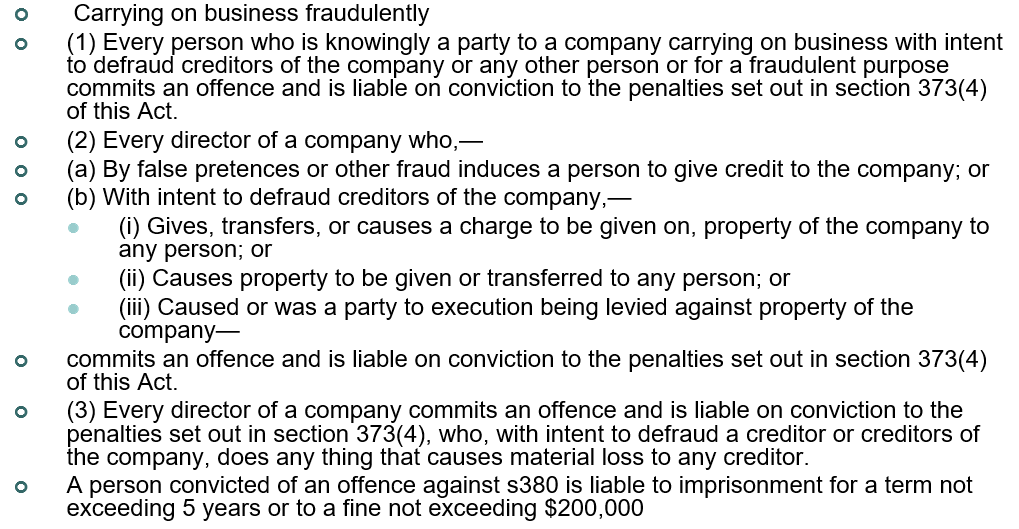
Section 380