Lecture 2: Inflammation
Inflammation
UNIT OUTCOMES:
Examine the body’s key defense mechanisms and outline the vascular and cellular change associated with inflammation
Human Defenses (3): lines of defense can overlap each other
PHYSICAL BARRIERS & SECRETION: prevents outside particles from getting inside your body
E.g. skin, mucous membrane, secretions (tears, sweat, saliva, acidic gastric secretions), normal flora (healthy bacteria)
INFLAMMATORY RESPONSE: localized, non-specific response triggered when tissues are injured or foreign material is identified in the body
Conditions usually end in -itis
ADAPTIVE IMMUNE RESPONSE:highly specific, systemic rxn typically in response to an antibody-antigen association
Has memory
Systemic = whole body rxn
*the first 2 lines of defense are part of our innate immune response*
*INNATE: always ready to go*
*ADAPTIVE: have to get exposed to a pathogen to build immunity defenses*
ACUTE INFLAMMATORY RESPONSE: activated by MAST CELLS!
Responds to cell injury, to:
remove cause
remove damaged tissue
initiate tissue repair
Response is immediate (seconds)
May last for 8-10 days
Chronic inflammation not good >> around 2 weeks
MAST CELLS >> guard dogs
Recognize foreign particles >> make chemical noise
Derived from the same stem cells as basophils (Never.Let.M.onkeysEat.Bananas)
Neutrophils, Leukocytes, Monocytes,Eosinophils, basophils
Typically located at site pathogen used to enter body
Near skin surfaces
Mucous membrane
Around blood vessels
MAST CELLS: initiate acute inflammatory response
Contain stores of inflammatory chemicals (e.g. histamine) in visible granules
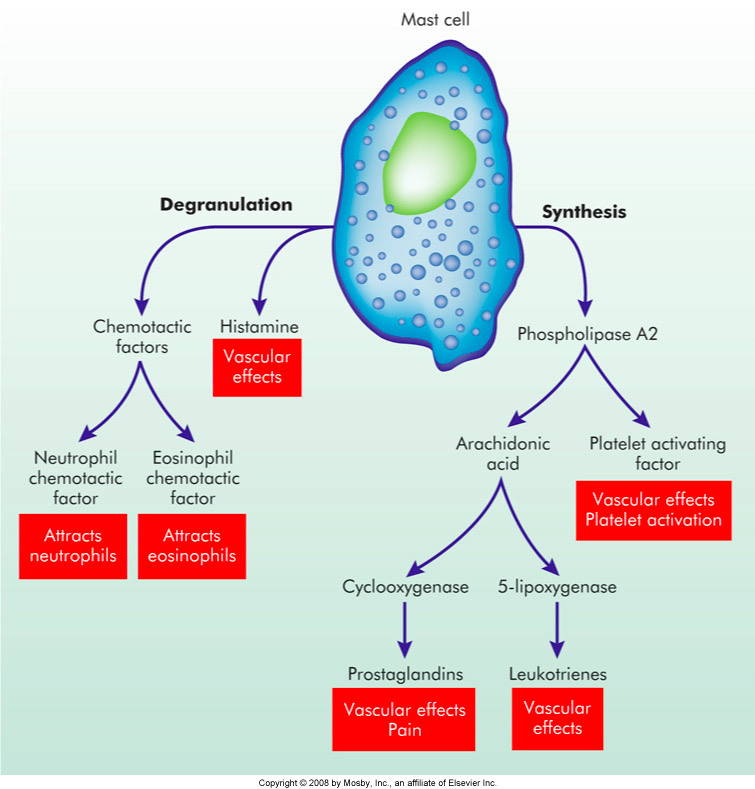
MAST CELL DEGRANULATION (VASCULAR STAGE):
DEGRANULATION: Emptying of pre-formed granules containing histamine and chemotactic factors to ECM (mast cells release degranulators)
Pre-formed biochemical mediators that work immediately:
Histamine
WBC chemotactic factor
Other cytokines
Release of HISTAMINE: (3 rxns)
Blood vessel dilation: increases blood flow to area = more cell and protein to areas
causes redness and warmth
Capillary endothelial retraction: Leads to space forming between the cells > allows cells and proteins to enter tissue (exudation)
RBCs, leukocytes, platelets, and clotting factors
Limit the spread of m/o
We see edema, pain, and impaired fxn
Mucus production: Traps the foreign objects
Release of chemotactic factors: “chemo” = chemical; “taxis” = movement
Chemotaxis: Attracts NEUTROPHILS and EOSINOPHILS to the site of injury towards area of higher concentration of signal
Different WBCs
Chemotactic factors leave a bread crumb trails for WBCs to follow
These WBCs act like phagocytes! >> Eat up dead cell, debris >> clean up the area
NEUTROPHILS are first PHAGOCYTES to show up to the area >> v important for acute inflammation
Most abundant WBC >> call other WBCs
Short-lived (10h), die, removed as pus
EOSINOPHILS: are important for parasitic inflammation
MONOCYTES/MACROPHAGE: travel as monocytes; become macrophages in tissue (similar fxn as neutrophile)
Arrive later >> 2-7 days
Increased number during _______
MAST CELL SYNTHESIS:
Synthesis of Membrane-Derived Lipid Mediators
Membrane lipid metabolism takes place over minutes – what is the importance of this?
Prolonged inflammation
Synthesis of 3 important inflammatory chemicals:
Leukotrienes: Produced from phospholipids, converted to arachidonic acid
Similar vascular effects as histamine, but…SLOWER + PROLONGED:
increase vascular permeability
induce blood vessel dilation
Also promotes neutrophil and eosinophil chemotaxis
Prostaglandins: Like leukotrienes, derived from phospholipids, converted to arachidonic acid and then into prostaglandins
Prolonged “histamine-like” effects: INDUCE PAIN by directly acting on neurons
increase vascular permeability
induce blood vessel dilation
platelet activation factor (PAF): Produced from phospholipids mainly by mast cells (but also by other WBCs)
Similar effects to histamine, with an emphasis on activating platelets (hemostasis -- BLOOD CLOTTING)
ACTIVATION OF MAST CELLS: 2 Responses
Vascular Response: Involves the arterioles, capillaries and venules of microcirculation >> vasodilation, endothelial cell retraction
Causes ⬆microvasculature permeability at site of inflammation causing protein-rich fluids to fill extravascular space
Activates 3 main plasma protein proenzyme systems:
Complement system - OPSONIZATION - “Tags” bacterial capsules with proteins and renders it susceptible to phagocytosis
Act as anaphylatoxin >> Causes degranulation of mast cells and increases inflammatory response
Cause direct death of pathogen >> Acts as membrane attack complex and perforates bacterial cell membrane
Clotting system: Activated by cell injury as well as bacterial products
Activating fibrinogen causes the production of ______ that forms insoluble clot
Prevents spread of infection and stops bleeding
Kinin system: Activation similar to clotting system
Bradykinin:
Induces pain (along with PGs)
Promotes leukocyte chemotaxis
Prolonged phase of inflammation with histamine-like effects: Dilates blood vessels and increases vascular permeability
Cellular Response:
Involved cells:
mast cells (basophils)
neutrophils
monocytes, macrophages
eosinophils
lymphocytes + NK cells
Platelets
WBCs normally circulating in the blood
Stimulated by inflammatory responses and cell injury to produce adhesion molecules and migrate into the local tissue (chemotaxis)
MARGINATION (pavementing): WBC sticks to the endothelial cells lining the blood vessels
Diapedesis (exudation): Move between retracted endothelial cells
Migrate to inflammatory site - chemotaxis
LOCAL MANIFESTATION
Cardinal signs of inflammation (PRISH)
Pain: stimulation of nerve endings
Redness: capillary dilation (hyperemia) >> increase in heat
Bring more O2, nutrients, and WBCs
Impaired fxn >> edema >> joint stiffness
Swelling (edema) >> increase blood vessel permeability
Extravasation of vascular proteins, including ______ >> water follows and moves into tissues
HEAT >> SYSTEMIC MANIFESTATIONS
Fever: usually accompanied by malaise, fatigue, anemia
Leukocytosis: primarily of _________
Increased plasma proteins
Muscle catabolism
Chronic Inflammation:
Caused by a relatively milder, more persistent stress or injury
Characteristics of chronic inflammation:
Lasts _______ or longer (>years)
Less hyperemia, less edema
Primarily lymphocytes and macrophages
More fibrosis, less exudate
Could have granuloma formation (walled off site with fibrous deposits)