63 BC
Overview of events: 69 – 63 BC
69 BCE : Cicero’s aedileship; Caesar’s quaestorship in Spain
67 BCE lex Gabinia granting Pompey imperium against pirates in the Mediterranean
66BCE lex Manilia granting Pompey imperium against Mithridates. Pompey’s subsequent absence fromRome, Crassus and annexation of Egypt
65 Caesar’s aedileship; annexation of Egypt (Crassus and Caesar behind the scene)
64BCE Cato’s quaestorship, Cicero’s campaign for consulship (difficulties faced) Cicero’s speech in theWhite Toga – attacks Catiline)
63BCE Cicero’s Consulship year:
Caesar - pontifex maximus – (chief priest)
lex agraria of Rullus
pro Rabirio trial
Murena trial
Catilinarian conspiracy and senatus consultum ultimum on the conspirators (December)
Cicero – consul for the people
Rome Cicero inherited was on the brink of chaos, many fell into huge debts and the only provision made for them by state was a subsidy on corn
In such circumstances a man who could represent himself as a politician for the people stood to gain much
- this explains partly why Cicero wanted to divorce himself from the nobles and emphasize that he was not just another self-serving aristocrat.
First on the agenda for 63 BC was agrarian bill proposed by Rullus.*
Cicero’s year as a consul was to test both his principles and his bond sand amicitia with optimates
In Rullum – against Rullus
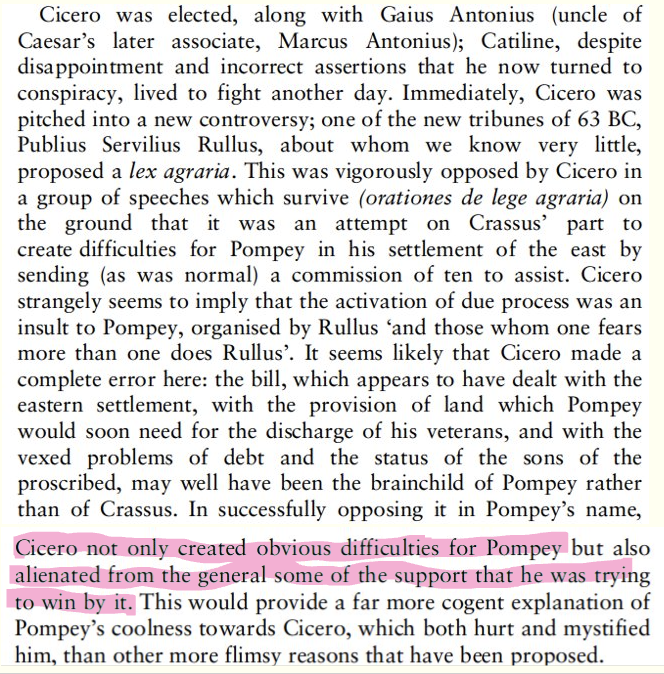
Cicero made 3 speeches known as ‘on the Agrarian Law’ (= InRullum/against Rullus while he was consul. He argues against theproposal of the tribune Rullus ( backed by Crassus and Caesar mostprobably) to allocate land and establish colonies in Italy and theprovinces. Cicero argues against the sale of public land. The bill iswithdrawn.
It seems that while Pompey is away, Crassus is attempting to getcontrol of all available land, knowing that Pompey on his return would need land for his veterans, thus he would be in a strong bargaining position. The bill is therefore a tool to prevent Pompey from any reconciliation with the optimates dominated Senate. Pompey will need land for his soldiers and would have to go to Crassus to get it.
Optimates or people
Arguing against this bill Cicero pleased the optimates because there was no radical change to land use. It may or may not have helped Pompey.
It showed how Cicero was content to use his oratory against people whose votes he had recently courted ( the tribunes and Crassus’ followers)
an example of a political U turn, Cicero was pleasing those (the optimates) who he had recently challenged in the Verres trial.
Shotter on
‘Against Rullus’
Cicero, Caesar and the Trial of Rabrius
Cicero often used populist language when he addressed the assembled mob, but in 63 BC, at the beginning of his consulship there was a further reason why he needed to pitch his oratory to the tune of the people
for there was another man ambitious for political advancement - Gaius Julius Caesar - and he had recently launched his career with a strong commitment to the popular case
A serious attack against the senate was launched – the trial against Rabirius, an elderly senator who allegedly committed a crime 37 years ago!!! - sought to undermine authority of Senate
- Labienus/Caesar wanted to question the senate's powers in issuing and implementing it's 'ultimate decree' the senatus consultum ultimum*
Trial of Rabirius – 63 BC
Rabirius was accused of murder and high treason for killing a radical tribune called Saturnius 37 years earlier. Cicero defends him during his consulship, arguing that Rabirius was acting with emergency powers to protect the state during a time of riots and unrest. Cicero believes that actions that protect the stability of the state should be worthy of praise.
Julius Caesar, who at that time was positioning himself as a reforming politician closer to the populares, was on the side of the prosecution of Rabirius. He wished the senate to be confronted with when and how it could use emergency powers.
The trial was aborted before voting took place. But what was discussed was awarning that the peoples’ rights should be protected by the senate evenafter the passing of an SCU ( senatus consultum ultimum ( final decree of theSenate).
This trial can be interpreted as Cicero’s ‘thank you’ to the optimates forelecting him into office. It also shows that Cicero is engaged in a balancing act between the reformers and the conservatives.
Pro Murena* - Cicero vs Cato
Later in 63 Cicero confronted Cato who supported the prosecution of the successful consular candidate Lucius Licinius Murena on the ground of excessive bribery.
Murena was defended by Cicero who won the case for Murena on the grounds that the threat posed to the state at that time meant that this was not the time to depose the consul elected for 62 BC **
Catilinarian conspiracy
Cicero’s most dramatic challenge during his consulship came in the form of a conspiracy to overthrow the government by Catiline.
Cicero’s patriotism, his sense of duty to the state and his dislike of popularis politics led him to go against Catiline –a man whose family embodied the tradition and past thatCicero was striving to save.
When the trial of some of Catiline’s fellow senatorial conspirators came up, Cicero as consul, was forced to decide on a punishment that would be effective , but also legal.
In summary - SCU
Having called a senatus consultum ultimum, there was historical precedent forCicero to have the conspirators executed for treason, despite their Roman citizenship
Caesar recommended imprisonment for life
Cato argued convincingly to the senate that the conspirators should be executed
With almost full senatorial backing Cicero declared the conspirators guilty of treason and had them put to death
SCU
SENATUS CONSULTUM ULTIMUM = Final decree of the senate
Pater patriae
According to Plutarch, Cato named Cicero parens patriae / pater patriae for having rescued the Roman Republic from collapse
For Cicero – it was a great example of a harmoniousrelationship between boni from the optimates and theequites in the face of a threat to the Republic
Cicero had achieved his personal ambition to become consul and had even been in a position to save the statefrom ruin ( !? )
Yet to come
Pompey’s coming home, Caesar’s coming into prominence
it’s arguable if Catiline was such a threat to the country
however united the senate may have acted over the issue of Catiline and his followers, the concordia ordiunum, so cherished by Cicero had not been embedded
The end of 60s saw optimates led by Cato close ranks and their uncompromising behaviour towards Caesar, Crassus andPompey drove the three men together to form an alliance that would undermine the future of the Republic forever