Nuclear Physics
- Nuclear changes of matter refer to the transformation of atomic nuclei through processes such as radioactive decay, fission, and fusion. These processes involve the release or absorption of energy and the alteration of the atomic nucleus.
- Radioactive decay is the spontaneous emission of particles or radiation from the nucleus of an unstable isotope. There are three types of radioactive decay: alpha decay, beta decay, and gamma decay. Alpha decay occurs when an alpha particle (consisting of two protons and two neutrons) is emitted from the nucleus. Beta decay occurs when a beta particle (either an electron or a positron) is emitted from the nucleus. Gamma decay occurs when a gamma ray (a high-energy photon) is emitted from the nucleus. The effects of radioactive decay include the emission of radiation, the alteration of the atomic nucleus, and the transformation of the isotope into a different element.
- Fission is the process of splitting a nucleus into two or more smaller nuclei, accompanied by the release of a large amount of energy. Fission is typically induced by the absorption of a neutron by the nucleus, and it occurs in certain isotopes such as uranium-235 and plutonium-239.
- Fusion is the process of combining two or more atomic nuclei to form a larger nucleus, accompanied by the release of a large amount of energy. Fusion occurs in the cores of stars and is the process that powers the sun.
- To calculate the amount of substance present after a given amount of time based on its half-life, we can use the following formula:
- N(t) = N(0) * 2^(-t/t1/2)
- where N(t) is the amount of substance present at time t, N(0) is the initial amount of substance, t is the time elapsed, and t1/2 is the half-life of the substance. The law of conservation of mass and energy states that the total mass and energy of a closed system remain constant, unless mass or energy is added to or removed from the system
The decay constant (lambda) of a radioactive nuclide is its probability of decay per unit time.
To calculate the decay constant, we can use the following formula:
- lambda = ln(2)/t1/2
- where ln is the natural logarithm function, 2 is the base of the logarithm, and t1/2 is the half-life of the isotope. The decay constant represents the probability of a nucleus undergoing decay in a given time interval.
Isotope Notation:
Isotopes are atoms of the same element that have the same number of protons in their nucleus, but a different number of neutrons. Isotopes can be distinguished by their atomic mass number (A), which is the sum of the number of protons and neutrons in the nucleus. Isotopes can also be distinguished by their atomic mass, which is the mass of the isotope expressed in atomic mass units (amu). The atomic mass of an isotope is approximately equal to its atomic mass number, but it is slightly less due to the binding energy of the nucleus.
Isotope notation is a way of representing isotopes using the symbol of the element followed by the atomic mass number in parentheses. For example, the isotope notation for carbon-14 is _14C, where the symbol "C" represents carbon and the atomic mass number "14" indicates that the isotope has 6 protons and 8 neutrons in its nucleus.
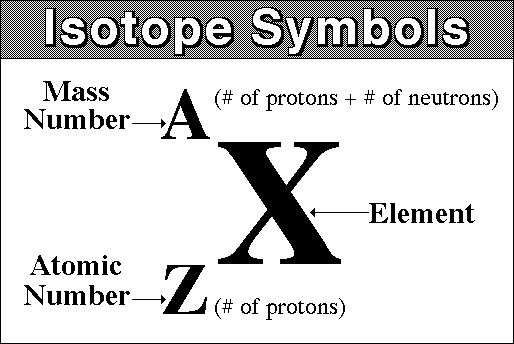
Example balanced chemical equations for different types of radioactive decay are:
- Alpha decay:
_238U -> _234Th + _4He
- Beta decay:
_14C -> _14N + _0e-
- Gamma decay:
_60Co -> _60Co + _0gamma
Remember the emissions of each type of decay:
- Alpha: Atom loses 2 neutrons and 2 protons
- Therefore A-4 and Z-2
- Beta: An electron is emitted and a neutron becomes a proton
- Therefore A is the same but Z+1
- Gamma: There is no change in the nucleus except energy is emitted
Binding Energy
Binding energy is the energy needed to break apart the nucleus. To be a stable atom the binding energy must be positive.
The best way to understand binding energy is with a practice problem:
Calculate the binding energy of a nucleus with 10 protons, 10 neutrons, and an atomic mass number of 20.
Solution:
First, we need to determine the values of the constants in the formula:
mp = mass of a proton = 1.007276 amu
mn = mass of a neutron = 1.008665 amu
c = speed of light = 299,792,458 m/s
Then, we can plug these values into the formula to calculate the binding energy:
BE = (Zmp + Nmn - A*mn)c^2
BE = (101.007276 + 101.008665 - 20*1.008665)299,792,458^2
BE = (10.07276 + 10.08665 - 20.08665)299,792,458^2
BE = (20.15941 - 20.08665)299,792,458^2
BE = 0.07276*299,792,458^2
BE = 2.206056*10^-11 J
The binding energy of the nucleus is 2.206056*10^-11 J.