Chapter 9 Textbook
Key Terms
- Generativity: An adult's concern for and commitment to promoting the well-being of future generations.
- Redemption via liberation: Move from slavery/oppression to freedom.
- Contamination story: A sudden transformation from positive to negative while holding to the desperate hope for a reversal.
- Selfish component: Promoting the next generation by committing the self to the betterment of one’s own children, own group, and own people (not others)
- Positive illusions: Overlooking the most negative aspects of life events + exaggerating the positive meanings.
- Positive future: Projects optimism for the future.
- Positive bias of aging: Older adults tend to emphasize positive emotions in their daily lives /memories compared to younger adults.
- High generativity: Involved in a wide range of social endeavours + higher levels of psychological health.
- Master narrative: How culture provides vital resources for the construction of narrative identity while also severely constraining the kinds of lives that people can live.
- Redemption via atonement: Move from sin to salvation.
- Generativity: Can be domain-specific so expressed only in the domains of family, work, or religious involvement.
- Redemption via recovery: Move from sickness/negative states to recovery of health, innocence, wholeness, and the like
- Self-defining memories: Emotionally vivid scenes in adults’ lives in which they grappled with important psychological issues
- Discounting the negative event: Way to narrate negative life events by either repression, denial, or dissociation
- Meaning making: Way to narrate negative life events by exploring the negative event in depth and articulating the self to a positive resolution of the event
- Narrative unconscious: Memories of shameful events may be buried in there
- Redemption via upward social mobility: Move from “rags to riches” (ex: immigrant success tale)
- Stagnation: to feel that you are stuck, that you cannot generate anything useful and that you are unable/unwilling to be of good use to the next generation
- Midlife: period from the late 30s through the mid-60s
- Redemptive self: common script for the life narratives constructed by highly generative adults that comprise 6 themes
- Ren: from a Confucian perspective, the highest purpose in life is a blending of benevolence, moral vitality, and sensitive concern for others
- Life review: when older adults relive and reflect on past events
Experiments
- Generativity is associated with the achievement-striving facet of C and the altruism facet of A
- Generativity is positively associated with E and O but negatively associated with N
- Midlife adults listed twice as many personal strivings oriented toward generativity as did younger adults
- People may show different levels of generativity in different domains of life (family, work…)
- People who score high on generativity tend to be productively involved in a wide range of social endeavours
- People who score high on generativity tend to enjoy higher levels of psychological health and well-being
- Parents who are more generative to begin with tend to be better parents and help more their children in school
- Generative parents view parenting as an opportunity to pass on values and wisdom to the next generation
- Parents high in generativity tend to adopt an authoritative style of parenting
- Generativity is the strongest psychological predictor of caring and doing for others and social responsibility in the domains of family, work, and community
- Extremely low scores on generativity are associated with depression
- Highly generative adults tend to narrate their lives as stories of redemption
- Highly generative adults construct life stories that tend to emphasize the 6 themes in the script to a greater degree than less generative adults
- Many people experience little frustration when stricken with misfortunes in life and instead show resilience
- People who emerge strengthened from negative life experiences often engage in a 2-step process of meaning making
- Mothers of children with Down syndrome who were able to articulate accounts of the pain and struggle they experienced as caregivers tended to score higher on psychological maturity and increased maturity over the next 2 years
- Exploring difficult life transitions in depth is associated with greater psychological maturity
- When people construct positive resolutions to difficult life experiences, they tend to enjoy higher levels of well-being and happiness
- The number of redemption sequences in a life story positively predicts psychological well-being
- For recovering alcoholics, the ability to create a redemptive narrative about alcohol addiction was strongly associated with maintaining sobriety
- Working-class children and adolescents learn to narrate their lives with a greater sense of humility and vigilance
- Chinese people more frequently drew on past events to convey moral messages than Americans
- European Americans may prioritize self-expressive functions whereas Chinese may prioritize the self-directive function, using personal narratives as guides for social conduct
- Through sharing stories, young Israelis and Palestinians developed close bonds across groups but when they returned back home, everything was erased
- The stories of older adults may emphasize stability while younger adults may emphasize change
- Older people tended to tell more vivid and coherent earliest memories relative to younger people
- Older adults find greater integrative meaning in their self-defining memories
- Adults use more positive and fewer negative words as they age
- Older adults focus mainly on a memory’s emotional gist rather than on its details
- Life review can improve life satisfaction and relieve symptoms of depression and anxiety among older adults
Examples
- Gandhi: worked to expand the civil rights for all Indians in South Africa and became the most influential leader in the drive for Indian self-rule and independence from England
- Gandhi conceived of his own life as a narrative of continuous development and self-realization
- Generativity marks the central psychosocial challenge of midlife
- A 40-year-old man/woman who is disengaged from the business of caring for society and for the well-being of future generations is viewed to be self-centred or psychologically deficient
- An expansive sense of generativity may satisfy narcissistic urges for some adults by bringing glory to the self
- There are wide individual differences in generative concerns, motives, and actions among midlife adults
- Gandhi’s generativity shone brightly on the public stage
- An important source of frustration and angst is the possibility that your children will never appreciate what you have done for them
- Generativity can be one of the deepest rewards in human life
- Generativity is really hard so it takes a good story to be a highly generative adult
- In some of the most inspiring stories, power motives are fulfilled in the service of communion
- The best stories result from a character’s encounter with trouble
- Highly generative adults construct narratives in which trouble is often transformed into growth, insight, or enhanced well-being
- Experiences of failure, loss, sadness, fear, shame, and guilt seem to beg for an explanation in life stories
- Generativity is a human universal
- Americans love stories of personal redemption
- George W. Bush: president who was seeking redemption
- Oprah Winfrey: spokesperson for redemptive narratives of upward mobility and recovery
- At the level of the social actor, culture provides rules for how to perform the traits and the roles that structure social life
- At the level of the motivated agent, different cultures provide norms for the content and importance of personal goals and values
- Stories distinguish what culture glorifies as good characters and vilify as bad characters
- Narrative identity reflects structural and cultural boundaries in society and the patterns of economic, political, and cultural hegemony that prevail at a given point in a society’s history
- Group members may sometimes resist the master narrative set forth by their culture
- Israelis and Palestinians hold dramatically different master narratives regarding the meaning of recent historical events
- Israelis emphasize the horror they endured and celebrate the resilience of their people (redemptive story) while Palestinians emphasize a catastrophe (contamination story)
- Developing a clear and meaningful ethnic identity is an important psychological project in adolescence and early adulthood
- The construction of global citizenship suggests that people may transcend the master narratives of ethnicity and nation-states to embrace stories about being part of the human collective at large
Tables/Figures
Table 9.2
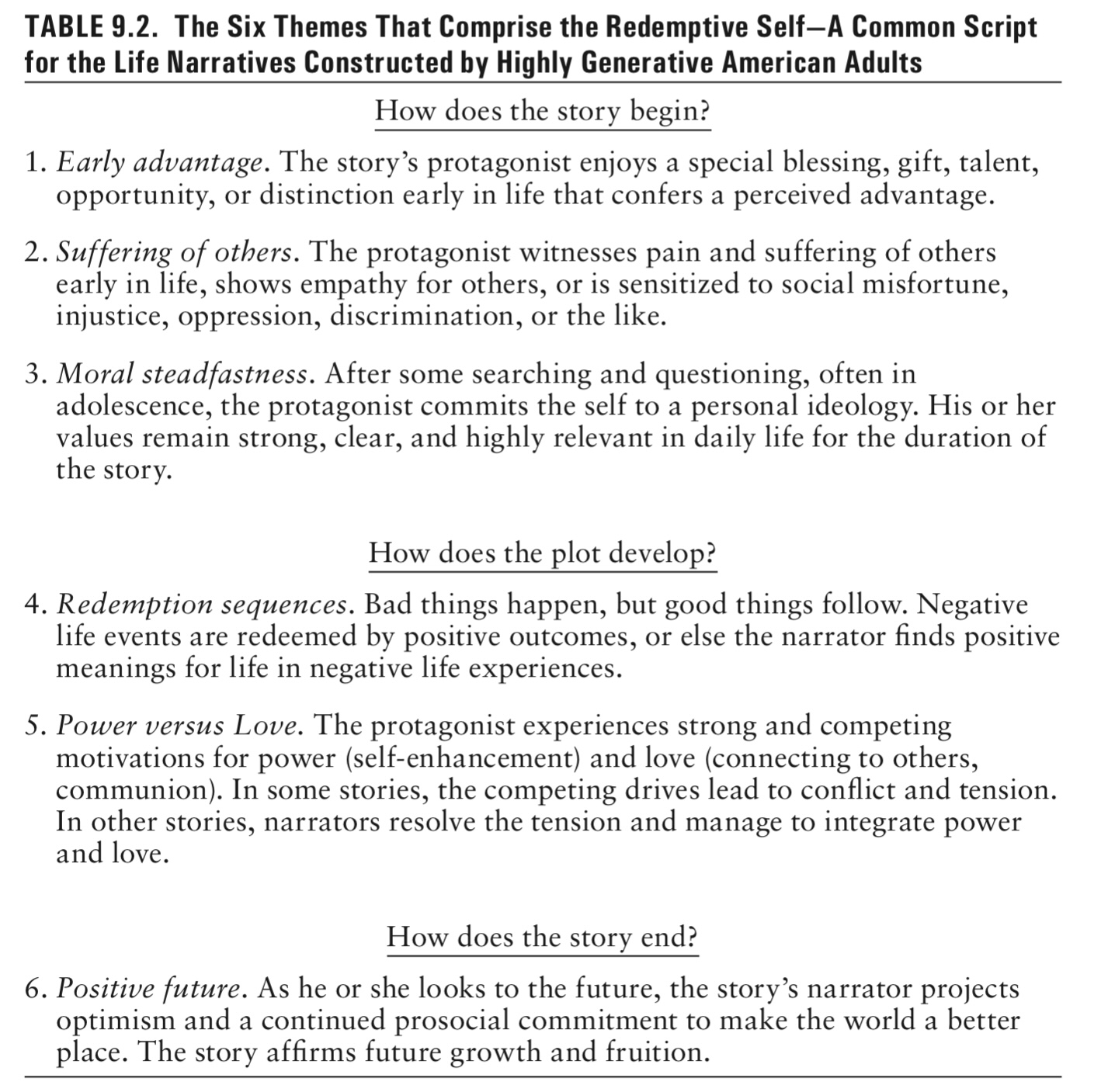
- Early advantage: the story’s protagonist enjoys a special blessing/gift/talent early in life that confers a perceived advantage
- Suffering of others: the protagonist witnesses pain and suffering of others early in life
- Moral steadfastness: the protagonist commits the self to a personal ideology
- Redemption sequences: bad things happen, but good things follow
- Power vs. Love: the protagonist experiences strong and competing motivations for power and love
- Positive future: the story’s narrator projects optimism for the future