Replication
Overview of DNA Replication
- If DNA did not replicate before reproduction, each cell would have half of the original amount, and the daughters of those cells would have a quarter of this amount, and so on until there was very little DNA left in the cell.
- Because DNA is double-stranded, the first step in DNA replication is to separate the two strands. The DNA unwinds and unzips. We call this space the replication fork. The blue triangle in the image below shows you the replication fork.
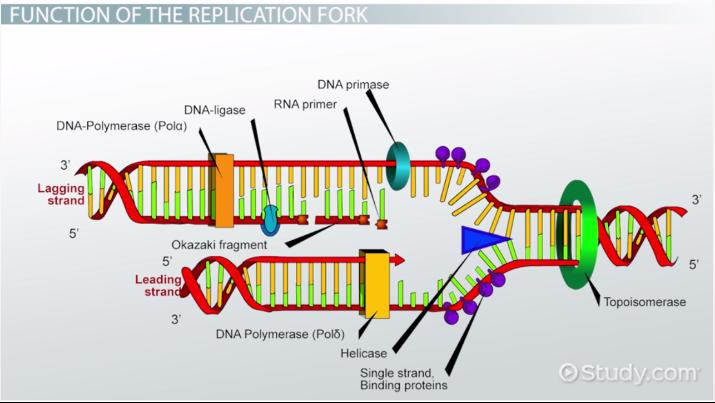
- Then, complementary strands, or two strands that match the two sides of the original DNA molecule are used as templates.
- This will eventually make two new pieces of DNA. This is known as the semi-conservative model, which just means that part of the original DNA molecule is found in each of the new DNA molecules.
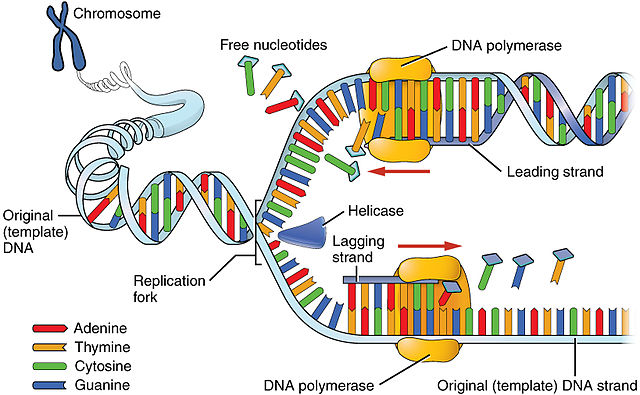
- The area in each of the coloured boxes below is known as the replication bubble, or where replication is actively happening. As you can see, replication occurs on both “sides” of the original DNA molecule simultaneously. This also means that each side works antiparallel to the other side – in other words, parallel but in the opposite direction. The new DNA molecule in the box is being assembled working “down” the page, away from the replication fork. At the same time, the DNA molecule in the purple box is being assembled working “up” the page, towards the replication fork. Lastly, DNA ligase proofreads the new DNA strands and makes sure they are assembled correctly.
Enzymes – Necessary Helpers
- The process of DNA replication requires the help of several enzymes. All enzymes, even those not involved in DNA replication have the “ase” suffix, making it easy to know when we are talking about an enzyme.
- You can remember this enzyme because it unwinds and unzips the HELIx and is called HELIcase or literally the enzyme that works with the helix. DNA helicase is the blue triangle at the replication fork in the image above. This enzyme works to unwind the strands of DNA and (unzipping the molecule).
- This keeps DNA from breaking due to the tension caused by supercoiling.
- The name polymerase literally means the enzyme that makes DNA into a polymer.
- Interestingly, because DNA polymerase can only add to the 3’ end of the DNA molecule, one strand can be built continuously and the other strand (the 5’ end) must be built in sections, known as Okazaki fragments.
- DNA primase is a type of RNA polymerase. These primers serve as a template and are required before DNA replication can occur.
- DNA ligase is one of the last enzymes involved in DNA replication. While it is linking, it proofreads the new DNA strand and makes small repairs, if needed
- In eukaryotes, DNA telomerase finalizes the DNA. It adds a poly-A tail to the end, which is a tail formed of several adenine nucleotides. This tail is known as a telomere, which makes DNA telomerase “the enzyme that makes telomeres.”
- You can think of this as a “cap” on the end of the DNA molecule or the plastic covering on the end of a shoelace. It simply protects the important part of the DNA molecule, reducing the likelihood that the ends of the DNA molecule will get damaged.
Edited: 04 December 2022