CROP MANAGEMENT
Selected crop management practices
Crop management is a set of practices carried out in an already established crop on the field to provide
it with proper conditions for healthy growth.
Weeding in a Crop Field
This is the removal of unwanted plants to avoid competition of nutrients, moisture and sunlight. Methods of weeding.
1. Physical weeding - Involve where farmers use mechanical force to remove weeds - It can be done through: Hand weeding(uprooting), hand hoeing, digging(tilling), cutting, mowing( cutting down weeds using a sickle)
- 2. Biological weeding- Where farmers use living organisms to control weeds. 3. Chemical weeding- where farmers use herbicides to control weeds.
4. Cultural weeding- farmers use some farming practice to control weeds in the farm such as mulching.
2. Thinning- is the removal of excess seedlings in a crop field.
- When farmers carry out thinning, they uproot excess plants from the garden to prevent overcrowding
- Thinned-out plants can be used for gapping or as livestock feed.
3. Gapping- is the replacement of seeds that did not germinate or dried after planting. In gapping farmer replace crops that refuse to grow may be due to pest and diseases.
4. Earthing up - Is the heaping of soil around the base or root zone of the crop to strengthen the roots and hold them firmly in the soil.
Importance of earthing up
i. In tubers, it provides room for tubers to increase in size.
ii. Helps to conserve moisture around the base of the growing crops. 
iii. It encourages development of propping roots in cereal crops like maize. This prevents lodging (falling of crops after bearing) in cereals.
5. Hardening/ curing-Hardening is a practice carried out after harvesting crops to prepared produce for storage. Hardening harvested produce makes their skins tough to avoid peeling and rotting in the store.
• In tubers such as Irish potatoes and bulbed onions are hardened just before harvesting to prepare them for storage by heaping the produce under shade and covering with grass for about four days. They are turned daily to ensure even drying.
Importance of hardening/curing
i. Helps to remove excess water in mature bulbed onions preventing rotting in the store.
ii. Hardening makes the crop not to lose quality during transportation.
Importance of Management Practices in Crop Production.
i. Well managed crops make maximum use of soil as a resource and give good returns to the farmer’s efforts.
ii. Improves crop yields for food security.
iii. Improves the quality of produce. This makes the produce attractive and marketable.
iv. It increases the storage shelf life of the produce.
Methods of planting various crop materials
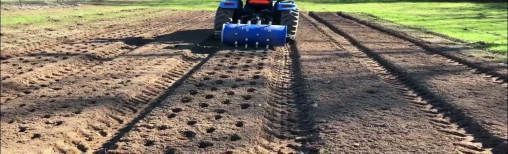
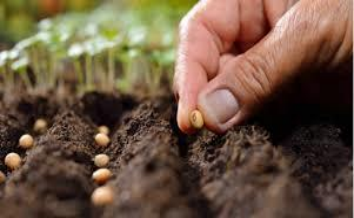
• Dibbling- This involves placing seedlings in holes in a seedbed and covering them with soil.
• It is helpful in achieving proper depth, proper spacing and amount of planting material in the seedbed.
2. Drilling
This involves putting seeds in furrows then cover them with soil. This method is commonly in planting tubers
Importance of drilling.
Fertilizer can be applied when planting
Manual weeding is easier because the crops are well spaced.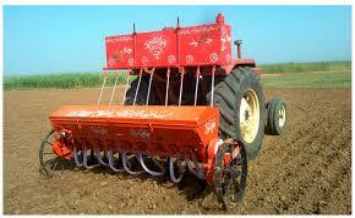
3. Broadcasting
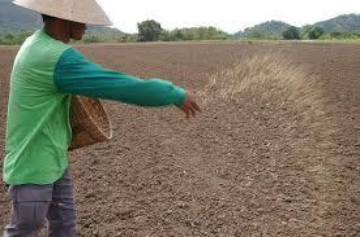
• This involves spreading seeds on tilled or untilled wet seedbed. • Shallow drills can be made for easier covering of the seeds especially on dry seedbeds.
• It is commonly used when sowing small seeds such as Finger millet, oats and cotton.