Week 9: Jupiter
Jupiter facts:
largest planet from our solar system
5th planet from the Sun
Jovian planet
Jupiter: King of the Gods
first telescopically observed by Galileo in 1609
distance from the sun: 480 million miles or 5.2 au
more than 5.2x distance from earth to sun
au = distance from earth to sun
Diameter: 88,000 miles or 11 Earth diameters
can fit 11 earths side by side to be same size and Jupiter
more than 1,300 Earths in volume!
1300 earths’ can fit inside Jupiter
Largest planet in entire solar system!
mass: 318 Earth masses
Axial Tilt: 3 degrees
Density: 1.3g/cm3
less than 1/4th Earth’s density!
not very dense compared to earth
Composed of gas and liquid, mostly hydrogen (around 85%)
similar to the sun
Surface Gravity = 2.5 g
don’t have solid surface, measured from top of cloud
Jupiter’s Rotation and Revolution
Rotation rate: 9 hours 50 minutes
fastest of all the major planets
spins faster due it being formed by bigger cloud than earth, causing angular momentum
gravity pulled the vast cloud of gas and dust inward to form Jupiter, the planet shrank in size, causing its rotation rate to accelerate
similar to a spinning ice skater pulling in their arms.
Exhibits differential rotation (not all parts of Jupiter rotates at same speed)
poles (top and bottom of planet) rotate 5 minutes slower than the equator (middle)
Revolution period: about 12 years
revolution period: how much time it takes to orbit the sun
Jupiter Clouds
Temperature at cloud tops: around 166 degrees F
reddish bands = belts
combination of ammonia, hydrogen, and sulfur
called ammonia hydrosulfide
lower altitude
belts move faster than zones
Whiteish bands = zones
frozen ammonia
higher altitude
zones move faster than belts

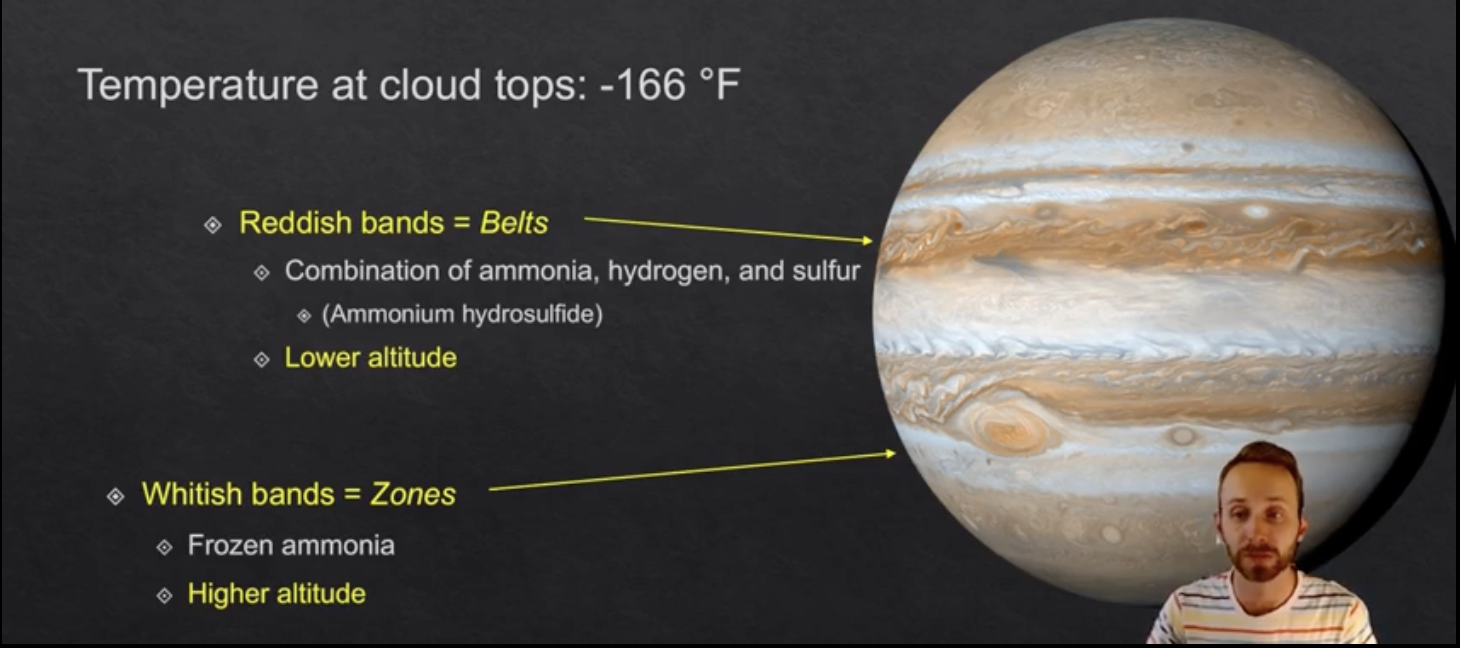
gas goes up in atmosphere (from red to white) then freezes, turning white

Great Red Spot
giant storm (winds, similar to hurricane)
2-3 Earth diameters! (can fit 2-3 earths inside of it! but getting smaller)
rotates once every 6 days
formed by winds blowing opposite direction and interacting
driven by internal heat
at least 200 years old
Jupiter’s Interior
layers are NOT distinct
more of gradual change between layers
as you move in towards center of Jupiter, becomes denser and thicker gases, then liquid hydrogen, until you reach solid core

Jupiter’s Opposition
opposition: when a planet is on the direct opposite side of Earth from the sun
during this time, Jupiter will be closest it can get to Earth
occurred December 7th, 2024
next one occurs around January 2026

Is Jupiter a Brown Dwarf?
Brown Dwarf: failed star
Jupiter has a very similar to a chemical composition to typical stars
but not enough mass
needs to be 70-80x more mass to be a star
Jupiter is not a brown dwarf
needs to have at least 10x more mass to be a brown dwarf (failed star)

Magnetic Field of Jupiter
Jupiter’s magnetic field is 19,000x stronger than Earth’s
has a very very strong magnetic field
can fry our electronics when we send spacecraft near the planet, making it crucial to design probes with robust shielding to withstand the intense radiation.
Jupiter’s Auroras
Auroras are created as solar wind interacts with magnetic poles
solar wind (charged particles) slam into magnetic field
causes gases in these areas to get excited and glow

Jupiter has Rings!
Jupiter has tiny rings
ring system discovered as Voyager 1 in 1979
(all of jovian planets have rings)
Galileo (the spacecraft)
launched in 1989
orbited Jupiter from 1995- 2003
first spacecraft to orbit an outer planet
dropped a probe that fell through Jupiter’s atmosphere, sending back data
only lasted an hour due to being crushed by all the pressure in Jupiter’s atmosphere
Juno Spacecraft
launched in 2011
arrived in 2016 and is still operating
most recent spacecraft at Jupiter
Jupiter’s Natural Satellites
95 official natural satellites, but likely more!
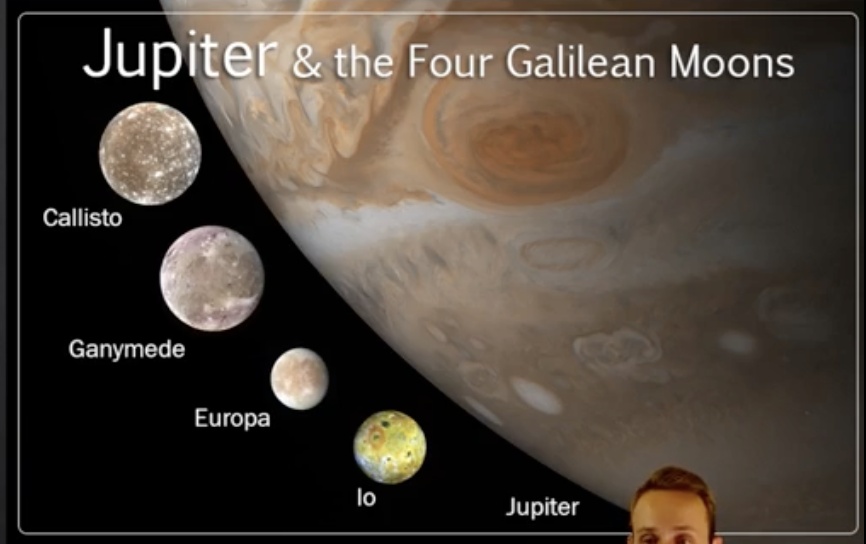
4 Galilean Moons:
io
Europa
Ganymede
Callisto
discovered by Galileo

Io (spelled io)
few impact craters
continually resurfaced by volcanic activity
most volcanically active body in the solar system!


Europa
surface composition: water ice
scientist think there is a liquid water ocean below the icy surface
interior warmed by tidal stretching, like io
warm salt water = possibility of life??

Ganymede
solar system’s largest satellite
larger than Mercury and Pluto!
but does not orbit the sun (orbits Jupiter) so it is not a planet
only satellite with its own magnetic field
named after Jupiter’s eagle bird friend / servant


Callisto
ancient surface: 4 billion years old!
most heavily created object in the solar system


Comet Shoemaker-Levy 9
comet that passed within the Roche limit and was ripped apart
stretched into a string of 23 fragments
first impact with Jupiter was July 16th, 1994


Jupiter’s Impacts
Jupiter takes a lot of hits
we think it could be responsible for absorbing / deflecting objects that could head towards Earth
Jupiter’s Trojans
Jupiter’s strong magnetic field causes little planets / astroids to stay within its orbits
Lagrange points: weird point of gravitational stability where objects (planets / astroids) can remain stable near a massive body like Jupiter

VIDEO NOTES
largest planet of solar system
Jupiter is called '“gas giant”
one day on Jupiter is mere 10 hours long
thats the fastest spin in the solar system
brightest planet in the solar system
jupiter’s atmosphere is banded, with multiple stripes running parallel to its equator

belts = lighter colored stripes
zones = darker colored stripes
belts and zones formed due to convection in jupiter
radiates more heat than received from the sun