Chapter 9 - Metabolism and Glycolysis (2/4)
Metabolism Overview
Catabolic Pathways: breaks down molecules to release energy
Anabolic Pathways: requires energy to build molecules
E from catabolism drive anabolism via ATP.
Why ATP works so well
ATP hydrolysis (ATP → ADP + Pi) is highly exergonic ΔG°′ ≈ –7.3 kcal/mol
Hydrolysis of ATP transforms it into ADP and inorganic phosphate, releasing a significant amount of energy (-7.3 kilocalories per mole).
This has High Energy due to…
Charge repulsion from negatively charged phosphate groups.
Resonance stabilization following hydrolysis. Products (ADP + Pi) are more stable.
Increased Entropy after the rxn (One molecule → two molecules)
ATP is chosen because it is an intermediate energy carrier
It sits in the middle of high-energy phosphate compounds
Can:
Phosphorylate molecules below it
Be made by molecules above it (like PEP)
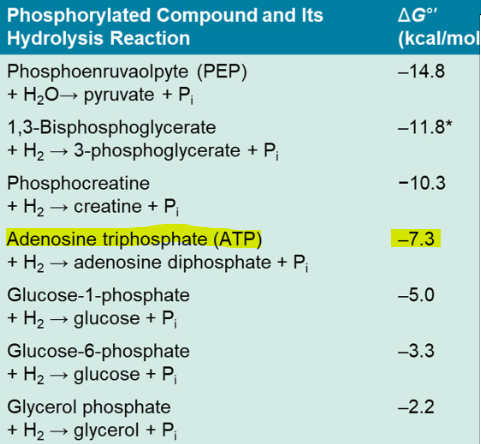
Transfer energies related to hydrolysis of donor and acceptor molecules indicates that ATP is not able to phosphorylate molecules above it on energy scale.
ΔG transfer = Δdonor - Δacceptor
REDOX Review
Oxidation = loss of electrons (often loss of H)
Reduction = gain of electrons (often gain of H)
NAD⁺ / NADH (nicotinamide adenine dinucleotide) acts as an electron transporter
NAD⁺ = oxidized (electron acceptor)
NAD⁺ gets reduced during glycolysis
NADH = reduced (electron carrier)
Glycolysis Overview
Break down of Glucose into Pyruvate
This universal Anaerobic Process Occurs in the Cytoplasm
Glucose + 2 NAD+ + 2 ADP + 2 Pi → 2 Pyruvate + 2 NADPH + 2 ATP + 2H+
Goal: To convert Glucose into 2 molecules of Pyruvate, while yielding NADPH and ATP along the way
This process has a Standard Free Gibbs of -686 kcal/mol indicating high energy use.
Phases and Reactions
Phase 1: “Investment Phase"
Phosphorylation of glucose w/ the investment of 2 ATP. (Ends w/ 2 G3P)
Hexokinase***
Glucose → Glucose-6-phosphate (G6P)
uses ATP → ADP + Pi
Irreversible
Phosphoglucose Isomerase
Glucose-6-phosphate (G6P) → Fructose-6-phosphate (F6P)
Phosphofructokinase-1 (PFK-1)***
Fructose-6-phosphate (F6P) → Fructose-1,6-bisphosphate
uses ATP → ADP + Pi
Irreversible & major regulatory step
Aldolase
This splits (cleavage) into Dihydroxyacetone phosphate (DHAP) + Glyceraldehyde-3-phosphate (G3P)
Triose phosphate isomerase
Dihydroxyacetone phosphate (DHAP) is converted making 2x Glyceraldehyde-3-phosphate (G3P) total
Phase 2: “Energy Payback”
“Pays back” the 2 ATP used and also produces 2 NADPH’s by reducing 2 NAD+
GAP dehydrogenase (GAPDH)*
Oxidizes 2x G3P → 2x 1,3-bisphosphoglycerates
Uses 2 NAD+→ 2 NADPH
Uses 2 Pi
Phosphoglycerate kinase*
2x 1,3-bisphosphoglycerates → 2x 3-Phosphoglycerates
Produces 2 ATP from 1,3-bisphosphoglycerate (Pi)
Completing substrate-level phosphorylation
Phase 3: “Energy Payoff”
Phosphoglyceromatase
2x 3-Phosphoglycerates → 2x 2-Phosphoglycerates
Enolase
2x 2-Phosphoglycerates → 2x Phosphoenol-pyruvate (PEP) + 2 H2O
Pyruvate kinase***
2x Phosphoenol-pyruvate (PEP) → 2x Pyruvate
Uses 2 ADP + 2 H+→ 2 ATP
Irreversible
Substrate-level phosphorylation
Summary: Glycolysis provides 2 ATP, 2 NADH, and 2 pyruvate from one glucose molecule with critical irreversible steps identified. ΔG°′ ≈ –20 kcal/mol
ATP Production in Glycolysis is ONLY made by substrate-level phosphorylation, no ETC.
Storage of Glucose (Polysaccharide Form)
Glucose enters the process of Glycolysis as a monosaccheride, but is stored in the cell as polysaccharides.
Ex. Starch in Plants; Glycogen in Animals (in Liver or Skeletal Muscle)
Polysaccheride Importance:
Storing glucose as monosaccharides → Increases solute concentration, causing osmotic imbalance and influx of water into cells.
Polysaccharides are insoluble in water, preventing osmotic overload. This forms Glycogen in animal liver and muscle cells
Glycogen
Primarily stored in Liver (hepatocytes) and Skeletal Muscle.
Glycogen in the liver is used to supply glucose to the rest of the body.
Glycogenolysis: In case of starvation or need for glucose, this process breaks down glycogen into glucose monomers.
Enzyme involved: Glycogen phosphorylase
Function: This enzyme uses a phosphate group to break the bonds, producing glucose 1-phosphate (G1P) through a reaction called phosphorylysis
The G1P can then be converted to G6P
Conversion to G6P
Enzyme used: Phosphoglucomutase
Function: Transfers phosphate from carbon 1 to carbon 6, forming glucose 6-phosphate, which can enter glycolysis.
Gluconeogenesis: Synthesis of Glucose in the Body
Occurs mainly in Liver/Kidneys
Made from 3-carbon or 4-carbon molecule precursors (Ex. Pyruvate)
Gluconeogenesis cannot simply reverse glycolysis due to three irreversible steps.
Bypass Reactions:
To convert pyruvate back to PEP → it goes through oxaloacetate using: Pyruvate carboxylase and PEP carboxykinase (PEPK).
To bypass PFK-1 → fructose-1,6-bisphosphatase is used.
To bypass hexokinase → glucose-6-phosphatase is used
Cori Cycle - (muscle ↔ liver during exercise)
Process:
Skeletal muscle converts glucose → pyruvate (glycolysis)
The pyruvate precursor is then converted into Lactate in anaerobic conditions (lactic acid fermentation)
Lactate is released into the bloodstream, taken up by hepatocytes, and converted back toq pyruvate.
The pyruvate can then be converted into glucose through gluconeogenesis.
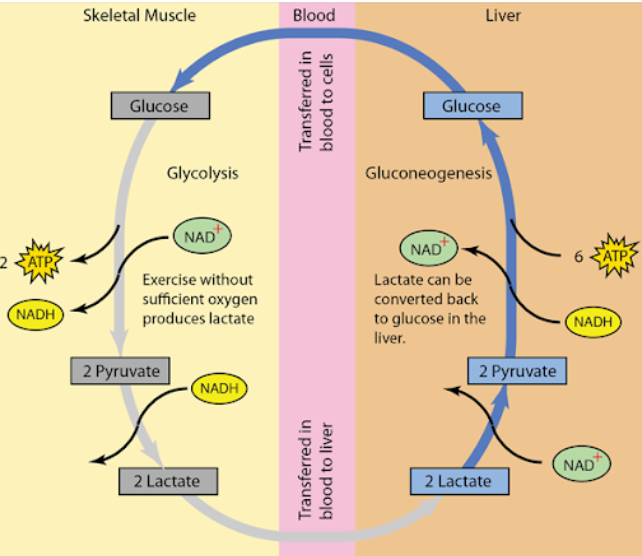
Gluconeogensis is NOT just “Glycolysis in Reverse”. Glycolysis has 3 irreversible enzyme reactions that must be bypassed in Gluconeogensis in order to convert pyruvate → glucose.
Step 1 - Hexokinase: Glucose → G6P.
Step 3 - Phosphofructokinase-1 (PFK-1): Fructose 6-phosphate → Fructose 1,6-bisphosphate.
Step 10 - Pyruvate kinase: Phosphoenolpyruvate → Pyruvate.
Steps to Synthesize Glucose from Pyruvate (Gluconeogensis)
Bypassing pyruvate kinase (pyruvate → PEP) 1st
Pyruvate → Oxaloacetate
Enzyme Pyruvate Carboxylase, Adds 2 CO2 to pyruvate forming oxaloacetate using 2 ATP energy
Oxaloacetate → phosphoenolpyruvate (PEP)
Enzyme Phosphoenolpyruvate Carboxykinase (PEPCK): Converts oxaloacetate to 2 phosphoenolpyruvate using 2 GTP (Guanosine Triphosphate). Removing 2 CO2 and adding phosphate
CO2 is added to form 3C PEP
2 Pyruvate = 1 Glucose (2 ATP, 2 GTP, 2 CO2)
Bypassing PFK-1 (Fructose-1,6-Bisphosphate → Fructose-6-phosphate) 7th
Using enzyme Fructose 1,6 Bisphosphatase
Uses 1 ATP
Bypassing Hexokinase (G6P → Glucose) 10th
Using enzyme Glucose-6-phosphatase
Uses 1 ATP
Energy cost of gluconeogenesis (G > 0)
Total energy cost:
Uses 4 ATP + 2 GTP = 6 ATP equivalents
Glycolysis and Gluconeogenesis cannot occur simultaneously in order to avoid counterproductive energy usage. Enzymes Phosphofructokinase-1 (PFK-1) and Fructose 1,6-bisphosphatase are subject to regulation based on cellular energy needs.
There’s a lot of Allosteric Regulation in enzymes: Conditions that inhibit one and stimulates the other.
PFK-1 has:
an active site for ATP & an allosteric regulatory site for ATP
Low ATP: ATP binds active site → reaction proceeds (Stimulates PFK-1 but inhibits Fructose-1,6-Bisphosphatase)
High ATP: ATP binds allosteric site → enzyme changes shape → enzyme is inhibited (while this stimulates F1,6Bisp.)
High AMP (Adenosine mono-phosphate) indicates low energy, stimulating glycolysis to generate ATP, stimulating PFK-1.
Key regulator of both pathways: Fructose 2,6-bisphosphate:
Stimulates PFK-1, promoting glycolysis and Inhibits Fructose 1,6-bisphosphatase, inhibiting gluconeogenesis.
This regulatory enzyme is formed by phosphorylation of Fructose 6-phosphate by Phosphofructokinase-2 (PFK-2).
Formed from: fructose-6-phosphate, Phosphate added to → carbon 2
The making of F-2,6-bisp is catalyzed by Phosphofructokinase-2 (PFK-2)
PFK-2
Dual Activity Enzyme: Catalyzes the conversion of Fructose 6-phosphate to Fructose 2,6-bisphosphate and vice versa.
In it’s Unphosphorylated State: (causes kinase activity) Activates glycolysis by forming fructose 2,6-bisphosphate.
Phosphorylated State: (causes phosphatase activity) Promotes gluconeogenesis by converting fructose 2,6-bisphosphate back to fructose 6-phosphate, removing phosphate group.
**Regulation Mechanism:
Reponses to hormonal signals like epinephrine can shift the balance between glycolysis and gluconeogenesis through phosphorylation states of PFK-2, leading to increased glucose production in times of need (e.g., during stress responses).