Fingerprints
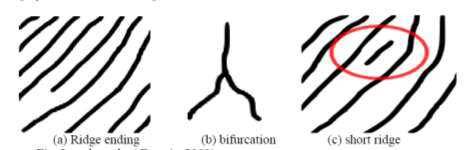
Fingerprints are the pattern of the epidermal ridges on fingers. They consist of friction ridge units that can be characterized by patterns (arrangement of ridges) and minutiae (small specific details such as bifurcations and ridge endings).
How do fingerprints arise?
Fingerprints develop during early fetal life. They undergo various phases, of which crucial events occur in the early weeks of the second trimester.
0–3 weeks
Fertilisation of egg initiates embryonal development
Gastrulation – an early single ball of cells reorganizes into three primary tissues
Ectoderm – forms the epidermis, including friction ridge skin
Mesoderm – forms connective tissue of the dermis
Endoderm – forms other major organ systems including the gastrointestinal tract, respiratory tract, urinary tract
4–8 weeks
Morphogenesis (shape)
Limbs rapidly develop from about 4 weeks: arms, legs, knees, elbows, fingers, and toes are seen at about 8 weeks.
At 7–8 weeks volar pads begin to form from mesoderm
9–16 weeks
Volar pads become less prominent and then disappear; friction ridge units develop
Volar skin is layered epidermis on top of shapeless fibrous dermis
The basal layer becomes more prominent and forms folds of the epidermis into the dermis (primary ridges)
Second trimester
Volar pad regression and friction ridge development continue; by week 16 permanent minutiae are set.
Sweat glands and epidermal-dermal ridge system continue to mature and enlarge.
By the end of the second trimester, sweat ducts and pores appear along epidermal ridges
Third trimester
The fetus continues to grow in weight
What are the theories of friction ridge development?
Two main theories aim to explain the processes underlying friction ridge formation.
Mechanical instability theory
The mechanical instability theory regards ridge formation as a consequence of a buckling process. Ridges form perpendicular to lines of greatest stress.
Differential growth of the cellular layers of the skin creates resistive boundary forces, causing a compressive effect.
The nervous system is also involved in this process.
Once the interaction of forces is great enough, a buckling instability occurs and further cell proliferation may increase the depth.
Neuro-ectoderm theory
The neuro-ectoderm theory describes an interdependent relationship between the neurological map and the pattern of primary ridges.
The ridges are established upon a grid of sensory nervous tissue. Mapping the volar pad precedes ridge formation.
Specialized cells such as Merkel, certain basal, and Meissner corpuscles are involved.
Results in primary and secondary ridge formation with anastomoses.
Clinical relevance of loss of fingerprints
Friction ridges can become thicker and shorter with aging and are more difficult to discern.
Loss of fingerprints is sometimes observed in various skin diseases. These include trauma, benign and malignant skin lesions, infections, and inflammatory skin conditions
Infections
Bacterial infections such as pyoderma
Pitted keratolysis
Leprosy
Scabies
Tinea manuum
Herpes simplex
Viral warts
Inflammatory diseases
Hand dermatitis including Exfoliative keratolysis and pompholyx
Psoriasis
Acanthosis nigricans
Systemic sclerosis
Raynaud phenomenon
Systemic lupus erythematosus
Epidermolysis bullosa
Lichen planus
Pyogenic granuloma
Erythema multiforme
Other
Drug eruptions
Dermatitis artefacta
Chemotherapy-induced hand-foot syndrome
These skin pathologies can cause disruptions to papillary lines, altering the depth and steepness of the ridges and valleys. This can affect analysis by modern-day biometric pattern recognition systems. This can interfere with the reliability of personal identification methods or "fingerprinting".
Most cases of damage to fingerprints are reversible, as the pathology
is relatively superficial. However permanent scarring can occur with deep lesions.