Definitions
Science: a highly logical, systematic, and organized approach to problem solving. this approach is referred to as the scientific method.
Chemistry: a science which studies substances, their properties, structures, compositions and transformations.
Types of Particles:
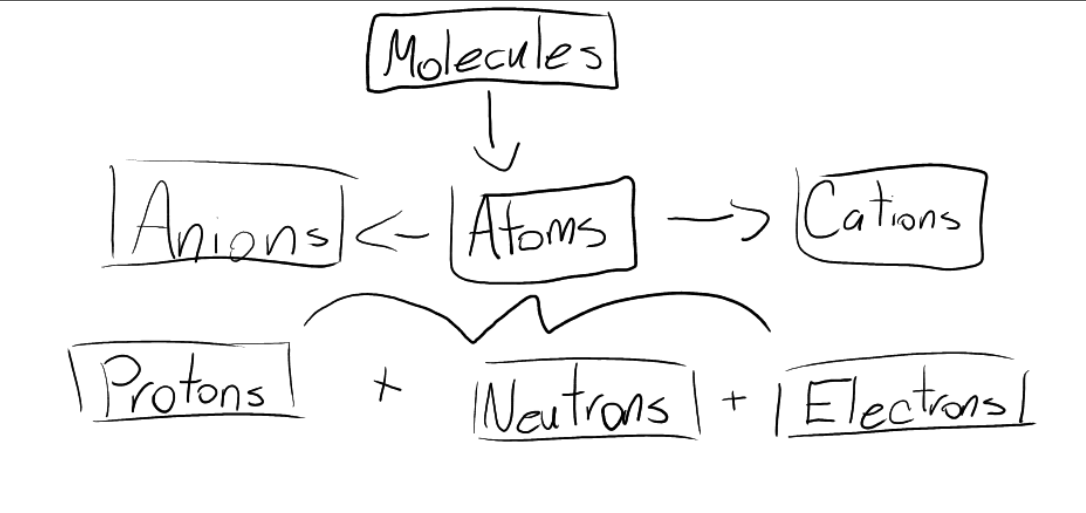
Protons: smaller than atoms and have a positive charge
Neutrons: smaller than atoms and have no charge
Electrons: smaller than atoms and have a negative charge
Atoms: neutral particles consisting of different proton, electron, and neutron combinations.
Cations: positively charged particles that are created when atoms lose electrons.
Anions: Negatively charged particles that are created when atoms gain electrons.
Molecules: Larger particles that are created when atoms join together
Matter: anything which has a mass and occupies space. There are 3 states of matter (solid, liquid and gas)
Pure Substances: a form of matter which is made up of only one kind of particle. ex: pure gold bar, glucose, salt
Elements: a pure substance which cannot be further broken down by ordinary chemical means. Elements are made up of identical particles called atoms. ex: hydrogen, gold, oxygen, silver.
Compounds: a pure substance which is made up