Structure of the Atom
Atomists and Democritus were from 400 BC, from Thrace in Greece, who believed atoms were indivisible parts which cannot be broken down further.
- The literal translation for Atom is “uncut table”.
Aristotle proposed that matter was continuous and was not made up of smaller particles.
insert table 4.1, page 103
| Democritus (460-370 BC) | - Matter is composed of atoms, which move through empty space- Atoms are solid, homogeneous, indestructible, and indivisible - Size, shape, movement of atoms determines the properties of matter |
|---|---|
| Aristotle (384-322 BC) | - Empty space cannot exist- Matter is made of earth, fire, wind, and water. 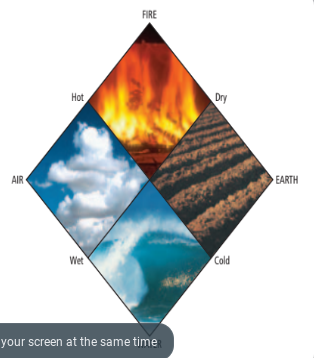 |
These ideas lasted until the 17th century.
- This was during the Renaissance, which was a scientific and artistic revolution
Fall of the Roman Empire; Dark ages; Medieval Period / Middle Ages (5th century-13th century)
- The Dark Ages in the western world are marked by the lack of change and the lack of knowledge about this time period.
In 1492, the Spanish “discovered” the Arabic numeral system (1, 2, 3, etc) and the concept of the zero (10, 20, etc) in Muslim libraries and monasteries.
Isaac Newton and Robert Boyle entered the scene
- ==Robert Boyle==: Proved gas pressure and volume were related mathematically
- ==John Dalton==: Logical hypothesis in the 1800s
- Also discovered the ^^law of multiple proportions^^, where the ratio of masses of one element that combine w/ the constant mass of another element can be expressed in small whole numbers.
- ==Antoine-Laurent Lavoisier==: Hottest wife of the time for any scientist, apparently.
- Also discovered elemental oxygen and the ^^law of the conservation of mass^^.
- ==Joseph Proust==: Specific substances always contain elements in the same ratio by mass
- ^^Law of definite proportions^^
The law of the conservation of mass and the law of definite proportions are the basis for ^^atomic theory^^, which stuck around to the 1940s.
- All matter is composed of atoms, which cannot be subdivided, created, or destroyed (Democritus’s idea)
- Atoms of a given element are identical in their physical and chemical properties
- Atoms of different elements differ in their physical and chemical properties
- Atoms of different elements combine in whole-number ratios to form compounds.
- Law of multiple proportions
- In chemical reactions, atoms are combined, separated, or rearranged but never created, destroyed, or changed
- Law of the conservation of mass
William Crooke: Used a cathode ray tube (an apparatus that helped discover the electron)
- Electrode: Metal piece in an cathode ray tube
- Anode: Positive electrode
- Cathode: Negative electrode
Cathode rays begin at the cathode and traveled toward the anode.
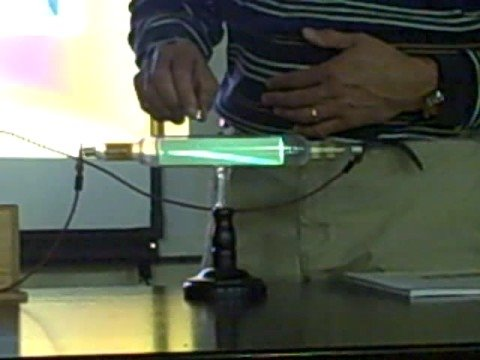
J.J Thomson: Researched with cathode rays and was credited with the discovery that cathode rays were actually electrons
- He was able to determine the ratio of an e⁻ charge to its mass.
Found rays traveling in the opposite direction of cathode rays (discovery of the proton, + charge).
- Mass of a proton is 1836 times that of an electron.
Robert Milikan: Used an oil drop experiment to obtain the first accurate measurements of an e⁻ charge
- Standard unit of negative charge (-1), symbol e⁻
Lord Rutherford predicted the existence of a third particle.
- Gold Foil Experiment: Subjected a sheet of gold foil to a stream of +charged particles & found out that most particles passed through, meaning atoms was mostly thin space.
- Closer the particle gets to the nucleus, the more its trajectory is changed -- but most just went straight though. With this, he determined there was a small “core” containing +charged particles and the mass (the nucleus)
- Occupies about the trillionth of the volume of an atom (10^-12)
- Closer the particle gets to the nucleus, the more its trajectory is changed -- but most just went straight though. With this, he determined there was a small “core” containing +charged particles and the mass (the nucleus)
Walter Bothe found evidence of the third particle.
James Chadwick found a high energy particle w/ no charge and the same mass of the proton -- the neutron.
- Changed John Dalton’s atomic theory
Atoms of the same element that differ in mass are called isotopes
EG:
| # Protons | # Neutrons | |
|---|---|---|
| Neon-20 | 10 | 10 |
| Neon-21 | 10 | 11 |
| Neon-22 | 10 | 12 |
Henry Moseley: Studied x-rays and found that the wavelength of the x-rays depend on the number of protons in the nucleus and is always the same for a given element
Atomic number (z) = number of protons
- This determines the identity of the atom / element
Nuclide: A particular kind of atom containing a definite number of protons and neutrons
Mass number - Z = Number of neutrons

There are three stable isotopes of hydrogen:
| # Protons | # Neutrons | Mass # | |
|---|---|---|---|
| Protium (¹H) | 1 | 0 | 1 |
| Deuterium (²H) | 1 | 1 | 2 |
| Tritium (³H) | 1 | 2 | 3 |
Under Rutherford’s direction of Bohr, Geiger, and Marsden, these scientists conducted experiments that are the basis for atomic structure.
Nuclear reactions are different from other reactions.
- Nuclear chemistry is concerned w/ the structure of the atomic nuclei and the changes they undergo
- Marie Curie and Pierre Curie.
Wilhelm Roentgen discovered X rays in 1895.
Henri Becquerel, Marie Curie, and Pierre Curie pioneered the fields of radioactivity and nuclear chemistry
- Becquerel discovered uranium salts which produced spontaneous radioactive emissions by seeing a uranium rock through a photo.
- These three shared the 1903 Noble Prize in Physics.
Radioisotopes emit radiation to try to reach their stable form, in a process known as radioactive decay.
- Nuclear reactions occur when nuclei combine, split, and emit radiation.
- Can involve protons, neutrons, and electrons
- Associated w/ large energy changes
- Atoms are converted into different elements
- They generally emit alpha, beta, and gamma rays.
Alpha particles have the same composition as a helium nucleus: two protons and two neutrons
- 2+ charge
Alpha radiation consists of a stream of particles with very little penetrating power (a sheet of paper will stop them)
Beta particles are very fast-moving electrons emitted when a neutron is converted to a proton (or vice versa)
- Insignificant mass
- 1- charge
Beta radiation is a stream of fast moving particles with greater penetrating power (foil will stop them).
Gamma rays are high-energy electromagnetic radiation
- No mass or charge
- Almost always accompanied by alpha and beta radiation
X-Rays are a form of high-energy radiation emitted by (x) in an excited state.
The ability for radiation to pass through matter is called its penetrating power.
- Gamma rays are highly penetrating because they have no charge and no mass.
Except for gamma radiation, radioactive decay involves transmutation: the conversion of an element into another element
- Protons and neutrons are referred to as nucleons
As atomic number increases, more and more neutrons are needed to produce a strong nuclear force that is sufficient to balance the electrostatic repulsion between protons
- Ratio gradually increases to 1:5:1
A series of nuclear reactions that begin w/ an unstable nucleus that creates a series of half-life decays to produce elements are known as radioactive decay chains.