9-Labour market development (1)
The Role of the Labor Market
Key Role: Integral in economic development, influencing human capital formation.
Major Dimensions of Labor Market Interaction:
The Role of Education
Technology and the Labor Market
Entrepreneurship
Aging
Locational Human Capital Mobility
The Role of Education
Incorporated into the Solow model as human capital:
Formula: Y = AK^α(hL)^(1-α)
Where: K = physical capital, L = labor, h = human capital
Per-worker output: y = Ak^αh^(1-α)
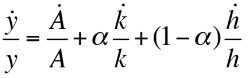
Growth accounting: Growth rate of income per worker depends on human capital per worker growth rate.
Average Growth Rate of GDP Per Capita (1960-2000)
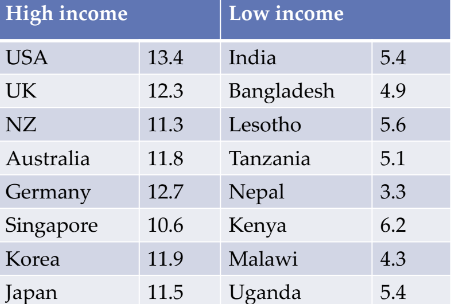
Years of Schooling (2010)
Does government-sponsored education necessarily boost economic growth?
The Education Explosion (1960-1990)
From 1960 to 1990, there was a remarkable government-led expansion of schooling in the world:
Primary Enrollment Increase:
1960: 28% of countries 100% enrollment; 1990: 50% of countries reached this.
Median increase: 80% in 1960 to 99% in 1990.
Secondary and University Enrollment Growth:
Secondary median increased from 13% to 45%.
University enrollment rose dramatically from 1% to 7.5% median.
Education and Incentives
How education is worth for economic growth depends on what the educated people are doing with their skills
In an economy with extensive government intervention, the activity with the highest returns to skills might be lobbying the government for favors. Such activity does not contribute to GDP
The state largely drove the education expansion by providing free public schooling and requiring mandatory schooling, while administrative targets for universal primary education do not in themselves create the incentives for investing in the future that matter for growth.
The quality of education will be different in an economy with incentives to invest in the future versus an economy where there are none.
Corruption, low salaries for teachers, and inadequate spending on textbooks, paper, and pencils are all problems that wreck incentives for quality education
Quality of Education: Global Examples
Case Studies:
Brazil: Poor infrastructure and lack of teachers. “state school is falling apart, there are whole weeks without a teacher, no director or efficient teachers, no safety, no hygiene.”
Malawi:
teachers sell publicly provided textbooks and supplies
school officers receive bribes from building construction and equipment purchases
both teachers and staff earn from secondary jobs
low school attendance without monitoring
Pakistan: politicians dispense teaching positions as patronage, leading to
large fractions of unqualified teachers with 75% failing to pass the exams taken by students
large-scale cheating at examinations supervised by those teachers
campus gangs, with high school students from rival religious fractions
fighting on campus using AK-47s (more guns than textbooks)
Taiwan: thorough education reform were undertaken in the 1950s and 1960s, with
1-12 public school teachers being required to pass nationally monitored qualification exams
1-12 public school teachers being provided with good salaries, superior fringes (health and pension) and job security
county-level standardized tests for students to take for entry to junior high and senior high, and university entrance exam
1-9 mandatory education
strong tech, agricultural and commercial schools that were tied to related businesses
publicly provided job advertisement and training
Measuring Quality of Schooling
Considerations include:
Teachers' human capital
Pupil-teacher ratios
Spending on educational resources
Health
Technology and the Labor Market
Discussion on the correlation between education and skill demand driven by technological advances.
College Premium Trends (1963-2008)
Analyzes college vs. high school wage gaps and the growing demand for skilled labor.
College premium significantly increased between 1963 and 2008, indicating rising returns on education.
College/non-college relative labor supply has increased
College premium was about 48% in 1963 and 97% in 2008, but has not always trended upward in the past decades
However, since early 1980’s, college premium increased substantially and nearly doubled up to 2008
Directed Technical Change
Skill-Biased Technological Change:
New technologies are complementary to skills (i.e., more productive when more skilled workers are hired), so new machines and new methods of production require more and more skilled workers (“skill biased”)
The increase in the relative demand for skilled workers due to skill-biased technology thereby increases wage inequality
Directed Technical Change:
The direction of technical change is endogenous
When there are more skilled workers, the market for skill-complementary technologies is larger. Higher profits provide incentives to inventors to devote more effort to the invention of skill-complementary technologies.
Two competing effects of an increase in the supply of skills on the skill premium:
• Substitution effect: reduces skill premium (short-run)
• Directed technology effect: induces faster upgrading of skill-complementary technologies (long-run)
Endogenous demand and supply of skills
As more skill-complementary technologies are adopted, the demand for skills increases, increasing relative wages of skilled workers.
This also encourages more workers to enroll in college and increases supply of skills further.
The positive feedbacks between supply of skills and directed technical change drive up wage inequality
Automation
What will be the impact of automation on the labor market?
productivity
demand for labor
wage and inequality
role of skills
capital accumulation
Entrepreneurship
Entrepreneurs' Economic Impact: Account for a significant share of total net worth despite a smaller population percentage.
Factors influencing agent’s choice:
Individual risk tolerance
Access to capital markets
Entrepreneurial ability vs labor skills
Barriers to entrepreneurship:
Preference bias toward “heroes” limited by true ability
Financial/liquidity constraints
Aging and Economic Implications
While most developed countries and many developing countries have completed demographic transition, their new demographic challenge is rapid aging as a result of technological change in health and medicine and rising income, among others
Challenges:
Lower labor force participation, healthcare costs, more welfare spending and less pension sustainability.
Proposed Policies:
Raising retirement ages, incentivizing increase in fertility, enhancing immigration, promoting healthy aging practices and improving pension management to secure decent return.
Rural-Urban Migration
Along the global trend of economic development, it is often observed rapid industrial transformation accompanied by continual rural-urban migration
In many developing countries there are yet abundant supplies of surplus labor from rural areas
Urbanization trend
Key Features:
Abundant rural surplus labor
Large urban-rural unskilled wage gap
Low growth in real unskilled wage
Gradual upgrade of some unskilled migrants to skilled
Policies raising rural-urban migration barriers:
Trade protection
China: household registration system
India: caste system
Policies reducing such barriers:
Trade liberalisation (labor-intensive export sector, rise of emerging economies accompanied bu rural-urban migration and trade liberalisation)
Taiwan: public training programs and job search assistance
UK: public provided/subsidised urban housing