AP Macroeconomics Unit 5: Long–Run Consequences of Stabilization
5.1 - Fiscal and Monetary Policy Actions in the Short Run
Putting Fiscal and Monetary Policy Together
Economic policies don’t exist in a vacuum
Policymakers need to work together to achieve economic goals
5.2 - The Phillips Curve
The Phillips Curve
Shows the trade off between inflation and unemployment
An inverse relationship between unemployment and inflation
A change in aggregate demand corresponds to a movement along the short-run Phillips Curve
A change in aggregate supply corresponds to a shift in the short-run Phillips Curve
Label equilibrium on the axis, not at the actual point of intersection
Tip: draw the AD AS curves first, then draw the Phillips Curve
Changing the natural rate of unemployment shifts Long-run Phillips Curve (LRPC)
5.3 - Money Growth and Inflation
Quantity Theory of Money
M X V = P X Y
M = Money Supply
V = Velocity
P = Price Level
Y = Quantity of output
Notice that P x Y = Nominal GDP
When velocity of money (V) is fixed and real output (Y) is limited to full employment -> Increase in money supply (M) causes increase in Price Level
Short- run spending leads to higher resources prices and inflation
If inflation is bad enough, banks won’t lend and the economy tanks
Numerous economists support expansionary policy due to the increase of output in short-run
Long run will raise everything
James “Downtown” Green
5.4 - Government Deficits and the National Debt
All Policies have Tradeoffs
Deficit Spending
Budget Deficit - annual government spending and transfer payments are greater than tax revenue
Budget Surplus - annual government spending and transfer payments are less than tax revenue
The National Debt - the accumulation of all the budget deficits over time
Entitlements - federal program that requires payments to any eligible person or unit of government. This mandatory spending must be paid (Social Security)
5.5 - Crowding Out
Crowding out - Government deficit spending and borrowing to pay off deficit spending, leads to higher real interest rates and less investment spending
Adverse effect of government borrowing on interest-sensitive private sector spending
Crowds out private investment and consumption
5.6 - Economic Growth
Measuring Economic Growth
What do economists use to measure economic growth and standard of living?
NOT Nominal GDP
Doesn't account for inflation
NOT Real GDP
Doesn't account for population
Real GDP per Capita is used
The Real GDP divided by the population
Why Do Some Countries Have More Growth?
Economic System
Capitalism promotes innovation and provides incentives to improve productivity
Rule of Law
Countries with solid institutions and political stability have historically had more economic growth
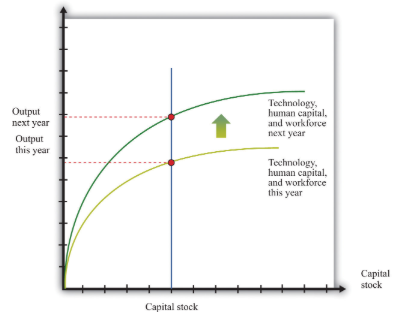
Capital Stock
Countries that have more machines and tools are more productive
Human Capital
Countries that have better education and training are more productive
Natural Resources
In general, countries that have access to more natural resources are more productive
Productivity
Output per Unit
Aggregate Production Function Graph
Will likely not be asked to draw on the AP Macro Exam
5.7 - Public Policy and Economic Growth
What government policies most likely result in long-run economic growth?
Education/Training Spending
Increases human capital
Infrastructure Spending
Public works like roads, bridges, and harbors
Increases physical capital
Production/Investment Incentive Programs
E.g. Investment Tax Credits
Increases physical capital
“Supply-Side Policies”
Supply-Side Fiscal Policy
Federal government policies designed to increase production by reducing business taxes and/or regulations
Why Is This Controversial?
Providing tax breaks to businesses might disproportionately benefit the wealthy
It assumes corporations will spend their tax cuts on investment rather than payout shareholders through stock