Operant/Classical Conditioning Quiz Notes
CLASSICAL CONDITIONING
Behavioralist perspective —> Behaviors are learned (nurture), not innate (fixed). All actions and personality traits are a result of environment/culture.
Learning —> Relatively permanent change in knowledge/behavior that results from experience.
Habituation —> Tendency to become familiar with a stimulus merely as a result of repeated exposure (clock ticking, humm) — sound *SENSORY ADAPTATION*
response decreases after too much repeated exposure
Classical conditioning —> learned behavior that occurs as an automatic response (behavior) to a neutral stimulus one stimulus predicts another stimulus
Associative learning —> learning that certain events occur together
associative is learning ________ predicts ________
a behavior and its consequences
Neutral stimulus —> stimulus which initially produces no specific response other than attention (paying attention to it = response)
UNCONDITIONED STIMULUS —> external factor (stimulus) that naturally triggers a response w/o prior learning - ex. dust→sneeze
UNCONDITIONED RESPONSE —> automatic, involuntary and unlearned reaction to a stimulus (present from birth) - ex. dust→sneeze
CONDITIONED STIMULUS —> previously neutral stimulus that, through repeated association w/ unconditioned stimulus triggers conditioned response
CONDITIONED RESPONSE —> learned behavior when a previously neutral stimulus produces response
Acquisition —> first stages of learning when a response is established - ex. you would acquire a fear of planes after being in a plane crash (connecting neutral stimulus to unconditioned response)
Extinction —> decrease or disappearance of a conditioned response (increased plane trips→ lessened fear of planes)
Spontaneous recovery —> reappearance of a conditioned response after rest period or a period of lessened response
Long-term potentiation and plasticity keeps memory traces
Stimulus generalization —> elicitation of a conditioned response by stimulation similar but not identical to original stimulus - ex. associating any ring with the sound of a bell, response follows
Schema assimilation, interpret with any schema
Stimulus discrimination —> ability to distinguish between like stimuli and respond to specific stimuli only - ex. Pavlov’s dogs distinguishing between different bell sounds
Schema accommodation, change schema
Higher-order conditioning —> conditioned stimulus used as unconditioned stimulus - ex. Pavlov’s dog was trained to salivate at the sound of a bell (through introducing food), now a light is introduced before the bell (OG conditioned stimulus) to train the dog to salivate at the light
Counterconditioning —> change a response (behavior) to a given stimulus, used on Little Albert to revert his fear of animals back to neutral
Taste-aversion —> one-trial conditioning
Sick even after thinking about certain foods, etc. (lasts forever)
One-trial conditioning = repeated pairings not necessary
Biological preparedness —> species are prepared, by nature, to learn some cond. stim. - uncon. stim. associations easier than others: “Garcia Taste Aversion Studies with Rats”
noises = fear
taste = nausea
Habituation —> diminished effectiveness of a stimulus in eliciting a response following repeated exposure - ex. losing reaction to gunshots in a shooting range after an hour
OPERANT CONDITIONING
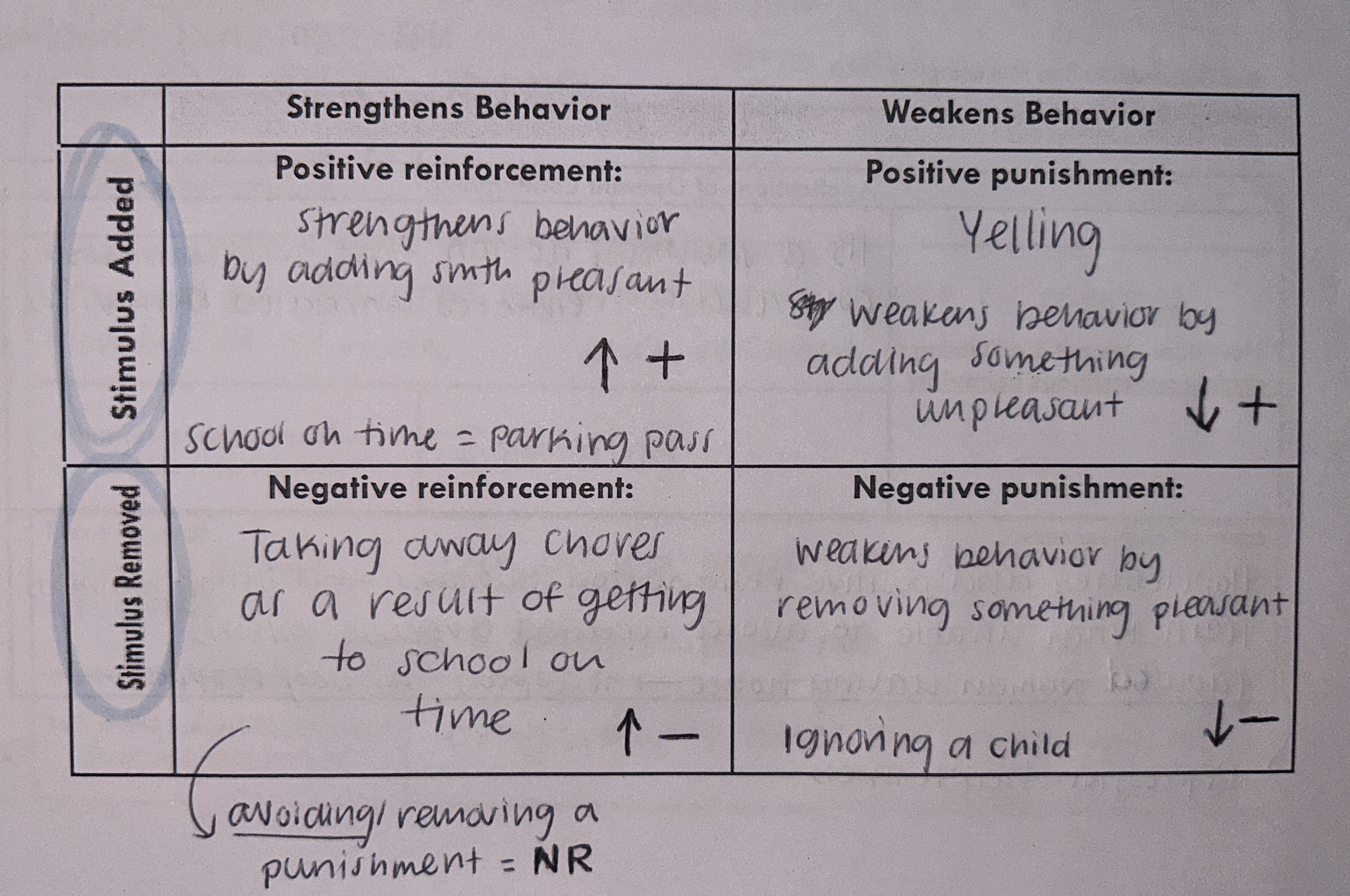
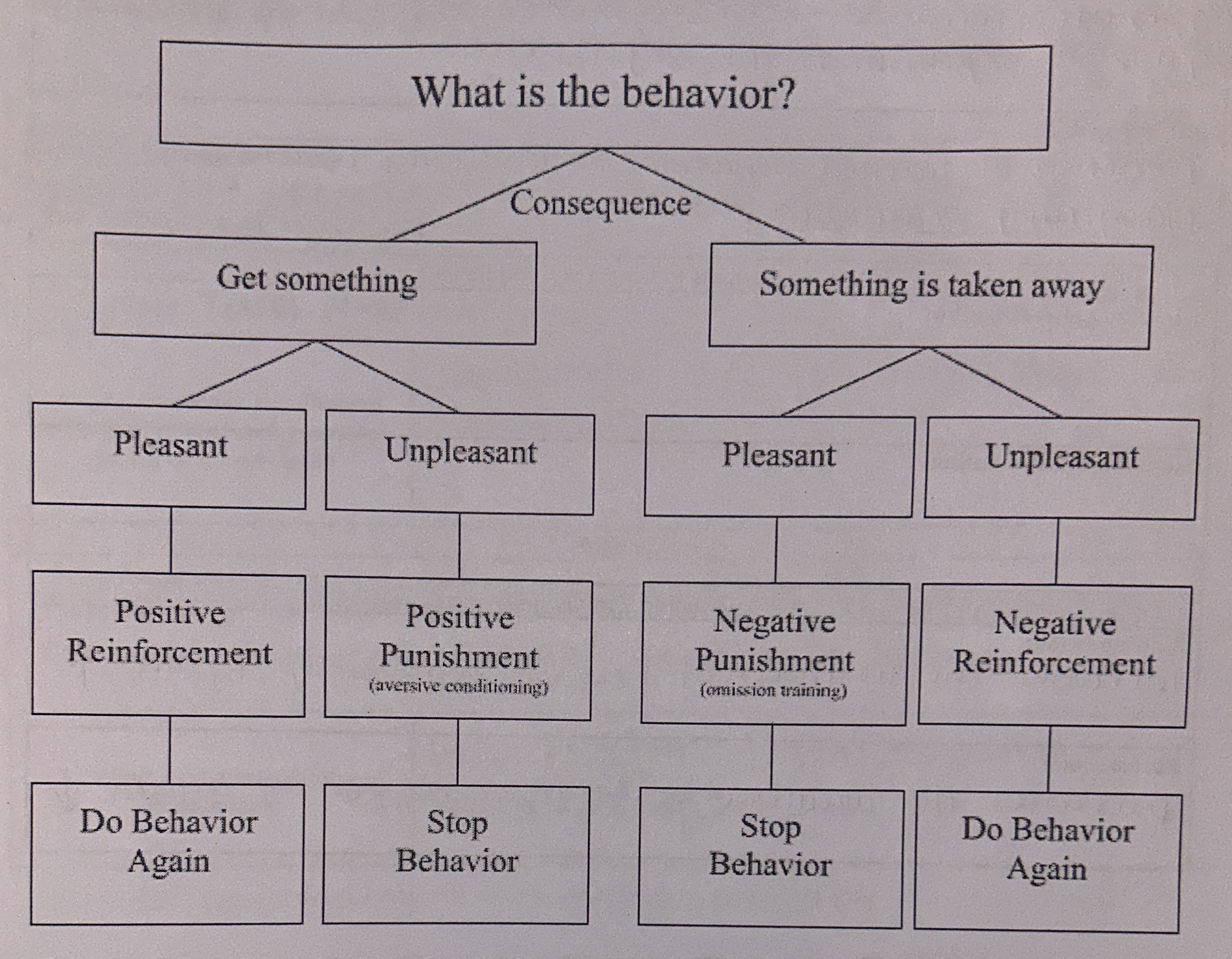
Operant conditioning —> voluntary process by which learning as a function of the consequence of the behavior, behavior→consequence
Reinforcement → any event that STRENGTHENS the behavior it follows
Punishment → any event that tends to DECREASE the behavior it follows
Aspects of reinforcers:
Primary → fulfills basic drive - ex. food, sleep, shelter, sex
Secondary → everything else - ex. money, cars, jewelry, concert tickets
Law of effect —> behaviors followed by desirable outcomes will be repeated and behaviors followed by undesirable outcomes will be extinguished
Commonalities with Classical Conditioning:
acquire behaviors (brushing your teeth)=acquisition
behaviors lost (saying “like” all the time)=extinction
generalization & discrimination
Shaping —> operant procedure - reinforcements are used to gradually guide an organism to the target behavior
Instinctive drift —> tendency of learned behavior to gradually revert to biologically predisposed patterns (conditioned responses can be disrupted by an animal's innate behaviors over time)
REINFORCEMENT increases the likelihood of behavior happening again
PUNISHMENT decreases the likelihood of behavior happening again
Learned helplessness —> hopelessness and positive resignation humans other animlas learn when unable to avoid repeated aversive events - ex. depression or addiction
People stop trying to change their circumstances, even when they have the ability to do so