Scientific Methods
Definition (#f7aeae)
Important (#edcae9)
Extra (#fffe9d)
Scientific Methods:
Scientific Method: Way to gain knowledge about behavior and mental processes.
Importance of Studying Methods:
Evaluating research.
Establishing validity of research (Good vs bad).
Justified vs unjustified conclusions.
Performing research.
Obtaining useful skills.
Awareness of experimenter bias issues and the importance of Operational Definitions.
Thinking about research (Connections between theory and data).
Scientific Methods:
Scientific approach [vs intuition and authority].
Avoid illusory correlation.
Authority vs scepticism.
Empirical approach (observation), set of assumptions, rules and procedures used to conduct research.
Theory → Data → Analysis → Theory
Procedures must be objective.
Findings should be replicable.
Pseudoscience:
Non-testable hypothesis.
The data, methodology and conclusions are suspected.
Supportive evidence relies heavily on authority/ is anecdotal.
Claims ignore evidence and are not revised.
Claims are vague, rationalize strongly held pre-existing beliefs.
Research:
Develop theories → Conduct research → Answer questions
4 goals:
Describe Behavior:
Describe events after observing.
Define, classify and categorize events.
Ex: Cunningham et al researched about attractiveness in 1976 and again in 1993. Results showed the judgement of attractiveness didn’t change.
Predict Behavior:
Predict behavior after 2 events connect/correlate.
Correlations allowing to predict mental processes and behavior.
Ex: Predicting career goals based on career assessments.
Determine Cause:
Find the cause to understand and explain a phenomena.
To find causation, 3 events must happen:
Temporal precedence: Cause precedes the effect.
Covariation of the cause and effect: No cause and effect.
Absence of alternative explanations: No other explanation.
Explain/Control Behavior:
Is it possible to recreate the behavior.
Apply knowledge to improve lives.
Ex: If Violent video games causes aggression, is it due to imitation of the behaviours or desensitization.
Basic vs Applied Research:
Basic Research: Study aimed at expanding the existing base of scientific knowledge. Goal is to add knowledge to an existing one, concerned with developing scientific knowledge and predictions..
Applied Research: Research designed to solve specific practical problems or questions. Goal is to find a solution for the problem, concerned with the development of technology and technique.
Process:
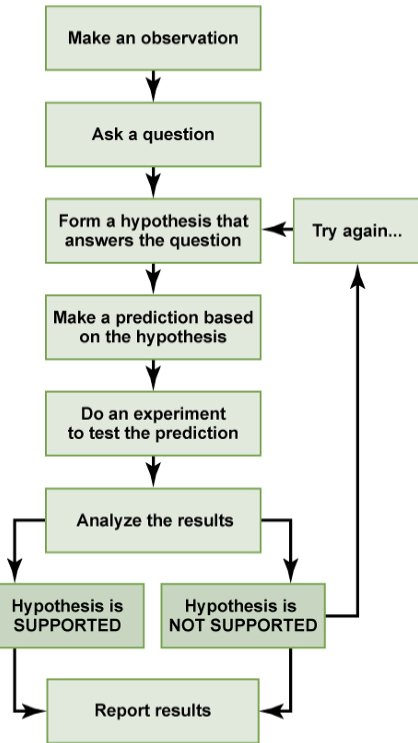
Hypothesis:
A prediction, more specific than stating a general research problem.
Can consists of multiple variables.
Formulated based on past research and theories.
Scientific Methods vs Everyday Knowledge:
General Approach:
Non-Scientific: Intuitive.
Scientific: Empirical judgement based on direct observation and experimentation.
Observation:
Non-Scientific: Casual, uncontrolled personal biases and other factors influence observation.
Scientific: Systematic, controlled.
Control: Investigate factors 1 at a time, 2 types of variables:
Independent Variable: Factor which is manipulated to determine its effect on behavior. 2 levels: Experimental and Control group.
Dependent Variable: Measure of behavior used to assess the effect of the IV.
Reporting:
Non-Scientific: Biased, subjective personal impressions.
Scientific: Unbiased, objective, separate from inferences.
Concepts:
Non-Scientific: Ambiguous, vague.
Scientific: Clear, specific. Construct = concept
Constructs: Plethora of psychological concepts. Depression, stress
Operational Definition: Specific measure of a construct.
Advantages: Defines constructs specifically, allows clear communication.
Disadvantages: Potentially limitless number of operational definitions for any construct, some operational definitions may be meaningless.
Instruments:
Non-Scientific: Inaccurate, imprecise.
Scientific: Accuracy, precision.
Measurements:
Physical Measurements: Dimensions have standards and instruments. Ex: length, weight.
Psychological measurements: Constructs have no agreed standard nor instrument. Ex: beauty, intelligence.
Valid and Reliable: Validity refers to truthfulness. Reliability refers to consistency
Hypothesis:
Attitude:
Non-Scientific: Uncritical, ignores contradictory evidence.
Scientific: Critical, skeptical behavior and mental processes.