economics price mechanism and surplus
explain how price mechanism allocates resources in market economy. (9)
Price mechanism is a process where supply and demand determine the price of goods and services in a market economy and consists of three functions being signalling, insentive and rationing.
Price acts as a signal for consumers and producers, when demand increases, prices rise, signalling firms to to increase production in order to meet this higher demand. As well as this, when demand falls, prices go down which signals firms to reduce their output. similarly, if supply decreases due to external factors such as natural disasters, prices rise which indicates scarcity. The signalling function within price mechanism is when prices at as a signal to consumers and producers about the scarcity of a product or service.
the incentive function is when prices provide incentives for economic agents to change their behaviour. higher prices create profit incentives for firms to increase production in order to potentially gain more revenue. For consumers, rising prices may discourage consumption whilst low prices increase demand for them. This function make sure that the resources are directed towards the goods and services that are most valued by society.
Since resources are scarce, prices help to ration goods to those who are willing and able to pay. if demand was to outweigh supply, prices would rise which would reduce demand and ensure that goods are going to those you value them the most. for example, in a drought, the price of water may increase, which would discourage consumers using excessive water and would ensure efficient allocation. in the labour market, if demand for skilled workers in technology fields was to increase, this would cause wages to rise, signalling for more people to train in the technology field. if demand where then to fall in that sector, wages would drop which would signal workers to find a different field of work.
How changes in market equilibrium affect consumer and producer surplus (9)
Consumer surplus is the difference between what consumers are willing to pay and what they actually pay for a good or service, so it shows the benefit consumers gain from paying less than what they were willing to. Producer surplus is the difference between the price producers receive for a good or service compared to the lowest price they were willing to sell it for. Therefore it shows the benefit producers gain from charging a higher price then the cost for producing.
Market equilibrium occurs when demand equals supply which determines the equilibrium price and quantity. a shift in either demand or supply leads to a new equilibrium which affects both consumer and producer surplus.
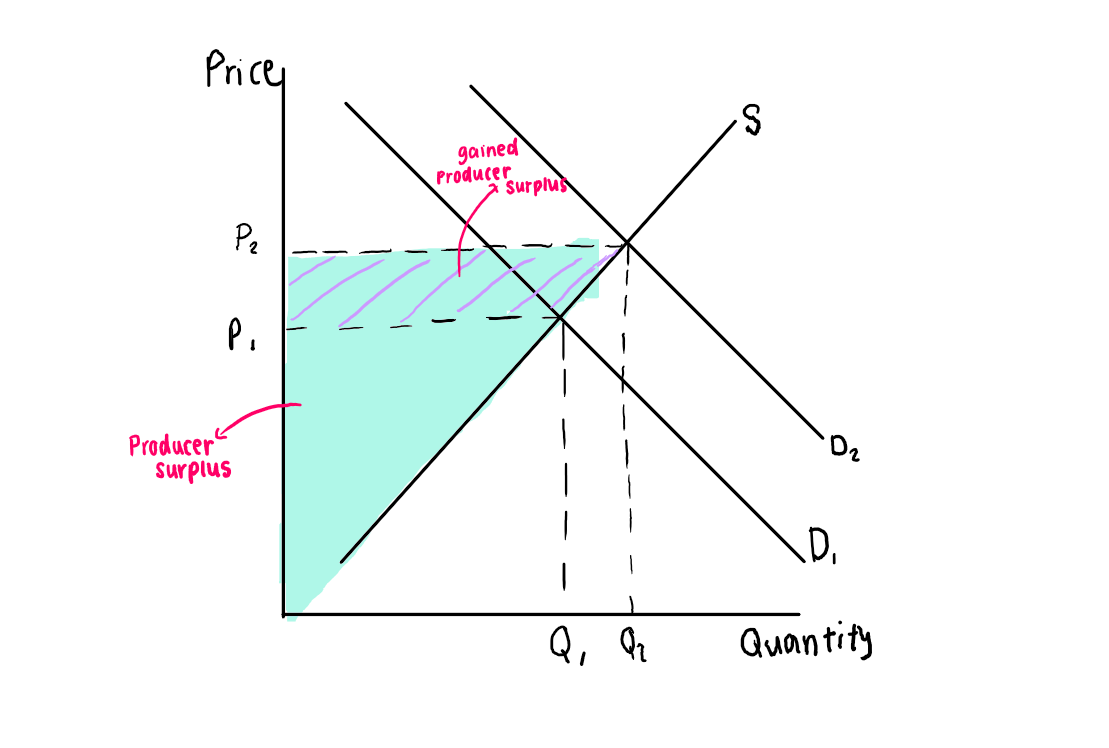
An increase in demand, increases both price and quantity, these higher prices reduce the consumer surplus however increases producer surplus as they charge higher than they are willing to. However a leftward shift in demand lowers price and quantity which reduces producer surplus but increases consumer surplus. on the other hand, when supply increases, the price is reduced but quantity is increased, this increases consumer surplus due to lower prices. however a decrease in supply would raise prices and lower quantity, reducing consumer surplus but increases producer surplus.
In the phone market, developments in technology have reduced production costs which has shifted supply to the right, leading to lower prices, increasing the consumer surplus as phones become more affordable. however some firms may have a decreased producer surplus if the price reductions outweigh cost savings.