Imperialism
What is Imperialism?
- @@Imperialism is the state's pursuit of expanding its power and dominance, particularly by outright territorial conquest or by seizing control of other nations' governments and economies.@@
Imperialism has frequently been viewed as ethically repugnant since it always entails the use of power, whether military, economic, or in some other subtle way.
Is Imperialism common nowadays?
- @@The term "imperialism" is now frequently employed in international propaganda to criticize and undermine the foreign policy of a rival.@@ International organizations, such as the United Nations, make an effort to preserve peace through actions like collective security agreements and assistance to poor nations. Critics assert that imperialism still exists today. For instance, many people in the Middle East believed that the U.S.-led invasion of Iraq was a fresh kind of anti Arab and anti-Islamic imperialism.
Did Imperialism cause World War I?
@@In an era known as "the New Imperialism," European countries tried to increase their economic and political influence abroad, particularly in Africa, when the Suez Canal opened in 1869.@@ A new global order was about to emerge, elites in Europe and the general educated classes thought as a result of this rivalry.
Key Individuals: ^^Napoleon I, Charlemagne, Alexander the Great, Frederick II, Augustus.^^
Causes of Imperialism:
- %%The Industrial Revolution caused a need for resources to fuel industrial production in Europe and the United States.%%
## Where would these resources come from?
- Africa, Asia, and Latin America.
### Summary on Causes of Imperialism:
%%1)%% Economic competition between European nations; new markets to sell their goods.
%%2)%% The need of European nations to add colonies to their empires as a measure of national greatness.
%%3)%% Growing racism, or the belief that one race was superior to another.
%%4)%% Because they were more technologically advanced, many Europeans and Americans felt they had the right to dominate the peoples of Asia, Africa and Latin America.
%%5)%% Social Darwinism: the idea that those who were fittest for survival and success were superior to others.
%%6)%% Because of Social Darwinism, Europeans felt they had the right and duty to bring progress to other nations.
%%7)%% Need to Christianize the people of Asia and Africa.
%%8)%% Need to civilize and “westernize” others.
What Enabled Imperialism?
- Europeans’ technological superiority ==(including the machine gun).==
- ==Improvements in transportation== to and within Asian and African colonies.
- Medical advances, such as Quinine, which protected Europeans from ==foreign diseases (malaria).==
- ==Disunity among ethnic groups in Africa.==
Impact of Imperialism in Africa:
^^(POSITIVES)^^
^^1)^^ Local warfare reduced.
^^2)^^ Improved sanitation.
^^3)^^ Hospitals led to increased lifespan.
^^4)^^ Schools led to increased literacy.
^^5)^^ Economic growth.
%%(NEGATIVES)%%
%%1)%%Loss of land and independence.
%%2)%% Men forced to work in European owned mines and on European owned farms.
%%3)%% Contempt for traditional culture and admiration of European culture = identity problems.
%%4)%% Dividing up of Africa = artificial boundaries divided kinship groups and united rivals.
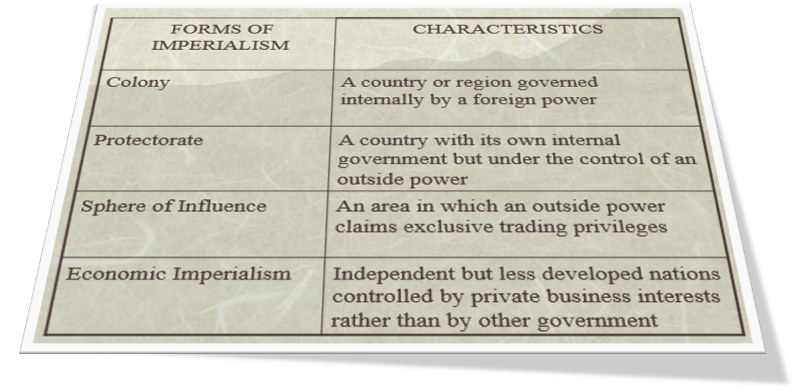
==Forms of Imperialism:==