SETS
SET
- A well-defined collection of distinct objects and is denoted by an uppercase letter.
Element or Member
- an object that belongs to a set
- usually denoted by lower case letter
- the symbol denotes a ^^membership^^ while ^^“∉”^^ denotes ^^non- membership^^ to a set.
WAYS OF DESCRIBING A SET
- [ ] ^^Roster or Tabular method^^ - elements in the given set are listed or enumerated, separated by a
comma, inside a pair of braces. - [ ] ^^Rule or Descriptive method^^ - method in which the common characteristics of the elements are defined. This method uses set builder notation where
x is used to represent any elementof the given set.
Example:
The distinct letters in the word “mathematics”
Let A be the set of distinct letters of the word “mathematics”
Roster form: A = {m, a, t, h, e, i, c, s} Rule form:
A = { 𝑥|x is the distinct letter of the word “mathematics”}
```
### **KINDS OF SET**
1. **Empty/Null/Void Set** - set that has no elements, denoted by **^^Ø or { }^^** with no element inside.
2. **Finite Set** - a set with countable number of elements.
3. Inf**inite Set** - a set with uncountable number of elements.
4. **Universal Set** - the totality of all the elements of the sets under consideration, denoted by **^^U^^**.
### **RELATIONSHIPS OF SETS**
1. **Equal Sets** - sets with same elements
2. **Equivalent Sets** - sets with same number of elements
3. **Joint Sets** - sets with at least one common element
4. **Disjoint Sets** - sets that have no common element.
### **SUBSET**
* Set wherein every element of which can be found on the second set.
* symbol **** =**** while **^^⊄^^** = ^^“not a subset of”^^
Example: I = {x|x is a positive factor of 4}
J = {x|x is a positive factor of 12}
```
POWER SET
- set containing ^^all the subsets^^ of the given set with n number of elements
- with 2^𝑛 number of elements, where
n is the number of elements
- set itself and a null set -denoted by a symbol ^^⊆^^
- other than set itself and a null set
- denoted by a symbol ^^⊂^^
OPERATIONS ON SETS
- UNION of sets – set whose elements are found in A or B or in both ^^(A U B), (or)^^
- INTERSECTION of sets – set whose elements are common to both sets ^^(A ∩ B), (and)^^
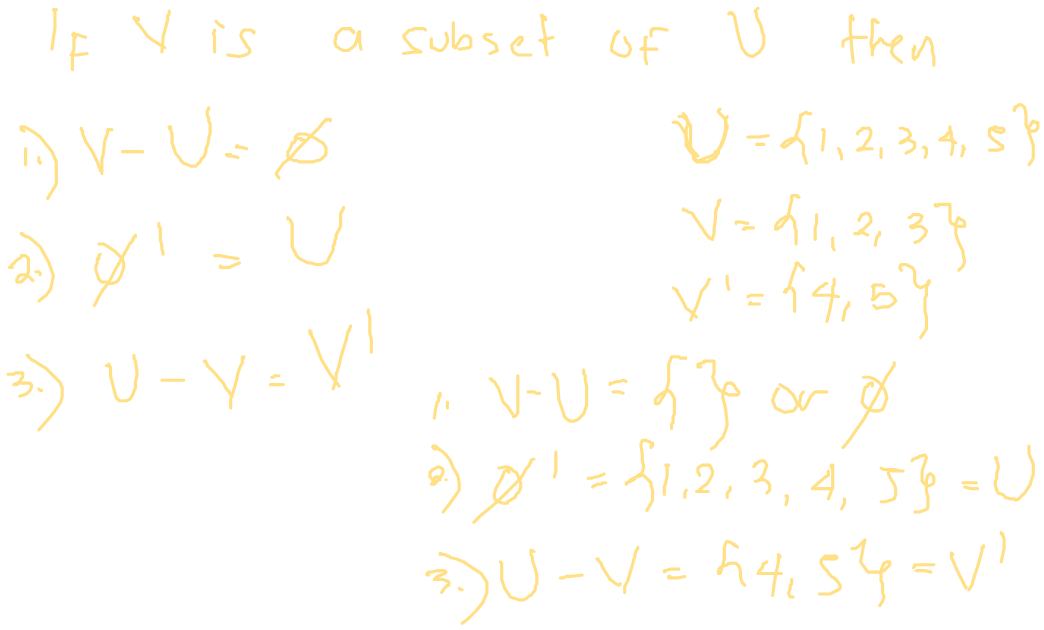
- DIFFERENCE of sets – set whose elements are found in set A but not in set B ^^(A - B), (and)^^
- COMPLEMENT of Sets – set of elements found in the universal set but not in set A ^^(A’)^^