Start of statistics
Null hypothesis:
no need for a null hypothesis under the research design
No difference between groups/conditions
Numerical differences caused by random noise
Not caused by the independent variable
The default position that your experiment is seeking to falsify
benefit in proving null hypothesis sometimes
Alternative Hypothesis:
A difference/relations exists between groups/conditions
Numerical differences are real/non-random
differences seen are because of the things you are changing
Experimental power:
Your ability to detect an effect of a certain size
Underpowered studies will leave you unable to detect small effects
sometimes you don’t have enough elite athletes to analyze the effect of one small supplement, cant power the study enough to show statistically meaningful effects
Most effects you are likely to examine are probably pretty small, given that you are examining slight adaptations of established paradigms.
Easiest way to ensure you have enough power is to test plenty of people
No such thing as ‘too much power’
Type 1 error:
incorrect rejection of a true null hypothesis
Usually, a type 1 error leads one to conclude that a supposed effect or relationship exists when in fact it does not!
The level of type 1 error we are willing to risk is called our α (alpha) level
Typically, we set our alpha to 0.05, meaning type 1 errors will occur 5% of the time (1 in 20)
t test comparing 2 means
Type II error
The failure to reject a false null hypothesis
Usually, a type 2 error leads one to conclude that an effect or relationship does not exist, when in fact one does
The level of type 2 error we are willing to risk is called our β (beta)
f we power our study to 0.8, this means our beta is 0.2 and we have a 20% chance of a type 2 error
when the risk of these error increase we can control for them
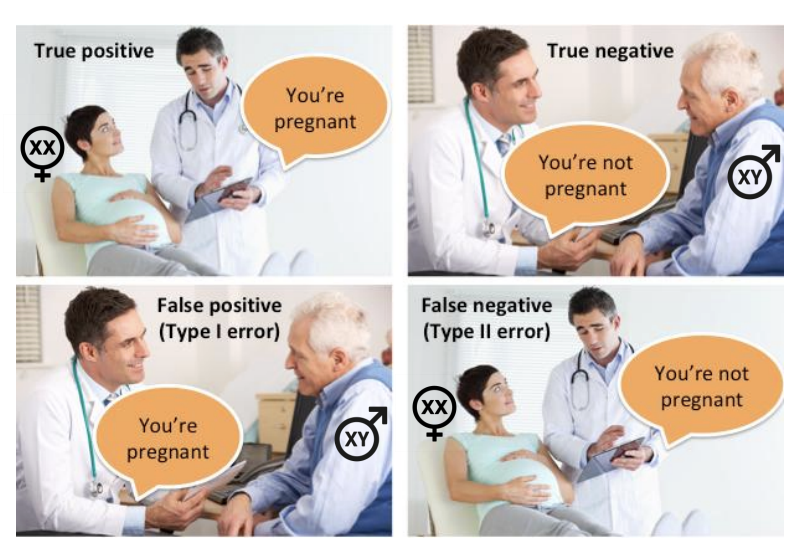
In context
A doctor is diagnosing whether an individual has an illness
Type 1 error is when a diagnostic test suggests someone is sick when they in fact are NOT sick at all (false positive)
Type 2 error is when a diagnostic test suggests someone is healthy when they are actually sick (false negative)
Statistical tests are based on the assumption that all variance is due to two things:
True effects
Random factors
All about the decision of the person interpreting the test
Type I error: decide there is a true effect, when random factors actually produced observed effect.
Type 2 error: decide there is no effect, when random factors have masked true effect.
Null Hypothesis:
In isolation, p values cannot demonstrate that there are no difference between conditions
p>0.05 does not allow you to accept the null hypothesis
p>0.05 does not tell you that a manipulation has no effect
p>0.05 does not tell you that the scores in two conditions are the same as one another
it can not do any of that, it does give an indication of the likely hood that what is happening has happened by chance.
a probability value
what is the probability that this has happened by chance?
P value of 0.04 means you can say what is happening is due to the manipulation but there is a 96% probability that what is happening is because of the manipulation and not because of random other effects that come from the data.
a p value of 0.06 is not statistically different, there is no statistical effect of the independent variable, there could be something happening = partial pita square
Range of reasons why p>.05:
No actual effect
Type 2 errors oLack of power (i.e., too small a sample to detect an effect of a certain size)
Inadequate variability within independent variable
Measurement error
Nuisance variables (things that you might not know of, example; drinking the day before a test
A null finding should not be considered a ‘failure’, especially in your dissertation.
it is hard to discuss why you have no statistical evidence, taking other literature and comparing things would benefit.
No extra marks awarded for significant differences!
Often difficult to publish null-findings
Publication bias – the tendency for significant results to be published at the expense of nonsignificant results: systematic reviews have an element of publication bias in them
an anova with a p vl of less than 0.05, you need to talk about an effect, they show the effects
post op t test show differences between two means
FAMILYWISE ERROR
why has a study not shown an effect when all of the previous studies have?
We use experimental designs to try to establish cause and effect
We manipulate independent variables and measure dependent variables
a repeated measures anova and an independent anova would be better
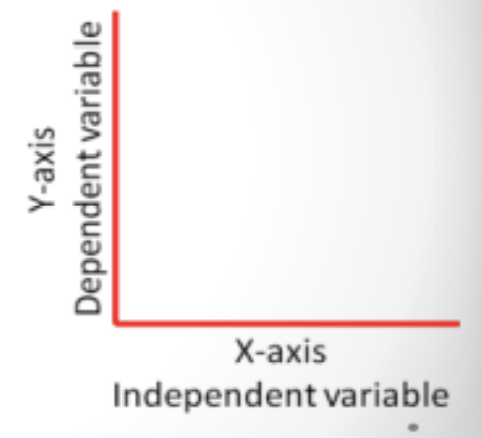
more t test increases the chances of showing a statistical effect when there are no effects there
If we are comparing two groups of scores
E.g. Drug A vs. control
Use a t test
If we have more than two groups of scores
E.g. Drug A vs. Drug B vs. Control
Run a few t-tests? NO
E.g. Compare drug A to Drug B, Drug A to control and Drug B to control
each test we run inflates the familywise error rate
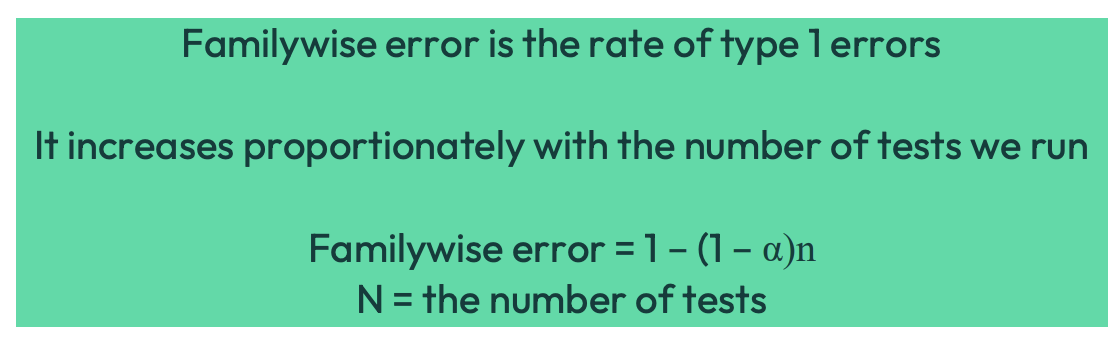
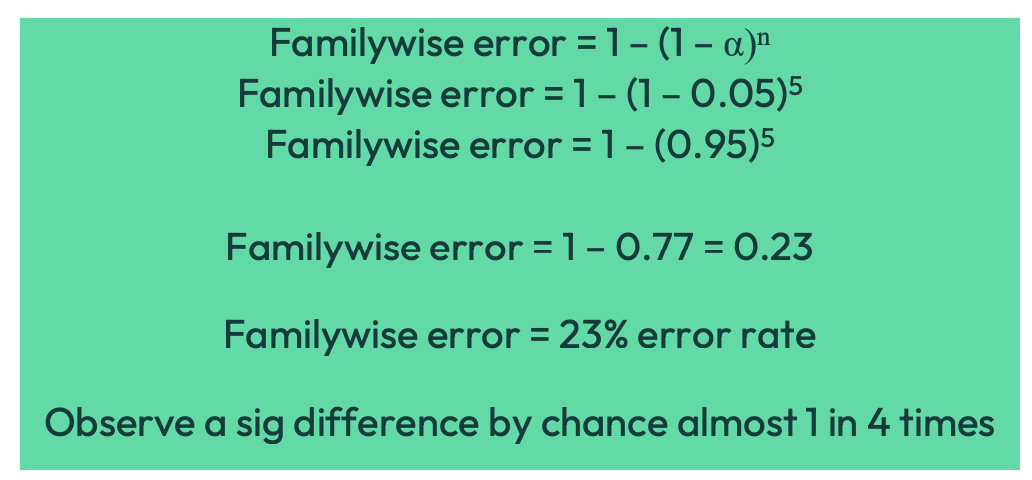
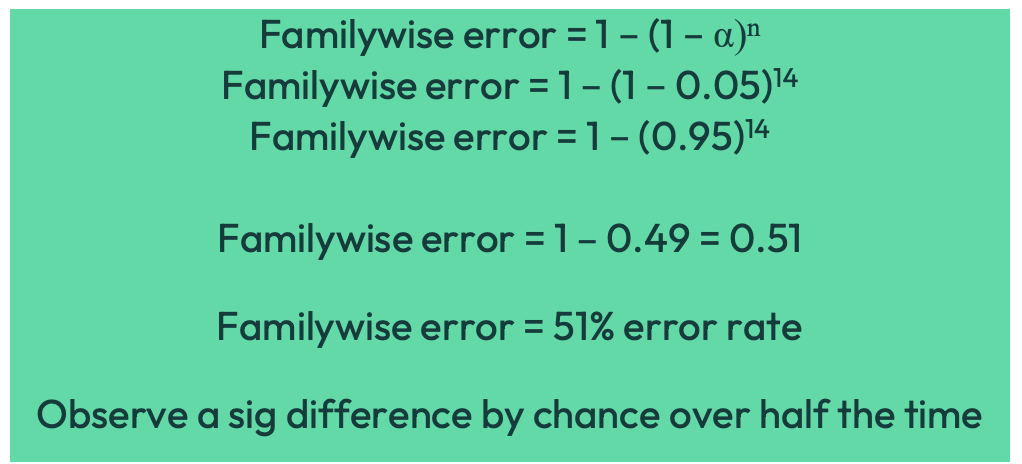
corrections: is it possible to mathematically account for a familywise error
corrections such as:
Bonferroni
Turky’s HSD
Holm
Scheffe
All of these corrections reduce your ability to detect a true effect
i.e. they lower your experimental power and increase your chance of making a type 2 error
The solution?
One-way independent ANOVA
Analysis of variance - ANOVA between each of the columns of data
M = typically used to signify the mean of a group of scores
df = degrees of freedom
g = the number of groups
N = total number of scores
n = number of scores in each group
SS = sum of squares
MS = means square (variance)
∑= the sum of
One-way independent ANOVA:
Compares three or more groups using a single statistical test
Controls the familywise error rate
Maintains statistical power compared with multiple t-tests
Tells you whether the factor has a significant overall effect
one factor, for example steroids, therefore we do a one-way
no steroid, low dose, high dose (condition), time is also changing, therefore one would do a 2 way anova. The independant variable is the factor
Post hoc tests are then used to identify which groups differ
effect is with factor, differ is with post op test, suggesting t test after the anova
Assumptions:
The samples are unrelated to each other (independent)
Like an independent t test
The data is interval/ratio scale
For ordinal data use non-parametric Kruskal-Wallis test
Data is normally distributed
ANOVA quite robust to violations of normality
Further assumptions:
Homogeneity of variance
Similar variances in all groups
Measured using Levene’s test
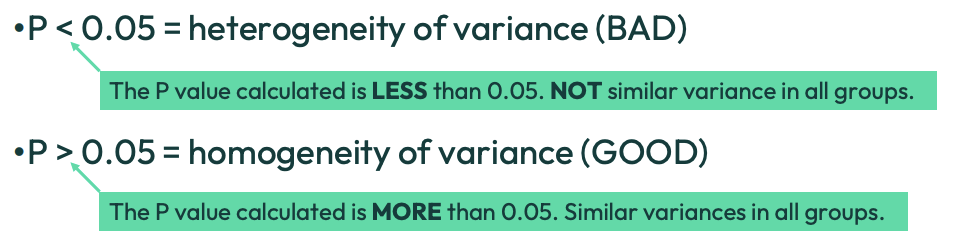
Similar variances in all groups, for ANOVA the levenes test is done, for repeated measures this tests for sarisity, one way you can identify if its a independent or a repeat measures anova. Outputs are something important to include in the exam
ANalysis Of VAriance
In ANOVA tables, variance is called ‘Mean Square’ (MS)
Effect/treatment variance
Error variance
Mean square error (MSE)
Variance is visually demonstrated in graphs by error bars
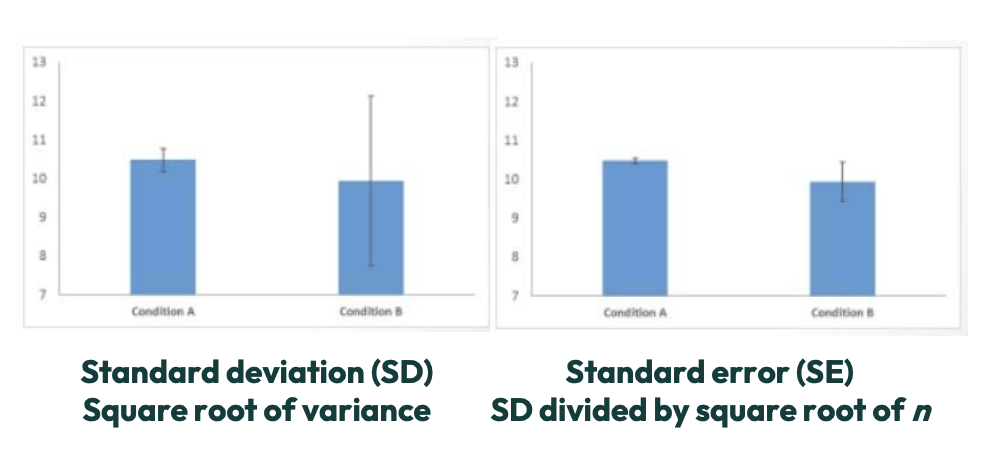
Standard error will always be smaller than standard deviation
ANOVA:
ANOVA asks how successful the experimental manipulation has been in comparison to the natural variability that exists
natural variability between individuals and in the person on the other end, person collecting the information.
Compares the type of variance you want (effect variance) with the type of variance you do not want (error variance)
we want to minimize error variance as much as possible, this is why you control as much as you can in a lab environment
This ratio between wanted (effect) and unwanted variance (error) is called the F-ratio
Error variance (MSE)
Measurement error
Always present because variables cannot be measured perfectly
Individual differences: always present in anything that you are measuring
Always present because scores might naturally vary from person to person
For independent ANOVA, the error variance (MSE) always occurs within each group (MSwithin).
Independent ANOVA
Independent ANOVA – the ratio of variance between your groups and the variance within your groups
MSbetween / MSwithin
Significant effects occur when you have at least four times as much variance between your groups as you do within your groups
look at degrees of freedom and p value table