16.5 The commercial use of plant hormones
Control of ripening
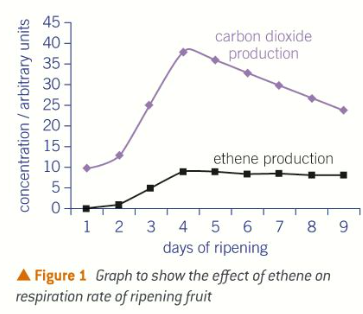
The gaseous plant hormone ethene is involved in the ripening of climacteric fruits. These are fruits that continue to ripen after they have been harvested. Their ripening is linked to a peak of ethene production triggering a series of chemical reactions including a greatly increased respiration rate.
Climacteric fruits include bananas, tomatoes, mangoes and avocados
Non-climacteric fruits including oranges, strawberries and watermelon, do not produce large amounts of ethene and do not ripen much after picking.
The effect of ethene on climacteric fruit can easily be seen if part of a bunch of green bananas is put in a bag with a single ripe banana. The bunch with the ripe banana will ripen faster than the rest of the bunch, even if the temperature is exactly the same. Ethene from the ripe banana stimulates the rapid ripening of the green ones.
 Ethene is widely used commercially in the production of perfectly ripe climacteric fruit for greengrocers and supermarkets. These fruit are harvested when they are fully formed but long before they are ripe, and then cooled, stored and transported. The unripe fruit is hard and much less easily damaged during transport around the world then the ripe versions.
When the fruit is needed for sale, they are exposed to ethene gas under controlled conditions. This ensures that each batch of fruits ripens at the same rate and are all at the same stage to be put on the shelves for sale to the public.
This careful control of ripening prevents a lot of wastage of fruit during transport, and increase the time available for them to be sold.
Hormones rooting powders and micropropagation
Auxin affects the growth of both shoots and roots. Scientists have discovered that the application of auxin to cut shoots stimulates the production of roots. This makes it much easier to propagates new plants from plant cuttings.
A cutting - is a small piece of the stem of a plant, usually with some leaves on.
If this is placed in compost or soil, or even water, roots may eventually appear and a new plant forms. Dipping the cut stem into hormone rooting powder increases the chances or roots forming, and of successful propagation taking place. This has made it easier for horticulturists to develop cuttings to sell and for individuals to take their own cuttings.
In both horticulture and agriculture, many plants are now propagated on a large scale by micropropagation, when thousands of new plants are grown from a few cells or the original plant. Plant hormones are essential in this process - they control to production of the mass of new cells and then the differentiation of the clones into tiny new plants.
Hormonal weedkillers
Interaction between different plant hormones are finely balanced to enable the plant to grow, if the balance is lost is can interrupt the metabolism of the whole plant and may even lead to plant death.
Commercial food crops are vital globally for producing the food people need to eat, weeds interfere with crop plants, competing for light, space, water and minerals.
Scientists have developed synthetic auxins which act as a very effective weed killers. Many of the main staple food are narrow-leaved monocot plants such as rice, maize and wheat. Most of the weeks are broad-leaved dicots.
If synthetic dicot auxins are applied as weedkiller, they are absorbed by the broad-leaved plants and affect their metabolism. The growth rate increases and becomes unsustainable, so they die.
The narrow-leaved crop plants are not affected and continue to grow normally, freed from competition, the synthetic auxins used by farmers and gardeners are simple and cheap to produce, have a very low toxicity to mammals and are selective.
Other uses of plant hormones
Auxins can be used in the production of seedless fruit
Ethene is used to promote fruit dropping in plants such as cotton, walnuts and cherries
Cytokinins are used to prevent ageing of ripened fruit and products such as lettuces, and in micropropagation to control tissue development.
Gibberellins can be used to delay ripening and ageing in fruit, to improve the size and shape of fruits, and in beer brewing to speed up the malting process.