chromosomes
I. The Chromosomal Basis of Genes and Heredity
Genome organization
Nuclear DNA: linear chromosomes in nucleus, double-helix structure
Organelle DNA: circular chromosomes in mitochondria (and chloroplasts in plants/algae), typically lacking introns and with distinct replication processes
Nuclear envelope: key feature of eukaryotes, a double membrane that encloses the nucleus and controls molecular transport
II. The Eukaryotic Cell Division Cycle
1. Phases
G1 (Gap 1): period of cell growth and normal metabolic roles, synthesizing proteins and organelles; prepares for DNA replication.
S (Synthesis): DNA replication occurs, resulting in identical sister chromatids per chromosome.
G2 (Gap 2): further growth, synthesis of proteins needed for mitosis; cell checks for DNA damage and completeness of replication.
M (Mitosis + Cytokinesis): division of nucleus and cytoplasm
Interphase = G1 + S + G2
G0: quiescent, non-dividing state where cells exit the cell cycle and differentiate into specialized functions (e.g., neurons, muscle cells).
Checkpoints: regulatory points (G1, G2, M) that monitor internal and external conditions, ensuring proper progression and preventing errors like incomplete replication or chromosome damage.
2. Chromosome/DNA content
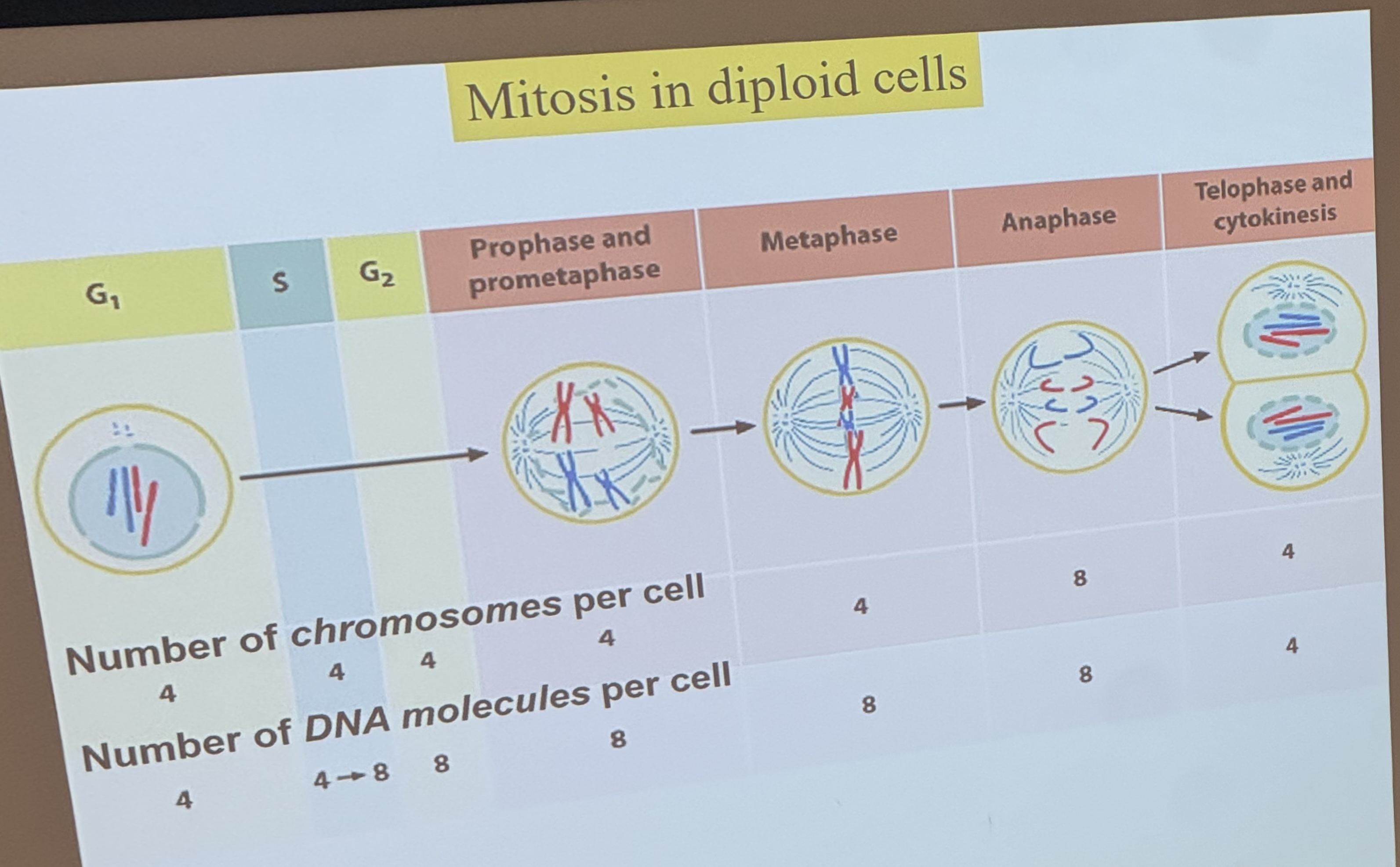
End of mitosis & G1/G0: 1 DNA molecule per chromosome
After S-phase & G2: 2 DNA molecules (sister chromatids)
3. Key structures
Telomeres: repetitive nucleotide sequences at the stable ends of linear chromosomes, protecting DNA from degradation and undesirable fusion.
Centromere: constricted region joining sister chromatids, essential for proper chromosome segregation during cell division.
Kinetochores: protein complexes assembled at centromeres, serving as attachment sites for spindle microtubules.
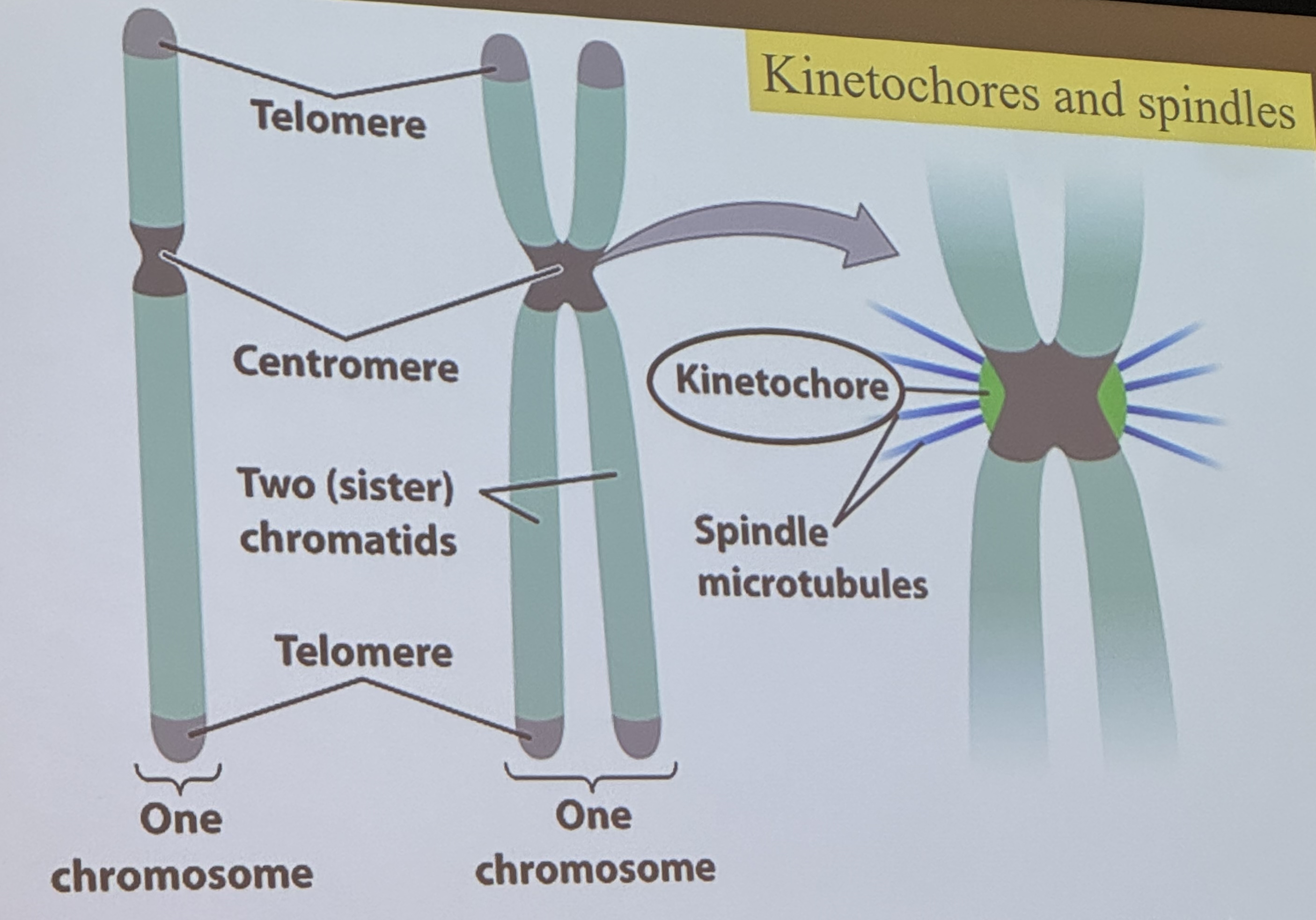
Centrosome: microtubule-organizing center (pair of centrioles in animal cells); involved in forming the mitotic spindle(the pole).
III. DNA in the Eukaryotic Nucleus
Chromatin
Decondensed DNA + histones (proteins that DNA wraps around to form nucleosomes)
Condenses before cell division into visible chromosomes through further coiling and folding.
Nucleosome = basic structural unit (DNA + histones)
Chromosomes
Before replication: single DNA molecule
After replication: two identical sister chromatids, joined at the centromere until anaphase.
Classification by centromere location:
Metacentric (middle)
Submetacentric (near center)
Acrocentric (near end)
Telocentric (at end)
Arms: p (short) and q (long)
IV. Genes, Loci, and Alleles
Gene
Transmission genetics: unit of heredity that is passed from parent to offspring.
Molecular genetics: region of DNA (or RNA) coding for a functional product (e.g., protein, tRNA, rRNA).
Locus
Specific, fixed position or location on a chromosome where a particular gene is found.
Alleles
Alternative forms of the same gene, residing at the same locus on homologous chromosomes.
Homologous chromosomes
Pair of chromosomes (one from each parent) that are the same length, have the same centromere location, and carry genes for the same traits in the same loci order.
May carry different alleles for those genes.
Not sister chromatids (which are identical copies produced during replication).
V. Karyotypes and Ploidy
Karyotype
Visual display of the complete set of chromosomes in a cell, arranged by size, centromere position, and banding patterns.
Human: 22 pairs of autosomes + 1 pair of sex chromosomes (XX or XY); used to detect chromosomal abnormalities and determine sex.
Ploidy
Diploid (): cells containing two sets of homologous chromosomes (e.g., somatic cells in humans, ).
Haploid (): cells containing a single set of chromosomes (e.g., gametes like sperm and egg, in humans).
Polyploid (, , etc.): cells or organisms containing more than two complete sets of chromosomes.
Aneuploid: abnormal number of chromosomes that is not an exact multiple of the haploid set (e.g., monosomy (2n-1), trisomy (2n+1), such as not 46 in humans).
VI. Mitosis
any ploidy can undergo mitosis
1. Phases
Prophase: chromatin condenses into visible chromosomes, mitotic spindle begins to form as centrosomes migrate to opposite poles.
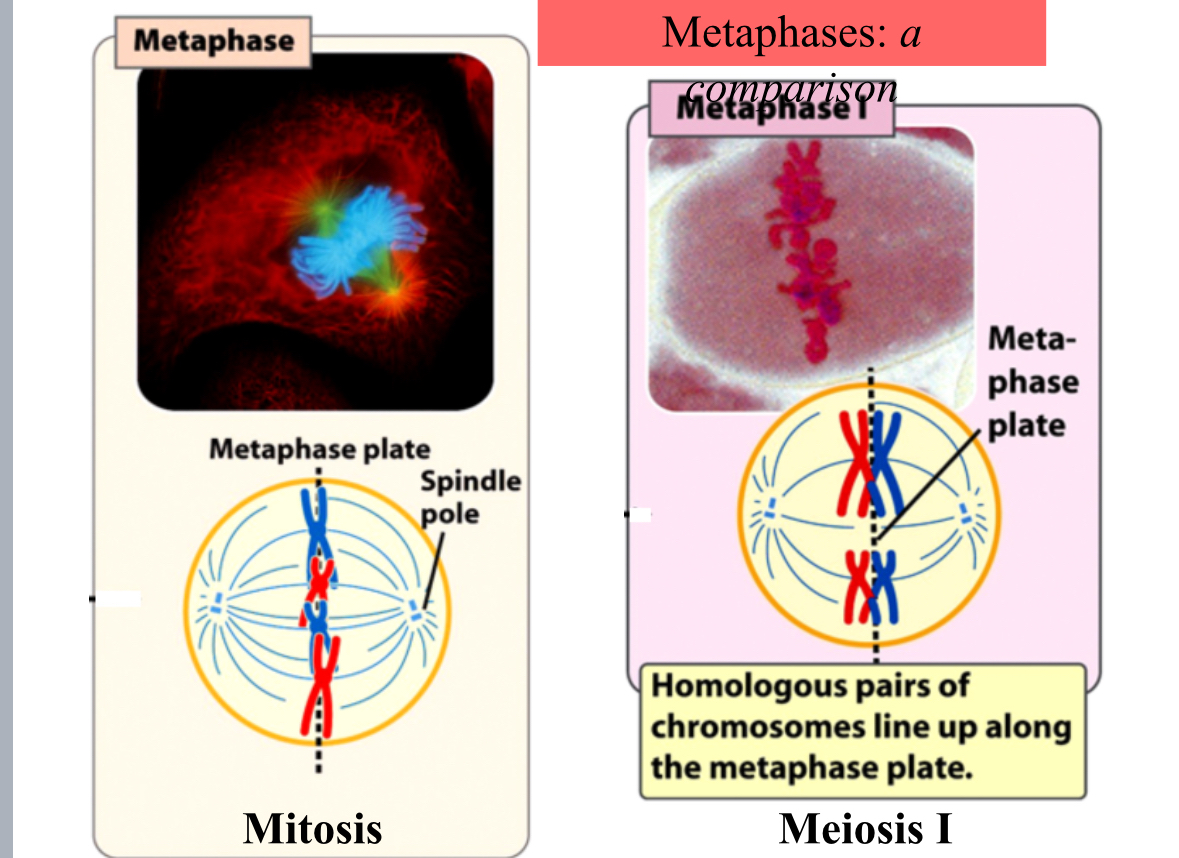
Prometaphase/Metaphase: nuclear envelope fragments; kinetochore microtubules attach to kinetochores on sister chromatids; non-kinetochore microtubules overlap; chromosomes align along the metaphase plate (equatorial plane).
Four individual chromosomes go to the plate which is the main difference with mitosis and meiosis.
Anaphase: sister chromatids separate and are pulled to opposite poles of the cell by the shortening of kinetochore microtubules. When separated they are now 8 chromosomes with one molecule of DNA each.
Telophase: DNA decondenses, chromosomes arrive at poles, and nuclear envelopes reform around the two sets of chromosomes; mitotic spindle disassembles.
Cytokinesis: cytoplasm divides; in animal cells, a cleavage furrow forms; in plant cells, a cell plate forms to create new cell walls.
Outcome: 2 diploid () daughter cells, genetically identical to the parent cell; crucial for growth, repair, and asexual reproduction.
VII. Meiosis
germ cells and has to be able to form pairs Diploid only or an even multiple of the haploid number
Overview
Specialized division gametes (animals) /spores (plants); (in sexually reproducing organisms).
Involves two successive divisions (Meiosis I and Meiosis II) leading to haploid cells.
Outcome: 4 haploid () cells, genetically unique due to crossing over and independent assortment; crucial for sexual reproduction and genetic diversity.
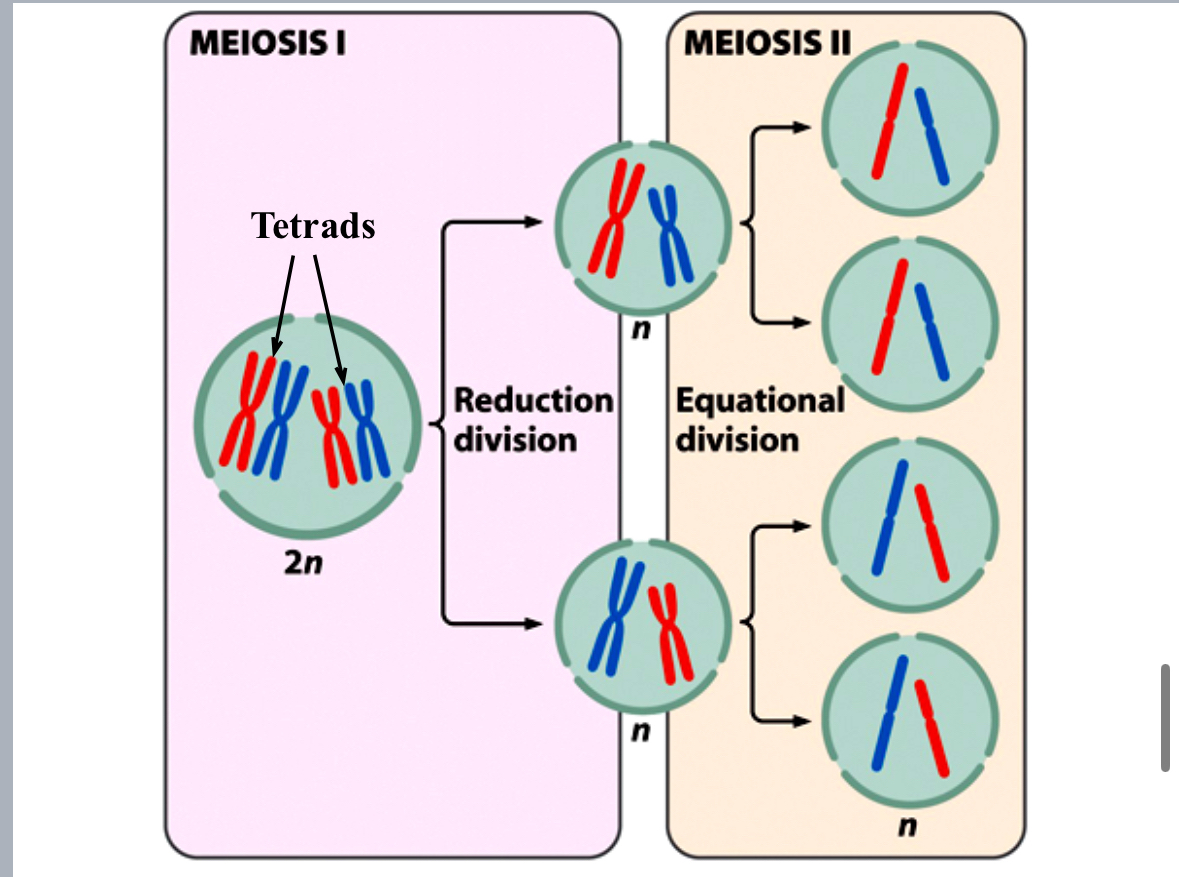
Meiosis I (Reductional division)
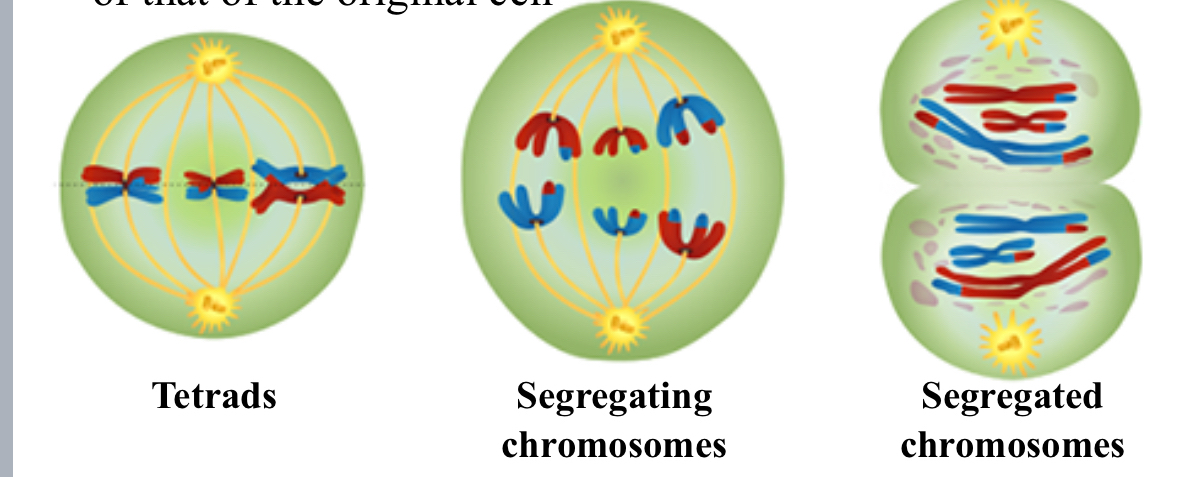
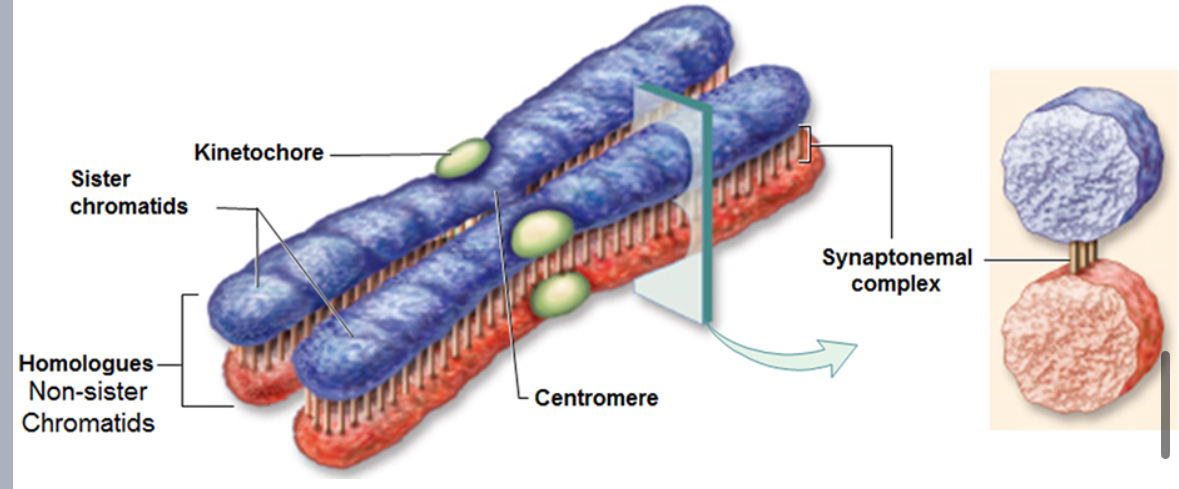
Homologous chromosomes pair tetrads (bivalents).
Synaptonemal complex: protein structure mediates stable pairing of homologous chromosomes (synapsis) and assists in crossing over. The cell makes enzymes which means it wants this to happen.
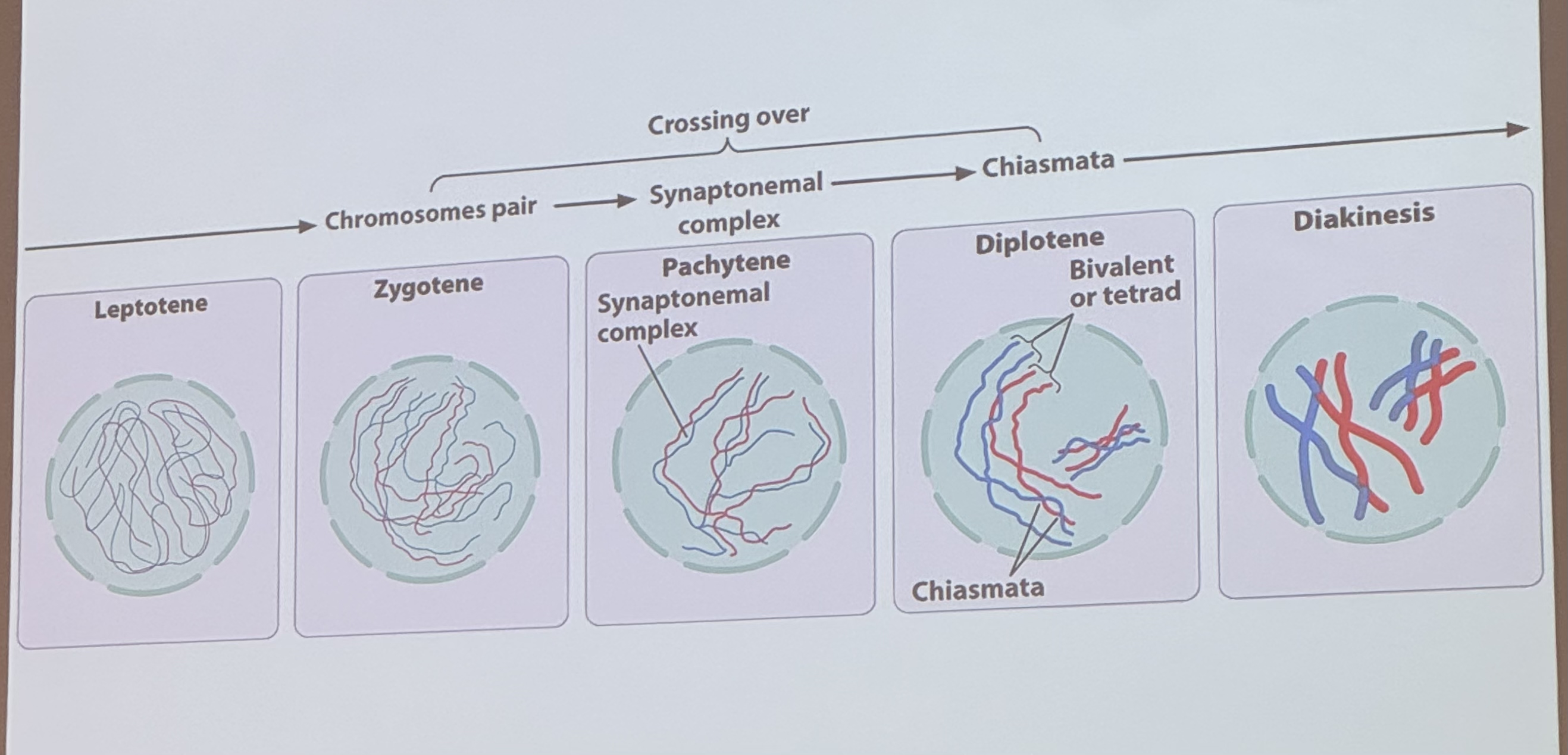
Prophase I substages:
Leptotene – DNA begins condensing, chromosomes become visible as long, thin threads.
Zygotene – homologs pair (synapsis) side by side, forming tetrads/bivalents; synaptonemal complex forms.
Pachytene – crossing over occurs between non-sister chromatids, exchanging genetic material; this is often the longest substage.
Diplotene – homologous chromosomes start to separate but remain joined at chiasmata (sites where crossing over previously occurred).
Diakinesis – final condensation of chromosomes; nuclear envelope fragments; spindle fibers begin to form.
Anaphase I: homologous chromosomes segregate and move to opposite poles; sister chromatids remain attached.
Homologous pairs of chromosomes line up along the metaphase plate is the main difference with mitosis and meiosis.
Outcome: 2 haploid () daughter cells (not identical) but each chromosome still consists of two sister chromatids.
Meiosis II (Equational division)
Sister chromatids disjoin; very similar to mitosis but occurs in haploid cells.
Outcome: 4 haploid gametes (or spores in plants/fungi), each with a single set of unduplicated chromosomes.
Comparisons
Mitosis: occurs in somatic cells for growth, repair, and asexual reproduction; no homolog pairing or crossing over; results in 2 genetically identical diploid cells.
Meiosis: occurs in germ line cells for sexual reproduction; involves homolog pairing, crossing over, and two divisions; results in 4 genetically unique haploid gametes.
VIII. Gametogenesis
Spermatogenesis: process in males leading to sperm formation; involves equal cytokinesis 4 functional sperm cells from one primary spermatocyte.
Oogenesis: process in females leading to egg formation; involves unequal cytokinesis 1 large functional egg (ovum) + 2 or 3 small polar bodies (which degenerate) from one primary oocyte.
Fertilization: fusion of male and female gametes (sperm and egg) restores the diploid state, forming a zygote.
IX. Yeast Life Cycle (Saccharomyces cerevisiae)
Exists as diploid () or haploid () cells.
Both can divide mitotically to produce more cells of their respective ploidy.
Haploids of opposite mating type (a and ) can fuse ( diploid zygote), which then grows mitotically.
Diploid cells under environmental stress (e.g., nutrient depletion) can undergo meiosis 4 haploid spores inside an ascus (a sac).
X. Meiotic Failures
Refer to situations where chromosome numbers are not even multiples of the haploid number, often leading to sterility.
Triploids (): organisms with three sets of chromosomes; typically sterile because homologous chromosomes cannot properly pair and segregate during meiosis, leading to unbalanced gametes.
Examples:
Seedless watermelon: often produced by crossing a tetraploid () parent with a diploid () parent, resulting in a triploid () hybrid that cannot produce viable seeds due to meiotic irregularity.
Mules: sterile hybrids resulting from a cross between a horse and a donkey, which have different chromosome numbers, leading to unpaired chromosomes in meiosis.
XI. Nondisjunction
Failure of homologous chromosomes (in Anaphase I of meiosis) or sister chromatids (in Anaphase II of meiosis or Anaphase of mitosis) to separate properly.
Consequences: leads to aneuploidies (abnormal chromosome numbers in gametes or somatic cells).
Trisomy: presence of an extra copy of a chromosome ().
Monosomy: absence of one copy of a chromosome ().