Biochemistry - lecture 17 - Glucose Homeostasis
Learning Outcomes
After this lecture, you should be able to:
Explain the importance of glucose as a metabolic fuel.
Describe the sources of glucose available to the body.
Outline how blood glucose homeostasis evolves after a meal.
Explain the role of liver and skeletal muscle glycogen in maintaining blood glucose levels.
Outline the enzyme reactions involved in glycogen synthesis and degradation.
Discuss control mechanisms in glycogen metabolism regulation.
Outline gluconeogenesis in the liver.
Summarize the roles of insulin and glucagon in glucose homeostasis.
Importance of Glucose
Continuous Requirement:
Glucose is the preferred fuel source for all tissues, especially those with constant dependence on it.
Blood Glucose Levels:
Physiological concentration: 3.9-6.7 mM
Average fasting level: 4.4-5 mM in adults
Critical levels: < 2.5 mM can cause coma/death; prolonged high levels lead to dehydration and tissue wasting.
Roles of Glucose
Energy Source: Serves as a primary energy source and is needed for synthetic reactions (e.g., fatty acids, steroids).
Pentose Phosphate Pathway: Converts glucose to pentose sugars for nucleotide synthesis and reduces NADP to NADPH for further synthetic reactions.
Carbon Source: Acts as a carbon source for other sugars and glycoconjugates.
Advantages and Disadvantages of Glucose
Advantages:
Water-soluble; no carrier needed for circulation.
Can cross blood-brain barrier.
Possible anaerobic oxidation.
Disadvantages:
Lower ATP yield per mole compared to fatty acids.
Osmotically active leading to potential cellular damage or toxic by-product accumulation in high concentrations.
Sources of Blood Glucose
Diet: 0-4 hours after eating
Liver Glycogen: 2-24 hours (max range)
Gluconeogenesis: Starts around 4 hours post-ingestion or until death.
Glucose and Glycogen Structure
Glucose:
Monosaccharide, approx. 10 g in plasma, acts as an immediate energy source.
Glycogen:
Polysaccharide, approx. 400 g in stored tissues, serves as a medium-term energy source, low osmolarity.
Glycogen Structure
Composed of branched structures with:
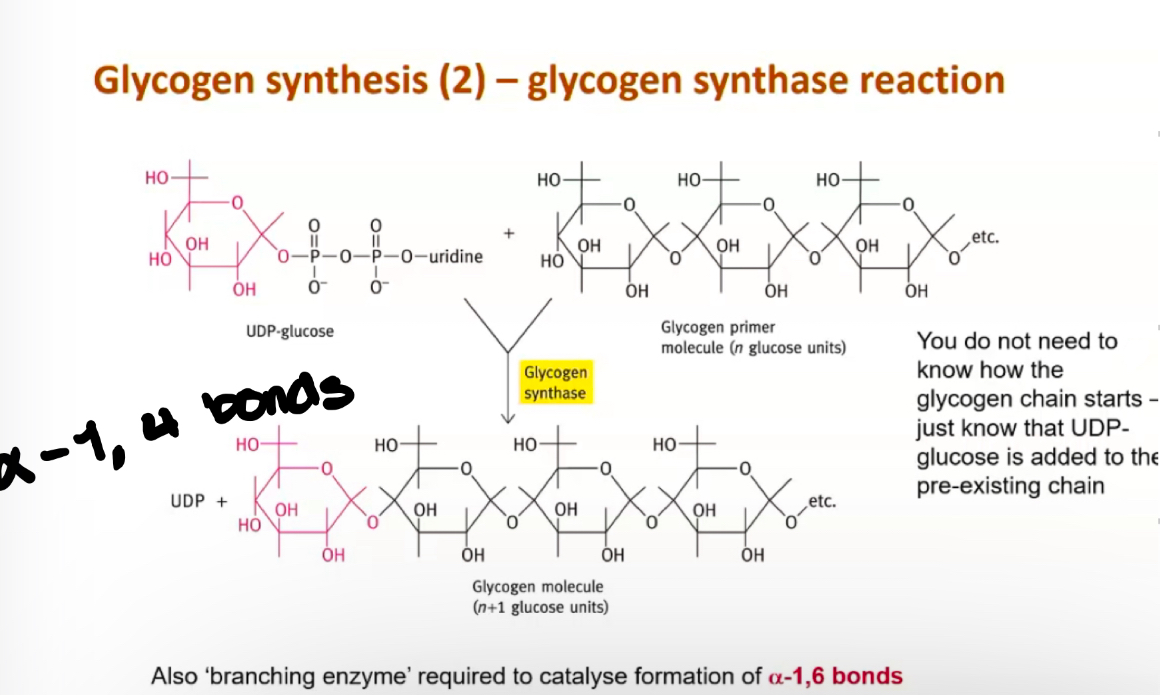
a-1,4 glycosidic bonds
a-1,6 bonds for branching.
Role of Glycogen
In Liver: Maintains blood glucose levels, sensitive to insulin and glucagon.
In Muscle: Serves as a fuel during exercise, sensitive to energy requirements (e.g., adrenaline, AMP).
energy for contraction
Glycogen Metabolism
Glycogen Synthesis:
Catalyzed by glycogen synthase, requires ATP and activated intermediates (e.g., UDP glucose).
hexokinase/glucokinase: glucose + ATP → glucose 6-phosphate
phosphoglucomutase: glucose 6-phosphate ↔ glucose 1-phosphate
UDP glucose pyrophosphorylase: glucose 1-phosphate + UTP → UDP glucose + PPi
Glycogen Breakdown (glycogenolysis):
Catalyzed by glycogen phosphorylase via phosphorolysis using inorganic phosphate.
glycogen phosphorylase: glycogen chain + Pi → glucose-1-phosphate + glycogen chain
phosphoglucomutase: glucose-1-phosphate + glycogen chain → glucoe-6-phosphatase
glucose-6-phosphatase (liver/kidney): glucose-6-phosphate + H2O → glucose + Pi
Final products: glucose in the liver and glucose-6-phosphate in muscle (enters glycolysis).
muscles don’t have glucose-6-phosphatase
Regulation of Glycogen Metabolism
Regulated by:
Allosteric control
Hormonal control (e.g., glucagon/adrenaline)
Example: Hormones activate signaling pathways that modulate enzyme activities (glycogen phosphorylase and glycogen synthase).
hormone binds to cell surface receptor and activates internal signaling pathway which activates a protein kinase
Gluconeogenesis
Synthesizes glucose from non-carbohydrate sources like lactate, glucogenic amino acids, and glycerol (not fatty acids since pyruvate dehydrogenase is irreversible).
Irreversible Reactions: Have to be bypassed in gluconeogenesis, catalyzed by specific enzymes.
hexokinase/glucokinase - glucose-6-phosphotase
phosphofructokinase - fructose-1,6-biphosphatase
pyruvate kinase - pyruvate → (pyruvate carboxylase) oxaloacetate + GTP → (PEP carboxykinase) PEP
all in cytosol
The Cori Cycle
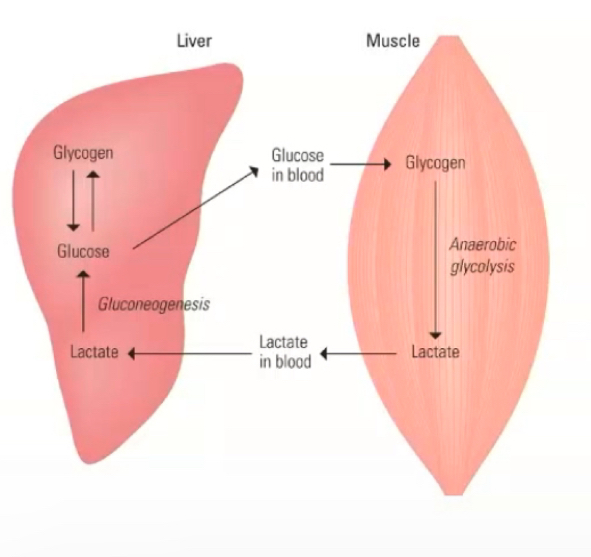
Converts lactate from muscle back to glucose in the liver then returns to the muscle and used for glycolysis, facilitated by lactate dehydrogenase.
Blood Glucose Maintenance
Coordinated by hormones (insulin, glucagon, adrenaline) across liver, adipose, and muscle tissues to maintain physiological blood glucose levels for glucose-dependent tissues (i.e brain).
pancreas - islets of langerhans: alpha cells secrete glucagon and beta cells secrete insulin
Insulin vs. Glucagon
Insulin:
An anabolic hormone that promotes synthesis and storage of glucose, amino acids, and fatty acids.
Glucagon:
A catabolic hormone that stimulates glycogenolysis and gluconeogenesis to increase blood glucose levels.
promotes degradation of stored fuel
Metabolic Effects of Insulin
Liver: Activates glycogen synthesis, increases amino acid uptake/protein synthesis, increases fatty acid synthesis/lipid assembly, and inhibits gluconeogenesis.
Muscle: activates glycogen synthesis, increases amino acid uptake and protein synthesis, and increases glucose uptake via translocation of glucose transporters (GLUT4) to the membrane.
Metabolic Effects of Glucagon
Increases blood glucose through glycogenolysis and gluconeogenesis in the liver; promotes lipolysis in adipose tissue.
Increases circulating fatty acids and ketone bodies
Decreases plasma amino acids