Intro to Bio (Unit 2)
Plasma membrane seperates internal enviroment from its enxternam enviroment
Invison it as a ball pit, They move with the waves that you create and will form around you
Plasma membrane composed of:
Phospholipids
proteins
glycolipids (carbohydrate attatched to a lipid)
glycoproteins (carbohydrate attached to a protein)
Cholestrol
Gylco= carbohydrate
periphreal protiens- on the edge
Intergal proteins- form channels through the proteins
Carbohydrates make up the glycocalyx (Sugar coat)
-Mainly function in identification of cell
Glycolipids and glycoprotiens- Represent carbohydrates
Cholestrol- prevents everything from coming undone so easily
Plasma membranes composed of 2 layers-
Hydrophillic portion and hydrophobic portion
The hydrophilic heads face both the outer and inner membrane surfaces
The hydrophobic (fatty acid) tails both face inwards, towards each other (caused lipids to be selectively permeable- Meaning if your not a lipid your not getting in)
-Lipids are generally water insoluble (hydrophobic)
Intergral Protein (imbedded in membrane)
Imbedded inside of the membrane
Can produce from both sides
Periphrial proteins (Attached on the inside or outside)
on the outside of the membrane
The glycocalyx
The thing that causes a problem with transplants (everyone has a different make up, used to recognize self vs not self or safe)
Family would have a more similar glycocalyx which is why its better to have organ transplants from other family members
Basically, This is the part that keeps transplants from working because EVERYONE has a completely different glycocalyx. The immune system could attack once getting a organ transplant if it doesnt recognize its glycocalyx
If attatched to a protein it becomes a glycoprotein
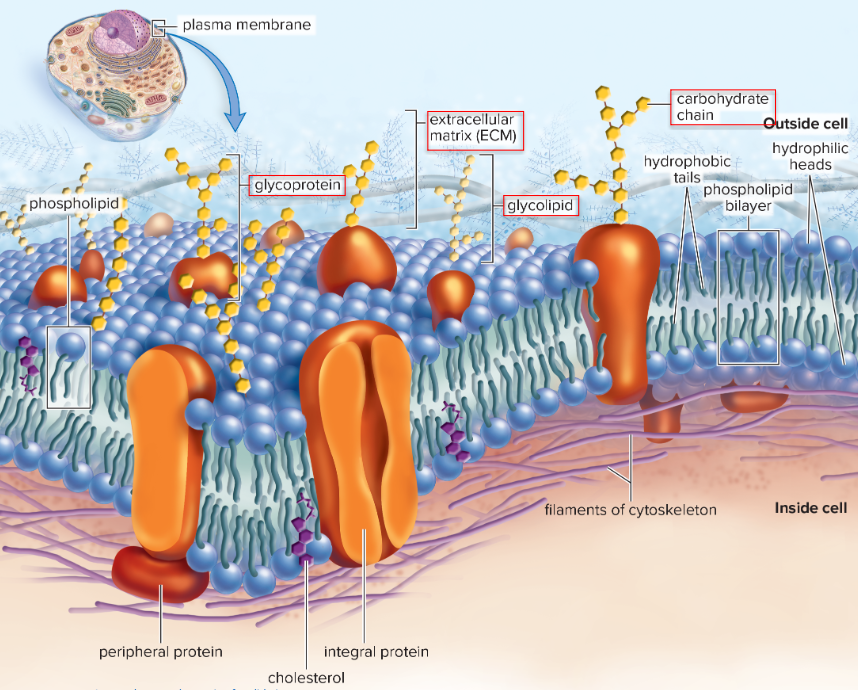
Phospholipids-
Peripheral protein-
Cholesterol-
intergral protein-
Filaments of cytoskeleton-
Glycoprotein-
Glycolipid-
Hydrophobic tails-
Phospholipid biolayer
Hydrophillic head-
(KEEP LISTING)
Recognition Proteins
allows immune cells to identify self and not self
-Glycoproteins (make up glycocalyx)
-Specific to each person
Transport proteins
Channel proteins, carrier proteins
-Some channels contain a gate
-Are very specifc
***different gates for different things, Chloride gate will not let anything besides chloride through***
-Specific bonding sites
Carrier proteins
-Change shapes to carry molecules
-Dont go through as fast
-Basically goes through and hands it off
Receptor proteins
-have specific shapes that allow receptor specific molecules to bond
Enzymes
Catalyze chemical reactions right on the plasma membrane
Attachment/Anchoring proteins( Stabilizers)
transmembrane proteins that attach to intercellular or extracellular structure and form cell junctions
joins 2 cells together
3 types of junctions :
Adhesion junction: Allow for bending and twisting, allow for flexibility (Think of your skin)
Tight junctions: Under lower levels of skin, Impermeable barriers (meaning you cant get past it). (makes sure everything stays)
Gap junctions: have channels(allow things to be passed), allow things to go in between cells. Communication between cells.

Check for understanding
1. Catalyze chemical reactions right at the
membrane - G. Enzymes
2. Form passageways through the
membrane. - C. Channel proteins
3. Cell junction that allows for
communication between cells. - E. Gap Junction
4. Allows immune system to identify cells
as “self” - A. Recodnition Proteins
5. Receptor-specific molecules bind
initiating a cellular response. - F. Receptor proteins
6. Anchor cells to other cells - B. Attachment proteins
7. Transport substances by binding to them
and changing shape. - D. Carrier proteins
Membrane permeability
Selectively permeable
***NEED TO KNOW WHAT CAN PASS THROUGH***
What can pass through:
Lipids
non charged molecules
alcohol
Carbon dioxide
Water goes through special channels called auqaporins
***Channels are specific***
Large molecules like glucose or proteins have to go through vesicles
anything that has a charge cannot come through the bilayer. If it has a charge it has to go through a protein channel.
Membrane transport
Transport is either passive or active
Passive processes do not require or use cellular energy
- Materials move from areas of greater concentration to areas with less concentration (Think of a an elevator with alot of people, Everyone is going to automatically step off not step on or stay on)
Diffusion, osmosis,facilitated diffusion
Active requires ATP or other energy
- Materials move of less concentration to more concentration ( Think of a person waiting on an elevator and it comes but its packed, it would take energy for them to squeeze on.
Active transport, Endocytosis, Exocytosis
Diffusion
Passive process
movement of solutes from high concentration to low concentration
Diffusion through the phospholipid bilayer
Lipids and small non-charged molecules
– Lipids, Steroids, Oxygen (O2), Carbon Dioxide (CO2), Alcohol
• Middle of the bilayer consists of fatty-acid tails which are
hydro__________ and part of what makes the membrane
selectively permeable
Diffusion through membrane channels and carriers
(proteins)
• Small water-soluble (polar) molecules and ions
– Glycerol, urea, ammonia, Na+, Ca2+
• Water passes through special channels called aquaporins
Osmosis - diffusion of water across a selective permeable membrane
Water molecules moving from a high concentration of water to a lower concentration of water across the membrane.
***Water and solutes(salt) move in opposite directions****
Facilitated Diffusion- Passive process
Higher concentration to lower concentration
***CANNOT go through lipid bilayer, Needs a carrier protein***
carrier proteins can only move something in one direction
Carrier proteins are specific – only
move one substance which must bind
to a specific receptor site on the
carrier protein.
• Move substances in one direction only
(into the cell OR out of the cell), down
the concentration gradient of the
substance

Active transport- Carrier cells that use ATP or cellular energy to move substances from low to high concentrations and/or use vesicles
• Carrier proteins are often referred to as pumps and can move
one solute in one direction and a second substance in the
opposite direction.
• Ex: The sodium-potassium pump moves 3 Na+ out the cell for every 2 K+
moved into the cell; 1 ATP molecule is used. ***NEED TO KNOW THESE NUMBERS***. 3:2:1
• Used to build a concentration gradient or electrical gradient on
either side of the membrane.
• Needed for things like muscle contraction, nerve impulse conduction and
the formation of ATP.
Sodium potassium pump
1. Three sodium ions (Na+) and
ATP bind to the sodium-potassium
pump protein (intracellular side).
2. ATP is split and a phosphate is
removed releasing E. This causes
the protein to change shape and
transport the 3 sodium to the
extracellular side of the membrane.
3. Two potassium ions bind to the
pump protein (extracellular side).
4. The phosphate (from ATP) is
released and the protein changes
back to the original shape,
transporting and releasing the 2
potassium on the inside of the
membrane.

Vescular / Bulk Transport- materials move into or out of the cell in
vesicles which requires cellular energy (ATP) and is an active
process.
• Exocytosis – the release of cellular products or wastes on the
extracellular side by a vesicle fusing with the plasma membrane.
• Endocytosis – the importation of extracellular materials
packaged within vesicles.
• Phagocytosis(Cell eating) – solid particle is ingested forming a large vesicle
• Pinocytosis(Cell drinking) – dissolved molecules ingested forming small vesicles.
• Receptor-mediated endocytosis – uses specific receptors in the
vesicles to ingest specific molecules.
Exocytosis – an active process.
• The secretory vesicle fuses with the
plasma membrane as secretion occurs.
• The vesicle membrane becomes part of the
plasma membrane.
• Cells of particular organs are specialized
to produce and export molecules.
• Pancreatic cells release insulin or enzymes.
• Anterior pituitary cells release growth
hormone.
Endocytosis – an active process.
• Cells take in substances by vesicle formation.
• Part of the plasma membrane invaginates (meaning to form a well) to
envelop the substance.
• The membrane then pinches off to form an
intracellular vesicle.
Phagocytosis (cell eating) : Large, particulate matter such
as “food” molecules, viruses, or whole cells
• Common in amoeba and macrophages
Pinocytosis (cell drinking): Liquids and small particles
• Common in blood cells and plant root cells
Endocytosis – an active process.
• Cells take in substances by vesicle
formation.
Receptor-mediated endocytosis
• Type of pinocytosis involving pits
coated with receptor proteins for
specific target molecules
• Very efficient and specific
***Diffusion is high concentration to low concentration***
***Active is low concentration to high concentration***
Check for Understanding
• When a substance moves down it’s concentration gradient it moves from an
area of High concentration to an area of low concentration.
• Which of the following can pass directly through the lipid bilayer?
Ions/Lipids/Glucose/Oxygen/Water/Non-membrane Proteins/Carbon dioxide
• During facilitated diffusion, substances are moving with(down)/against(up)
their concentration gradient and ATP is/is not used.
• Classify the following as: Active Transport (A) or Passive Transport (P)
• Pinocytosis-
• Na+-K+ Pump-
• Receptor mediated-
endocytosis-
• Facilitated diffusion- Passive
• Phagocytosis-
• Osmosis- Passive
• Exocytosis-
• Simple diffusion- Passive
Membrane permeability and osmolarity
Osmolarity- concentration of solute expressed as a total number of solute particles per liter
Osmotic pressure- the pressure that develops in a system due to osmosis

Tonicity – The ability of an extracellular solution to make water move
into or out of a cell through its membrane by osmosis.
• Isotonic solution: The solute concentration is equal inside and
outside a cell. (cells stay the same)
• Hypotonic solution: A solution has a lower solute concentration
than the inside of a cell. (Higer water concentration) (Water moves in/ cell swells)
• Hypertonic solution: A solution has a higher solute
concentration than the inside of a cell. (Lower water
concentration) (released water/ cell shrinks)
Solution = Solute (solid) + Solvent (liquid)
Cells in an isotonic solution have no
net movement of water, so appear
normal.
Cells placed in a hypotonic solution
will swell as water rushes in.
• Animal cells may burst - cytolysis
• Central vacuole of plants increases
and produces more turgor
pressure.
Cells placed in a hypertonic solution
will shrink as water rushes out.
• Animal cells shrivel – crenate
• The central vacuole shrinks,
plasma membrane moves away
from the cell wall, turgor pressure
is reduced and plants wilt -
plasmolysis

Picture examples of tonicity
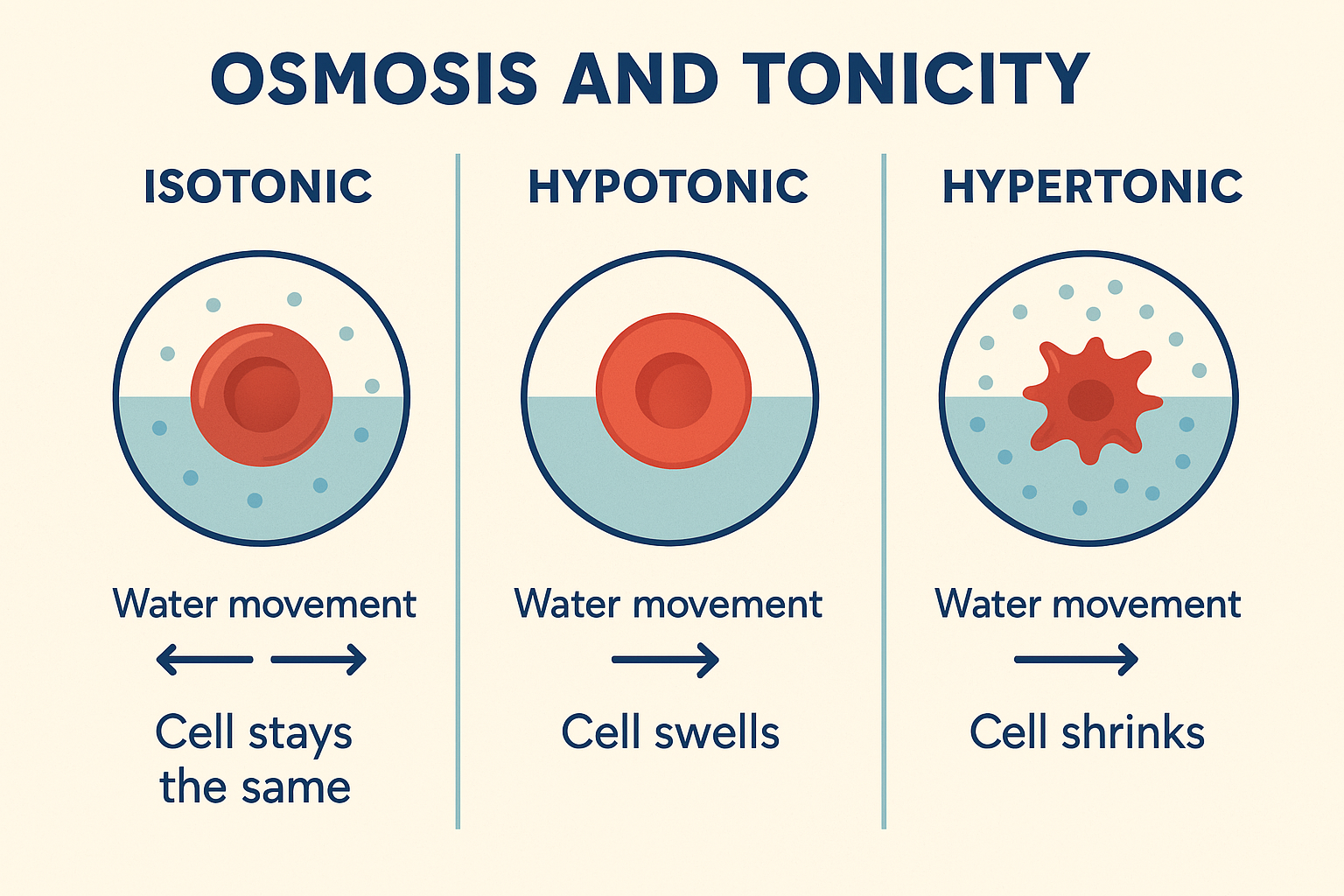
Salt goes the opposite direction of water
Isotonic- Everything stays the same
Hypotonic- Water comes in, salt goes out
Hypertonic- Water goes out, salt comes in