tumour_rupture
Introduction
Tumor rupture is a significant risk factor for recurrence after macroscopically complete resection of gastrointestinal stromal tumors (GISTs). This occurrence serves as a crucial indication for potentially implementing lifelong adjuvant therapy with imatinib, a targeted therapy for GISTs. However, the variability in reported incidences across various studies is largely due to the absence of a universally accepted definition for 'tumor rupture.' This inconsistency presents challenges in evaluating the true clinical significance and affects the outcomes when conducting multivariate analyses on retrospective data.
Proposed Definitions of Tumor Rupture
After extensive review of current literature and international guidelines, the authors propose six explicit criteria to define tumor rupture, grounded on the Oslo criteria:
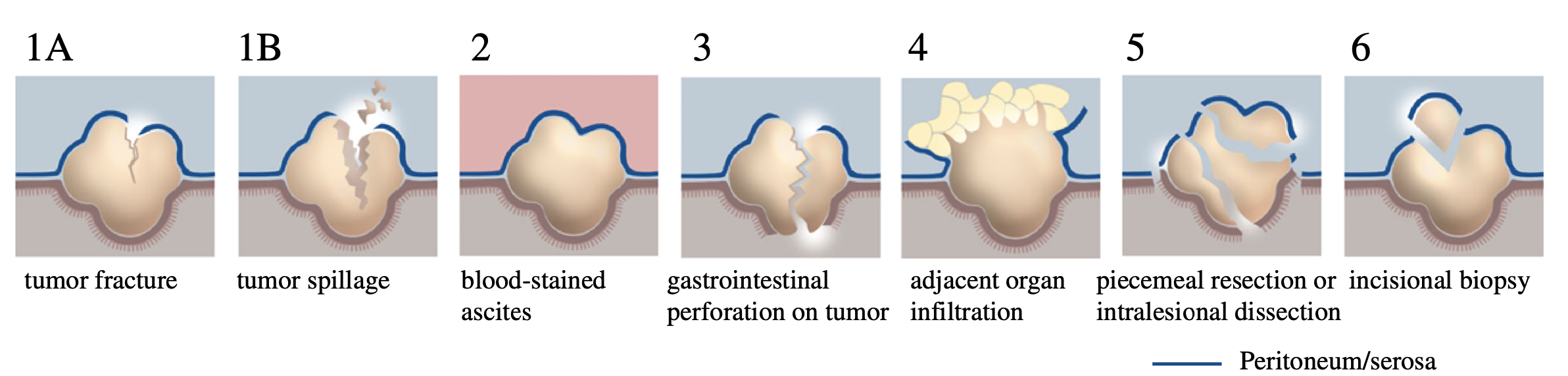
Tumor Fracture or Spillage: This criterion includes spontaneous or iatrogenic tumor fracture that results in the leakage of tumor content into the surrounding tissues or cavity, which often necessitates emergency surgical intervention, particularly if accompanied by hemorrhage.
Blood-Stained Ascites: Observations of blood-stained fluid in the abdominal cavity during laparotomy or laparoscopy frequently correlate with spontaneous tumor fracture, although macroscopic signs of rupture may not be present.
Gastrointestinal Perforation at the Tumor Site: This situation arises due to increased luminal pressure or inherent tumor fragility, which can lead to gastrointestinal obstruction or perforation, creating surgical emergencies that complicate treatment.
Microscopic Adjacent Organ Infiltration: This criterion indicates that there has been longstanding and aggressive biological behavior of the tumor, which often results in poor prognostic outcomes due to the tumor's invasive characteristics.
Piecemeal Resection or Intralesional Dissection: Surgical techniques that involve removing tumor tissue in pieces can result in a significant risk of tumor cell dissemination throughout the peritoneal cavity, further complicating the patient's prognosis.
Incisional Biopsy: While considered a type of piecemeal resection, incisional biopsy is generally discouraged in patients with resectable primary GISTs due to the associated risks of spreading tumor cells due to inadequate handling.
Minor defects, including conditions such as mucosal defects, contained spillage, microscopic tumor penetration of the peritoneum, and iatrogenic damage to the peritoneal lining, are not classified as tumor rupture according to these proposed definitions. Expanding this definition could enhance the identify GIST patients who are at particularly high risk for recurrence, although further investigation is needed to assess its applicability across other types of sarcomas.
Understanding Gastrointestinal Stromal Tumors (GISTs)
GISTs are classified as a subtype of sarcoma, accounting for approximately 15% of all sarcomas. These rare mesenchymal neoplasms occur in roughly 1% of all malignancies seen in adults, with an estimated incidence of around 1 per 100,000 individuals annually. Typically, they develop within the bowel wall—often the stomach or small intestine—and can grow aggressively into adjacent tissues, which may lead to spontaneous rupture and the dissemination of tumor cells into the peritoneal cavity, substantially worsening the overall oncologic outlook.
Surgical Considerations
When managing GISTs, surgical goals focus on achieving a macroscopically complete resection. However, surgical techniques that disrupt the tumor capsule can unintentionally lead to the dissemination of tumor cells, contributing to postoperative complications. The prognosis of GIST patients is evaluated using established risk stratification systems that consider numerous factors: tumor size, mitotic count, anatomical location, and the significant impact of clinical events, including tumor rupture.
The Need for a Precise Definition
Discrepancies in the incidences of tumor rupture reported in clinical studies—ranging from 1% to 27%—are primarily attributable to variations in definition use across those studies. Therefore, clarifying and standardizing the definition of tumor rupture becomes paramount. Uniform definitions enable more reliable comparisons of outcomes across various studies and enhance the prognostic understanding of GISTs, leading to improved patient management strategies.
Management of Tumor Rupture and Prognosis
The prognosis for GIST patients with tumor rupture presents a significantly dire outlook, with long-term relapse rates approaching 80%. Adjuvant therapy, predominantly utilizing imatinib, is often considered in cases of ruptured GISTs, although the overall efficacy of such treatment in preventing recurrences remains limited. Potential approaches to mitigate the risks associated with tumor rupture include the utilization of neoadjuvant therapy for larger tumors and ensuring careful referrals to specialized surgical centers dedicated to GIST management.
Relevance to Other Sarcomas
In comparison to GISTs, rupture occurrence is less common in other soft tissue sarcomas, often observed only in iatrogenic situations where improper surgical techniques or handling might lead to complications. The long-term effects of tumor rupture in broader classifications of sarcomas necessitate further research and an improved understanding of their implications for treatment and prognosis.
Conclusion
The lack of a consistent definition for tumor rupture in GISTs inherently complicates the evaluation of these tumors' prognostic implications. The authors propose a comprehensive definition to establish clearer guidelines for future studies and improve patient management. Ongoing research focused on refining these definitions is essential for enhancing clinical outcomes for patients with GISTs and similar sarcomas.