Police Organization + Administration
Content
Identifying the importance of Organizational Structures in Police Departments
Understand the Duties Associated within the Operations Division
Evaluate the extent of the militarization of police departments
MOST police agencies in the U.S. are effective and efficient.
Organizational Structures
Organizational structures of police departments can differ considerably depending on the style of policing and other interdependent variables; size of community, size of police force, and available resources.
Functions of police officers depend on the type of organization and positions officers occupy within the organization itself.
The structure of police organizations helps determine productivity, the manner in which goals are achieved, and influence of individual variations on the organization.
Changes have been implemented throughout these departments, however the principles continue to be retained.
Decision-making, centralized leadership, specializations.
In certain contexts, police organizations can be the same, but different.
Current & future organizational structures for the police must strie a balance between inclusiveness and the need for rapid responses, efficiency, and considerations for new advances for both crime & prevention.
Police Hierarchy
One area that remains in tact is the hierarchical structure of police administrations.
In this, a person’s position in the hierarchy dictates both rank and responsibilities.
Three important characteristics of these structures are unity of command, ran structure, and span of control.
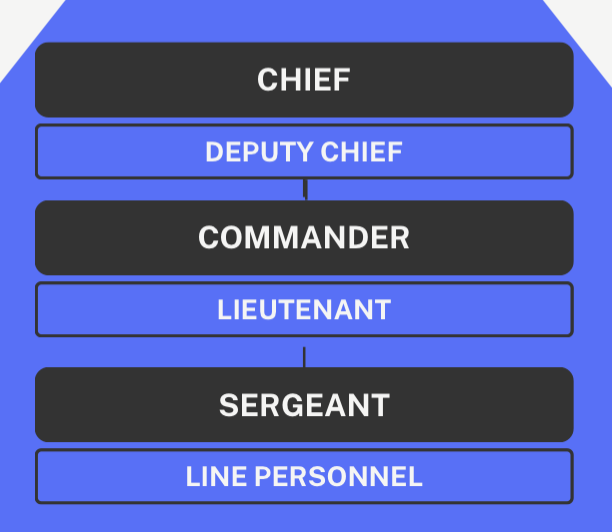
Characteristics
UoC
Unity of Command
Every member of the police organization reports to an immediate superior
Rank
Chain of command
Identification & orders to and from who firmly identifying lines of authority
SoC
Span of Control
Ratio of supervisors to subordoinates
Paramilitary Structure
1900s
Informal with the public leading to social problems with the police leading to social problems with he police
This caused lac of accountability, training, and supervision
Change in Direction
Created a top-down management, which led to a centralized control with classic principles established in the military.
Police adapted terminology, use of command, strong enforcement, resistance to change, and discouragement of creativity
Police Militarization
Bill of Rights established the distinction between officers and soldiers, and further codified in the Posse Comitatus Act of 1878. This act was established to limit federal government power in using military personnel for domestic law enforcement.
Police should maintain peace inside the country, military troops should protect interests outside its borders.
Prohibition Era is when the police became more militarized deploying armored cars and automatic weapons to counteract illegal alcohol bootlegging
SWAT team was created for the modern militarization protection toward the community. They handle extraordinary and dangerous situations with specialized and trained force. SWAT raids and deployments can be violent acts.
The SWAT team was primarily being used during Nixon’s no-knock raids and Bush’s War on Drugs.
Militarization on police does not stop there, instead Congress has established a program to reutilize military equipment within police departments.
Decentralized & Proactive
Decentralized
Community Policing has been a huge catalyst when speaking about organizational change toward decentralized and formalization of police
Discretion can be used but it’s not actively encouraged
Proactive
Proactive police work in contemporary society calls for organizations that achieve support for discretion at all levels, control, counseling, communication, positive reinforcement, flexibility in operations, decision-making skills, and adaptive to changes.
Encourages Discretion at all levels
Operations Divisions
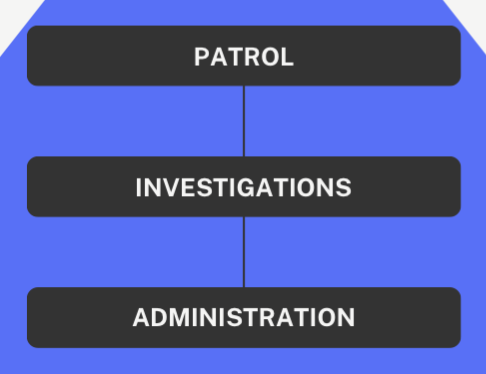
Operations
Patrol
Responsible for providing continuous police service and degree of visibilities.
Responds to calls for service, initial contact with victims, gathering evidence to an extent, making arrests, reports, and securing crime scenes.
Known as the backbone of the organization
Investigations
Subdivision of the operations division and is responsible for obtaining, processing, documenting, arresting, and solving crimes.
Glorified on media/tv
Extremely difficult job.
Specialized units
Administration
From record keeping, communication, research, planning, training, counseling, maintenance, advisors, and more - primarily civilian employees
Organized Substructures
Functional Designs
The creation of positions and departments based on specialized units. Depending on the size of the policing org, the number of specializations increase. FD is based on tasks performed by all police departments, but varies depending on size.
Geography
Place design involves establishing units geographically while retaining significant aspects of functional design.
City is divided accordingly and as it goes, officers are assigned.
Scheduling
Time design (24 hr coverage)
Officers can be scheduled form 8 hour shifts, plus overtime, different breaks, days of work, and more.
Functional Design in detail
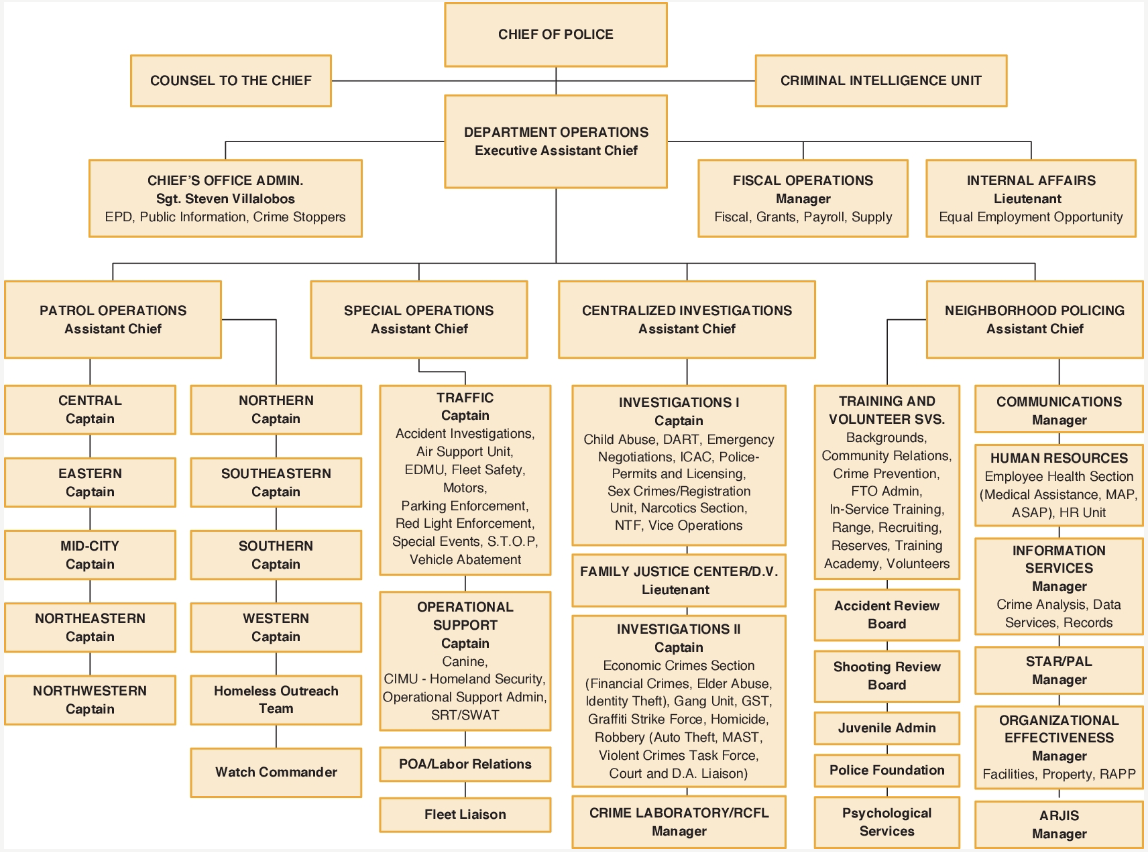
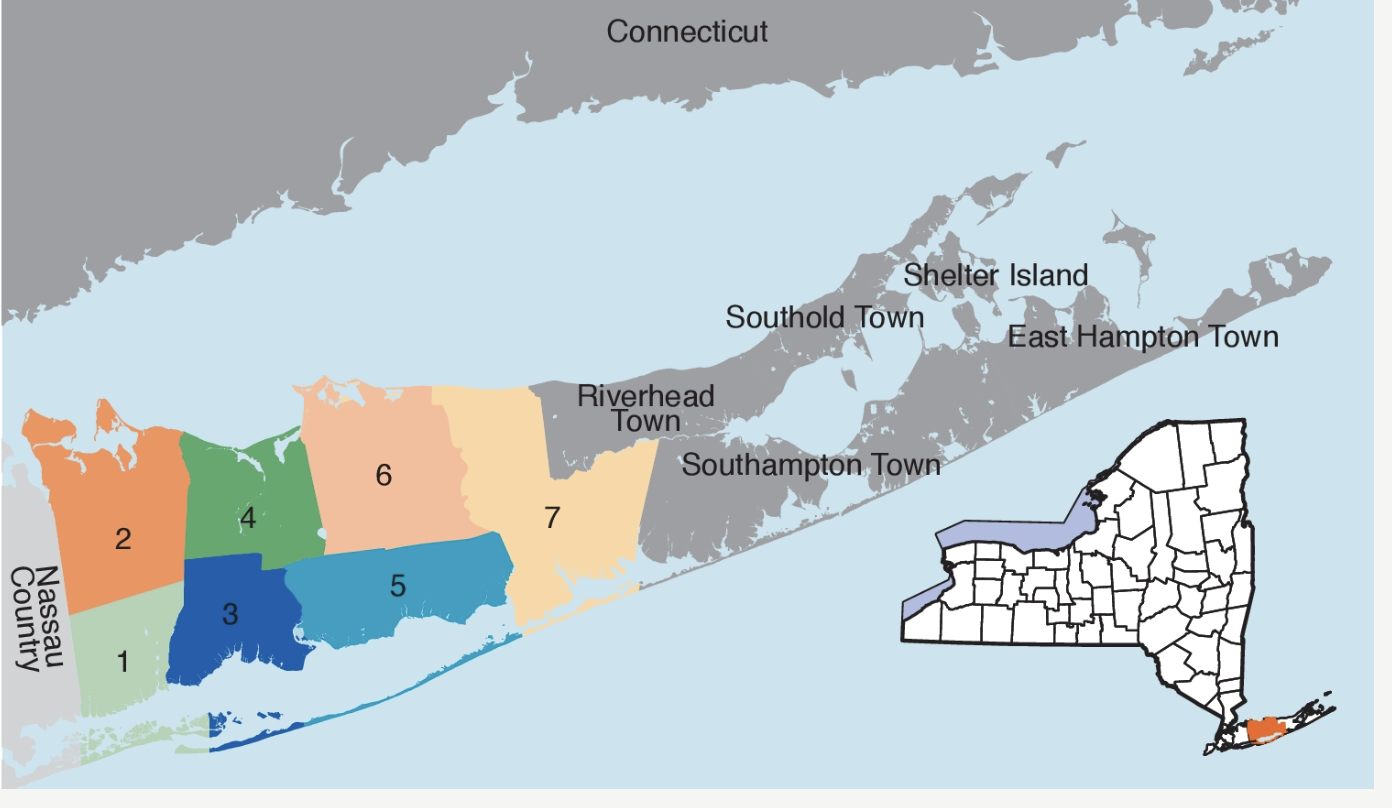
Handling Change
The way an organization deals with change tells us a great deal about its effectiveness and efficiency.
Change is a given within police; retirement, resignation, injuries, recruitments, promotions, resources, policies.
Change and innovations when applies to traditional organizations can impose and expose conflicting sets of expectations.
Change should be flexible, encourage initiative and allow exercise of discretion at any point.
Professionalism
Professionalism involves belonging to a profession, achieving a level of mastery and specialized knowledge, along with behaving within certain standards.
professionalism became a goal for policing during the Reform Era.
An example of what lead to professionalism was the Baltimore Police Strikes. Police officers gathered fighting for better wages and changes to policy. Police began a campaign of international misbehavior and silliness, making the department increase fires and looting. A negotiation was established between both parties, but still ended up in problems.
As policing evolved, characteristics of professionalism were established. This included professional literature (doctoral dissertations, FBI Bulletin, International Journal of Police Strategies), research, codes of ethic, memberships in professional associations, dedication to self-improvement, and existence of identifiable academic field of knowledge through higher education.