PL characters + themes
Characters
Adam
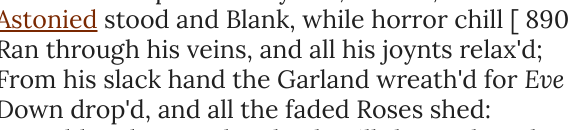
Milton shows how Adam freezes in shock and horror at her actions.
He also uses the garland to represent Adam’s changing emotions towards Eve.
Plosive alliteration of down dropped shows the strong shock he feels.
Additionally, the Garland made for Eve represented her as the most beautiful woman in his eyes, and him dropping this shows his love for her and her beauty is damaged by her action.
However, he still loves her too much to not fall with her, suggesting this may just foreshadow his fall alongside her.
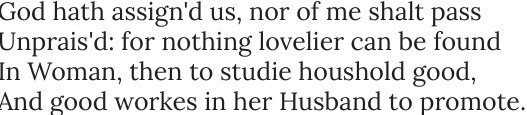
Adam attempts to remind Eve of her position, in order for her to agree with him and stop attempting to separate.
This attempt at persuasion could link to Satan’s attempts, however Adam fails, suggesting he is either not as skilled as Satan, or Eve does not respect him.
He uses the biblical idea that woman is the ‘help meet‘ of man, and therefore she should help him and look after the household.
She is shown to do this in book 5 of Paradise Lost, when she provides food for Raphael and Adam while they converse, showing her rebellion is new.
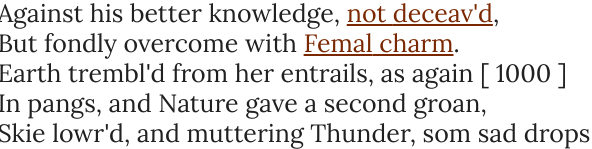
Adam eats the fruit against his better knowledge, unlike Eve, who eats it while not knowing death, suggesting he is more culpable in the situation.
Additionally, he was not persuaded by Eve, and therefore fully used his own free will in the situation.
However, this could also present that Eve, and therefore women, were the sole cause of the fall of mankind - Adam only ate the apple because she did.
Milton uses pathetic fallacy to highlight the suffering of the world, similarly to the classical references he uses to describe creation where nature gives birth to earth.
They seem to react worse to Adam’s fall, which could be due to the fact now both of them have fallen, or that the man fell.
This suggests that the woman is replaceable, as both Adam and Eve feared, showing that Milton believes women are less valuable.
This could reflect on him having 3 wives, 2 of which died in childbirth.
Additionally, this happens on line 999, an inversion of the devil’s number according to numerology.
Earlier in book 2 sin arrives on line 666, suggesting Milton agrees with numerology, perhaps seeing it as another scientific field to ‘justify the ways of God to man‘.
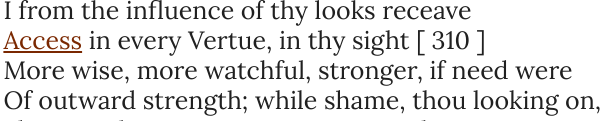
Adam continues to attempt to persuade Eve, and instead of reminding her of her purpose here suggests he works better with her present.
This is a classical idea - from Plato’s symposium, the army of lovers. He believed this would be an invincible army, as they would strive to impress each other and avoid embarrassment.
It was also a well-liked idea at the time, with Cavalier poets such as Herrick saying ‘A deal of courage in each bosom springs by your access‘ when writing a poem describing the arrival of the King to the warfront.
However, Eve does not address this idea, suggesting she disagrees.
Milton also heavily disliked Cavalier poets, suggesting he believes this is a naive idea from Adam, whose sin is to love Eve too much.
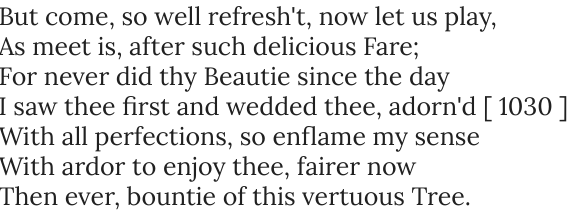
Adam persuades Eve to have sex after they eat the apple, showing that they have now become sinful and lustful after consuming the apple.
Milton especially disliked lust, believing a major purpose of marriage was to avoid the sin.
This is especially due to Cavalier poets writing positive things about such sins, which he would have vehemently opposed, such as Suckling writing ‘Tis not the meat, but ‘tis the appetite Makes eating a delight‘.
‘now let us play‘ is contrary to Milton’s Calvinist values of the importance of work, especially as they have done nothing to deserve such fun.
Fire imagery is used, which could be seen as the fire of lust, but also the fire of hell that is consuming them as they have now falling.
Eve
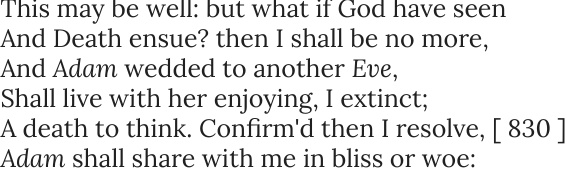
Eve shows her jealousy after eating the apple, showing that she is quickly becoming sinful after she has fallen.
Additionally, her opposal to Adam finding another Eve could portray her as anti-divorce, which Milton liked.
She also mimics wedding vows when she decides she will persuade Adam to also eat the apple, showing they shall be married and sin.
This could suggest she does not properly love Adam, as she is completely okay with condemning him to die alongside her.
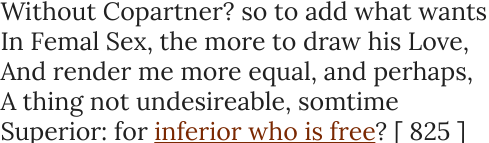
Eve aspires to be equal to man, which can be seen as a massive overreach as Milton believed women were naturally inferior as they were made for man.
‘Who can be ignorant that woman was created for man, and not man for woman?‘
Additionally, she echoes Satan’s beliefs that you cannot be inferior when free, she as she is a woman, and him as primogeniture exists in heaven and God’s son was favoured over him.
Therefore, both Satan and Eve oppose patriarchal ideas.
Milton also agreed with Satan, believing that everyone should be born free and Kings should not exist, suggesting it is only his own bigotry that stops him agreeing with Eve.
‘All men naturally were born free … born to command and not to obey‘.
Eve also agrees with early feminist ideas.
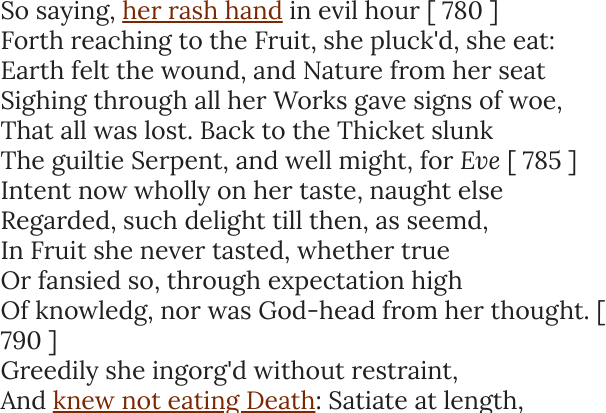
Milton emphasises the speed of her decision by quickly describing her plucking and eating the fruit, showing her as impulsive.
Milton uses pathetic fallacy to highlight the suffering of the world, similarly to the classical references he uses to describe creation where nature gives birth to earth.
Additionally, it shows that Satan’s persuasion worked, as she is considering becoming a God as he suggested.
This shows her as similar to him, as he also wished to be a God.
However, it also suggests she wouldn’t have eaten the apple if not for Satan’s persuasion, suggesting she cannot be fully blamed.
It also shows her unaware of the true consequences of her actions, unlike Adam, suggesting he is more to blame than her.

Eve suggests that his eating of the apple was proof of their love, as he is willing to disobey God for her.
The language used is anti faith, as it follows a branch of epistemology (the study of knowledge) known as empiricism, which is the idea that only what is seen or experienced can be believed.
This cannot coincide with faith, as God is not visible. Instead, Milton was a rationalist, as if God was included in rational thinking. Therefore, this view of knowledge can fit with God’s existence.
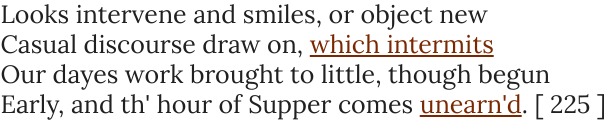
Eve agrees with Milton’s Calvinist ideas that work is needed to give man dignity, and is a form of worship to God, therefore it is included in his idea of Eden.
This is also a classical idea, that works makes things more satisfying and therefore joy can be earned.
This is shown via Latin language, with negotium (work) being the opposite of fun (otium).
However, this contrasts her past wishes to be with Adam, such as her avoiding a conversation between Raphael and Adam in book 8 so she can hear it from Adam, who will intermingle it with kisses.
Her sudden avoidance could be linked to Satan whispering to her in book 4, causing her to dream of her future sin.
It could also show her wanting to assert her independence as a woman.
Adam and Eve
Milton shows how Adam freezes in shock and horror at her actions.
He also uses the garland to represent Adam’s changing emotions towards Eve.
Plosive alliteration of down dropped shows the strong shock he feels.
Additionally, the Garland made for Eve represented her as the most beautiful woman in his eyes, and him dropping this shows his love for her and her beauty is damaged by her action.
However, he still loves her too much to not fall with her, suggesting this may just foreshadow his fall alongside her.

Eve suggests that his eating of the apple was proof of their love, as he is willing to disobey God for her.
The language used is anti faith, as it follows a branch of epistemology (the study of knowledge) known as empiricism, which is the idea that only what is seen or experienced can be believed.
This cannot coincide with faith, as God is not visible. Instead, Milton was a rationalist, as if God was included in rational thinking. Therefore, this view of knowledge can fit with God’s existence.
Eve shows her jealousy after eating the apple, showing that she is quickly becoming sinful after she has fallen.
Additionally, her opposal to Adam finding another Eve could portray her as anti-divorce, which Milton liked.
She also mimics wedding vows when she decides she will persuade Adam to also eat the apple, showing they shall be married and sin.
This could suggest she does not properly love Adam, as she is completely okay with condemning him to die alongside her.
Adam attempts to remind Eve of her position, in order for her to agree with him and stop attempting to separate.
This attempt at persuasion could link to Satan’s attempts, however Adam fails, suggesting he is either not as skilled as Satan, or Eve does not respect him.
He uses the biblical idea that woman is the ‘help meet‘ of man, and therefore she should help him and look after the household.
She is shown to do this in book 5 of Paradise Lost, when she provides food for Raphael and Adam while they converse, showing her rebellion is new.
Adam eats the fruit against his better knowledge, unlike Eve, who eats it while not knowing death, suggesting he is more culpable in the situation.
Additionally, he was not persuaded by Eve, and therefore fully used his own free will in the situation.
Milton uses pathetic fallacy to highlight the suffering of the world, similarly to the classical references he uses to describe creation where nature gives birth to earth.
They seem to react worse to Adam’s fall, which could be due to the fact now both of them have fallen, or that the man fell.
This suggests that the woman is replaceable, as both Adam and Eve feared, showing that Milton believes women are less valuable.
This could reflect on him having 3 wives, 2 of which died in childbirth.
Additionally, this happens on line 999, an inversion of the devil’s number according to numerology.
Earlier in book 2 sin arrives on line 666, suggesting Milton agrees with numerology, perhaps seeing it as another scientific field to ‘justify the ways of God to man‘.
Satan
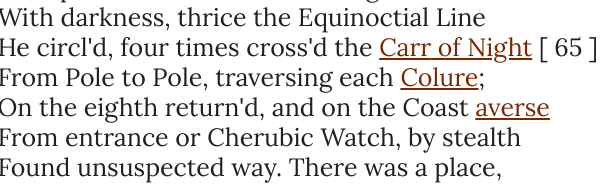
The ‘Carr of Night‘ Satan remaining in night as it moves around the Earth, therefore avoiding the watchful eyes of the Cherubin.
This knowledge of how this works shows him as incredibly Erudite - again likely referencing his meetings with Galileo.
It also shows how Milton wanted to ‘justify the ways of God to man‘. Unlike the Catholic Church who arrested Galileo, he wishes to be realistic to science to properly justify God.
It also shows him as an erudition - incredibly learned.
The eighth night could be seen as a reference to God resting on the 7th day, as all of man does, therefore further separating Satan from God and showing his desperation and anger.
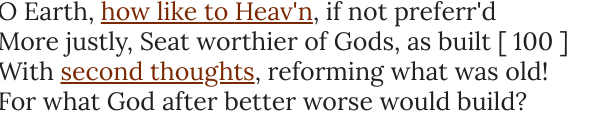
Satan echoes both Raphael in book 5, but also the Lord’s prayer.
This shows that he is mimicking angels, perhaps showing him as similar to them or mocking them in his own thoughts, showing his hatred and determination.
This could be seen as linked to Plato’s platonic forms - the idea that ideas (forms) are timeless and unchanging, but physical things are always changing.
Earth, therefore, is a form and imprint of heaven.
Satan echoes the arguments of early feminists, such as Soheman, who argued women were superior to men due to them being created second.
By putting it in Satan’s mouth, he shows his opposition, but he also wrote about this in his second edition of the divorce tracts, which focused on male domination and attacking female pride.
‘who can be ignorant that woman was created for man, and not man for woman?‘
His echoing of multiple points could show his lack of his own opinion.
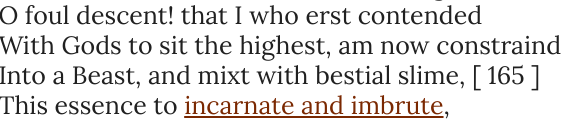
He uses an interjection and an exclamation mark to show his distress at his fall from grace.
Could link to Milton being forced out of his role as Secretary of Tongues, arrested, and forced to write poetry.
Links to Milton writing as Satan as one of the best and most loved angels.
Could link to tragic stories, such as the Odyssey, which Milton would have been familiar with - Satan’s fall from a great height would be more dramatic.
The alliteration of ‘incarnate and imbrute’ highlights them.
Additionally, the word incarnation shows this as opposite to Jesus’ incarnation, Jesus becomes a man and Satan becomes a beast, highlighting his lower nature.
Additionally, ‘constraind‘ shows he believes it is God’s fault he does this, and not of his own free will, which is truly what God has granted him - Areopagitica link.

Satan, disguised as the snake, suggests to Eve that God may be jealous of her.
He does this using two classical forms of repetition, diaphora and epizeuxis.
He therefore suggests that man can be Godlike, which convinces Eve to oppose God, similar to his jealousy of the Son causing him to oppose God.
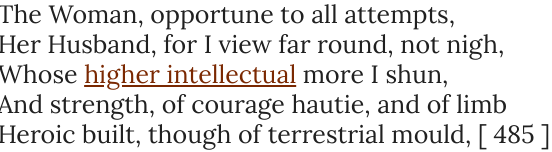
Satan says that man is intellectually superior to woman, an idea Milton would agree with.
He believed that women had no intellectual needs, unlike man.
Eve is also presented this way throughout the book, with her inability to recognise the serpent as Satan and her preference for hearing conversations through Adam and he kisses her while doing it in book 8.
Additionally, this shows Satan going for the weaker target, as he also did in book 4, showing he is scared of Adam and potentially the wrath of the angels.
God
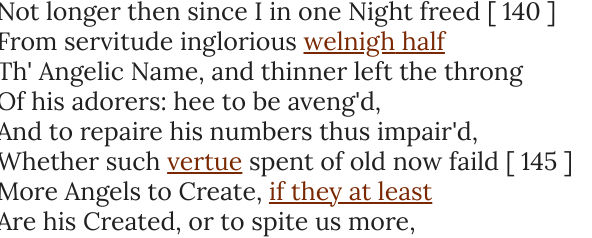
Satan shows his lying nature.
He claims that he freed ‘welnigh half‘, when before this was mentioned to be only a third in book 2.
He says ‘if they at least‘ referencing that he declared he was not created by God in book 5, but also admitted he was created by God in book 4, showing this as an insecurity of his.
Additionally, it shows he doubts God’s omnipotence.
Satan, disguised as the snake, suggests to Eve that God may be jealous of her.
He does this using two classical forms of repetition, diaphora and epizeuxis.
He therefore suggests that man can be Godlike, which convinces Eve to oppose God, similar to his jealousy of the Son causing him to oppose God.

Eve attempts to convince herself that God has not seen her sin.
She uses epizeuxis, a classical figure of repetition, similar to Satan, showing she is becoming more like him.
Additionally, this shows her doubting God’s omniscience. However, the fact he has not intervened does suggest he was not watching her.

Adam reflects on how their fall looks bad for God, especially after Satan’s.
However, this could reflect on his true feelings, that God allowed for both Adam and Satan to fall, as he tells the son in book 3.
This could highlight his lack of omnibenevolence, he doesn’t love his subjects enough to save them from their own fates.
Adam could also be seen as mimicking Satan right before he falls, showing that he has basically already fallen by deciding to eat the apple.

References how all creatures, including humans, cannot receive any harm in Eden, and how God allowed them free will.
This is due to Sin and Death not entering the world yet, as man has not fallen.
Additionally, this references how God allows free will, as he discusses in book 3.
This idea of free will is slightly infringed by God knowing that Adam and Eve would fall, as he tells the son.
Additionally, it shows Milton’s agreement with rationality and free will.
He advocates for free will in Areopagitica, believing that this is necessary for a true understanding of good and evil.
However, Adam and Eve have not yet eaten from the tree of knowledge, suggesting they cannot fully reason yet.
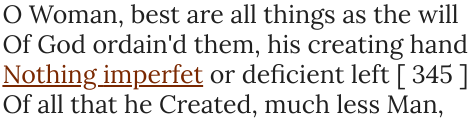
Adam becomes angry with Eve for insisting they separate, and for insinuating Eden is not perfect.
‘O woman‘ uses a poetic apostrophe, showing him harshly addressing her.
Women is additionally harsh, as it is done to remind Eve of her origin from Adam’s rib, as in Genesis 2.23 Adam names her woman as she came from man.
Therefore, she is beneath him and should obey him.
‘Nothing imperfet‘ was only true after Eve’s creation, as Adam’s single imperfection was loneliness.
This links to the Doctrine and Discipline of Divorce, where Milton asserts marriage exists ‘against the evil of a solitary life‘.
However, it could also link to Soheman’s argument that ‘what God, after better, worse would build‘ when arguing for female superiority.
Adam therefore says this to Eve to remind her she is beneath him.
Tree
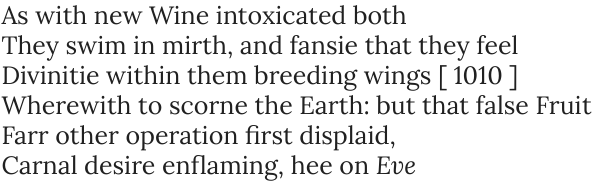
Milton shows that the fruit is akin to a drug, such as alcohol, in how it affects Adam and Eve.
New wine is used to show the strength of it, as wine loses it’s alcoholic content over time.
They are both shown to go slightly insane, genuinely feeling as they are becoming divine, even though Adam was aware this wasn’t true.
The fricative alliteration shows the harshness of their real situation, underneath their belief of it giving them power.
It also makes them lustful, showing they have begun to sin now they have fallen.
Milton emphasises the speed of her decision by quickly describing her plucking and eating the fruit, showing her as impulsive.
Milton uses pathetic fallacy to highlight the suffering of the world, similarly to the classical references he uses to describe creation where nature gives birth to earth.
Additionally, it shows that Satan’s persuasion worked, as she is considering becoming a God as he suggested.
This shows her as similar to him, as he also wished to be a God.
However, it also suggests she wouldn’t have eaten the apple if not for Satan’s persuasion, suggesting she cannot be fully blamed.
It also shows her unaware of the true consequences of her actions, unlike Adam, suggesting he is more to blame than her.
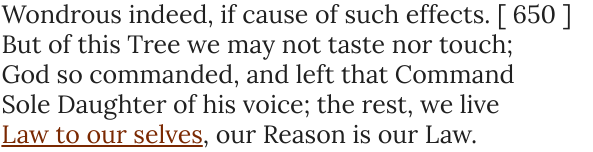
Eve informs the snake that she cannot eat the tree, no matter the consequence.
This can be seen as dramatic irony - all audiences would know from the beginning of the story that she would indeed eat the apple.
She echoes Genesis 3.3, where God informs Adam and Eve they cannot eat from the tree, again showing that milton based this story on the original Bible story.
This being his only command highlights his belief in free will, which is how Milton perceives God.
Reason is our law is a reference to Paul’s remark in the Bible that gentiles lived outside Hebrew law, but still had their own laws.
This was a positive, as reason is supported by God.
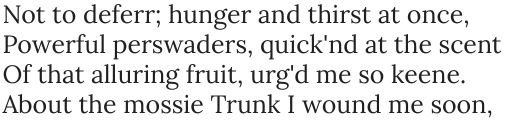
The snake’s ability to only perceive bodily pleasures is emphasised, as he is persuaded by simple hunger and first.
The plosive alliteration emphasises their strength.
The phrase quickened means his hunger and thirst had awakened, but could also refer to the quickening of a foetus being it’s first movement. Therefore, his reason is awakening.
However, Satan is again lying about the tree, as he never ate it and is not actually a snake. Therefore, his description should be doubted.
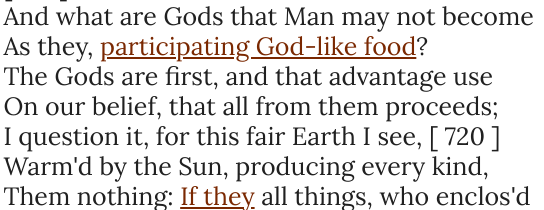
Satan questions the difference between God and Man, which could be seen as similar to Milton questioning the difference between Kings and Man in his On The Tenure of Kings and Magistrates.
He was against the great chain of being, as he believed all human beings were born free, but he does seemingly believe in the great chain of being as it relates to Gods and angels.
Satan here seems to doubt that God is above anyone, which could link to his own jealousy at God’s greater power, his focus is emphasised by a mesodiplosis like repetition.
Contrary to his assertion, Raphael told both Adam and Eve they would be allowed to eat the diet of angels if they remained obedient. Due to Eve’s actions, they will never be allowed to consume it.
God-like food likely is a reference to ambrosia, the food of the Gods in Greco-Roman myth.
Satan asserts that is the sun that creates energy for the world, and not God, however it was God who created the sun in Genesis 1.1.
However, this is a scientific truth, as all energy originates from the sun, as this is absorbed by plants.
Snake
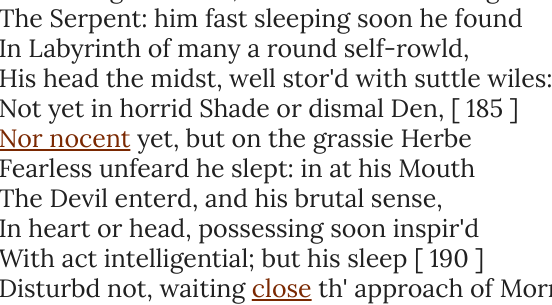
Satan finds and possesses the snake when he is sleeping, emphasising that he is too scared to do this when the snake is awake.
The snake is described as being a labyrinth of rolls, which is likely a reference to the minotaur, with Satan being the monster hidden in the centre - or at least, soon to be.
Nor nocent emphasises the fact that the snake is innocent, as it is not yet cursed to bruise the heel, and have it’s head bruised.
Currently, it moves upwards, and does not crawl across the floor.
However, this brings up the question of whether the snake ever becomes guilty, as he never consciously sins, as he is never actually conscious. Therefore, his punished can be seen as unfair.
When the devil possesses the snake, he inspires it to have intelligent thought, but the snake never wakes, suggesting he is completely unaware of anything that transpires.
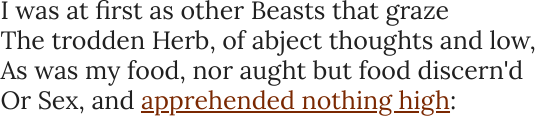
Milton describes how he believes a snake would think.
He bases this on Nicomachean ethics, where animals and children only experience bodily pleasures and nothing higher.
If this is true, how can the snake ever be considered guilty if he was never capable of reason.
Animals are often for this reason considered not able to sin, as they are unable to become aware of God in order to purposely break his laws - they only have instincts.
However, Satan has never experienced this, and it is highly likely a false account.
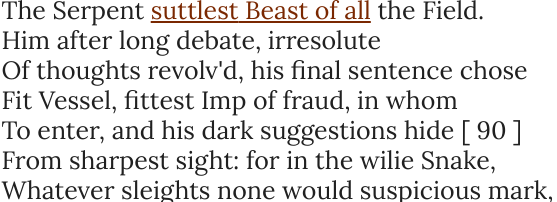
Satan describes his decision making process in choosing to possess the snake.
This directly echoes his description in Genesis 3.1 ‘serpent was more subtil than any beast of the field‘.
This is highlighted by the sibilance, showing sneakiness but also the hissing sound of a snake, perhaps showing satan is beginning to become more snake light.
‘Sharpest sight‘ could be said to imply the sight of God, which would make no sense as God is omniscient, he would see everything whether Satan hid or not.
Inconsistent omni triad.
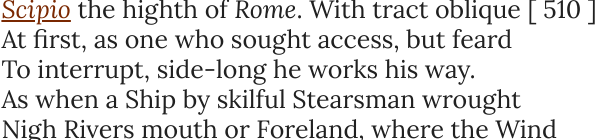
The acrostic SATAN shows that satan is hidden within the snake, but also that satan is hidden within Eden.
Sibilance again highlights the sound of a snake.
The snake is described as shiplike, showing it possesses no conscious thought and is just controlled by satan.
This again brings up the question of whether he can be blamed for his actions.
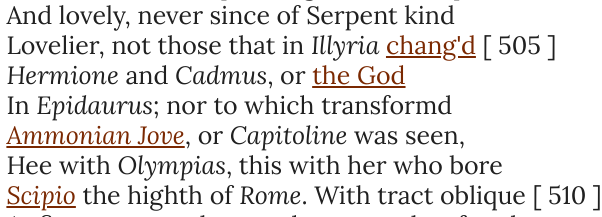
Milton describes the snake, done in a way to highlight his beauty as God’s creation over all the false myths before him.
Illyria changed references Ovid’s metamorphosis, which includes the story of Cadmus and Harmonia into snakes.
This was done as a punishment, perhaps linking to Satan seeing himself as punished by God and forced into his snakely form.
Additionally, Harmonia asks to also become a snake once Cadmus is turned, perhaps foreshadowing the fate of Adam to fall - become snakelike - as Eve did.
The God in Epidaurus references another Ovid story within the metamorphosis.
This is of the God of healing, Aesculapius, who appeared in his temple in Epidaurus in the body of a snake.
This imagery - of Aesculapius surrounding a staff - is currently the WHO logo.
He then references the conception stories of Alexander the Great and Scipio Africanus, by the Macedonians and Romans respectively.
Their mothers were visited by snakes, in Alexander’s case specifically Zeus, and were conceived then.
This could link to Eve, as the fruit can be seen as a symbolism for sex, and Satan’s following of Eve is described used rape-like imagery.

The serpent has now become guilty, even though it consciously did nothing as it was possessed by Satan and had no ability for reason.
This could suggest that Milton simply had to make the snake guilty, as in the Bible it was punished by bruising heel and having it’s head bruised - genesis 3.15.
To stick true to the source material, the snake must therefore be found guilty.
Alternatively, Milton believes the snake had some strength to deny Satan, or to not have betrayed God, but there is no sign in the text of the snake even having the ability to recognise it’s own possession.
The serpent leaving suggests that Satan is running away from what he had done, as he is fearful of God’s punishment.
Ideas
Eden
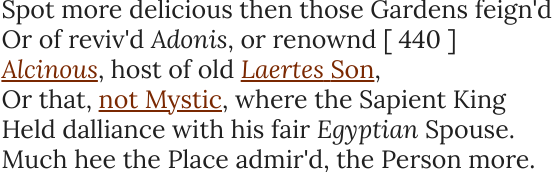
Satan’s description of Eden shows the beauty of God’s creation, but is ultimately done to highlight the beauty of Eve, and therefore mankind, in comparison, showing that humanity is the best of God’s creation.
The gardens of Adonis were commonly compared to Eden.
He references the gardens of Alcinous, which were visited by Odysseus in the Odyssey, written by Homer.
This highlights Milton’s classical knowledge, and Eden’s superiority.
The sapient King refers to King Solomon from the Bible, who had a renowned garden with his wife, showing Milton’s biblical knowledge.
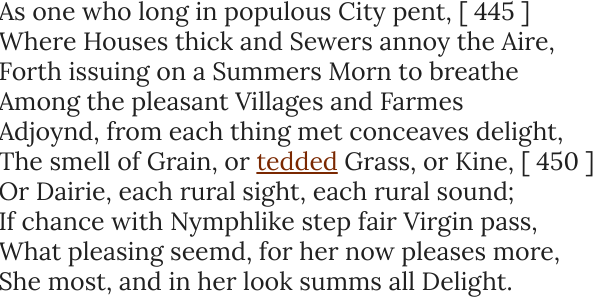
Milton compares Satan’s experience of Eden after hell to leaving a city for the countryside.
This is likely due to his experience of London, which during this time period did not have a proper sewage system and therefore was likely quite disgusting.
Milton uses many techniques of classical repetition in order to highlight the beauty of the countryside and Eden, such as polysyndeton, tautology and diaphora.
Sibilance is also used, perhaps highlighting the presence of satan and the snake throughout
He refers to Eve as a virgin, although she is likely not, as she is said to have sex with Adam in book 4.
However, this was within marriage, meaning she did not lose her virginity according to Milton.
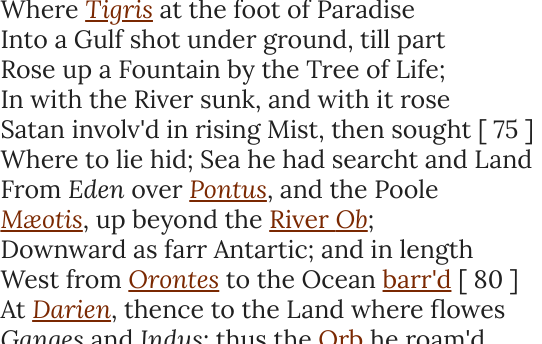
Milton then goes on to describe Eden, representing both his Biblical and Erudite knowledge.
Tigris is a direct Bible reference, as this is one of four rivers that links to Eden.
Pontus is a reference to the Pontus Euxinus, which is the name for the black sea on some Latin maps.
Poole Maeotis is another sea, again showing his in depth geographical knowledge.
River Ob is the 4th largest river in the world.
Orentes is a river in the middle East.
This shows how scared Satan is of the wrath of God, the angels and the Cherubs, as his extensive hiding shows he cannot manage a direct confrontation.
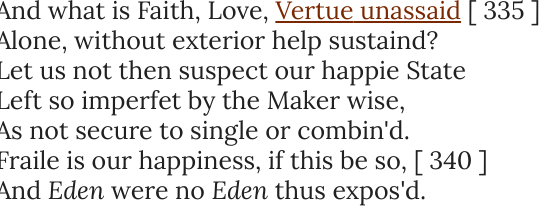
Eve argues that ideas of faith, and Eden, are weak if Adam is so fearful of them being easily dismantled.
Vertue unassayed echoes Milton’s belief that faith is not strong enough unless it can be challenged by different ideas, highlighting his beliefs in free speech from Areopagitica.
‘knowledge of good is … interwoven with the knowledge of evil.‘
However, Eve says this when attempting to convince Adam to allow her alone so she will overcome Satan, which she obviously doesn’t do.
Either Milton now disagrees with free speech, or believes women are too feeble to withstand the intellectual challenge that comes with free speech.
Eve uses diacope to compare the idea of Eden as a perfect paradise, and the place that they actually live.
Therefore, paradise cannot exist if it can be so easily be challenged and taken from them by Satan’s arrival.
Women
Eve aspires to be equal to man, which can be seen as a massive overreach as Milton believed women were naturally inferior as they were made for man.
‘Who can be ignorant that woman was created for man, and not man for woman?‘
Additionally, she echoes Satan’s beliefs that you cannot be inferior when free, she as she is a woman, and him as primogeniture exists in heaven and God’s son was favoured over him.
Therefore, both Satan and Eve oppose patriarchal ideas.
Milton also agreed with Satan, believing that everyone should be born free and Kings should not exist, suggesting it is only his own bigotry that stops him agreeing with Eve.
‘All men naturally were born free … born to command and not to obey‘.
Eve also agrees with early feminist ideas.
Satan says that man is intellectually superior to woman, an idea Milton would agree with.
He believed that women had no intellectual needs, unlike man.
Eve is also presented this way throughout the book, with her inability to recognise the serpent as Satan and her preference for hearing conversations through Adam and he kisses her while doing it in book 8.
Additionally, this shows Satan going for the weaker target, as he also did in book 4, showing he is scared of Adam and potentially the wrath of the angels.
Adam attempts to remind Eve of her position, in order for her to agree with him and stop attempting to separate.
This attempt at persuasion could link to Satan’s attempts, however Adam fails, suggesting he is either not as skilled as Satan, or Eve does not respect him.
He uses the biblical idea that woman is the ‘help meet‘ of man, and therefore she should help him and look after the household.
She is shown to do this in book 5 of Paradise Lost, when she provides food for Raphael and Adam while they converse, showing her rebellion is new.
Adam eats the fruit against his better knowledge, unlike Eve, who eats it while not knowing death, suggesting he is more culpable in the situation.
Additionally, he was not persuaded by Eve, and therefore fully used his own free will in the situation.
However, this could also present that Eve, and therefore women, were the sole cause of the fall of mankind - Adam only ate the apple because she did.
Milton uses pathetic fallacy to highlight the suffering of the world, similarly to the classical references he uses to describe creation where nature gives birth to earth.
They seem to react worse to Adam’s fall, which could be due to the fact now both of them have fallen, or that the man fell.
This suggests that the woman is replaceable, as both Adam and Eve feared, showing that Milton believes women are less valuable.
This could reflect on him having 3 wives, 2 of which died in childbirth.
Additionally, this happens on line 999, an inversion of the devil’s number according to numerology.
Earlier in book 2 sin arrives on line 666, suggesting Milton agrees with numerology, perhaps seeing it as another scientific field to ‘justify the ways of God to man‘.
Free will
Eve argues that ideas of faith, and Eden, are weak if Adam is so fearful of them being easily dismantled.
Vertue unassayed echoes Milton’s belief that faith is not strong enough unless it can be challenged by different ideas, highlighting his beliefs in free speech from Areopagitica.
‘knowledge of good is … interwoven with the knowledge of evil.‘
However, Eve says this when attempting to convince Adam to allow her alone so she will overcome Satan, which she obviously doesn’t do.
Either Milton now disagrees with free speech, or believes women are too feeble to withstand the intellectual challenge that comes with free speech.
Eve uses diacope to compare the idea of Eden as a perfect paradise, and the place that they actually live.
Therefore, paradise cannot exist if it can be so easily be challenged and taken from them by Satan’s arrival.
Eve aspires to be equal to man, which can be seen as a massive overreach as Milton believed women were naturally inferior as they were made for man.
‘Who can be ignorant that woman was created for man, and not man for woman?‘
Additionally, she echoes Satan’s beliefs that you cannot be inferior when free, she as she is a woman, and him as primogeniture exists in heaven and God’s son was favoured over him.
Therefore, both Satan and Eve oppose patriarchal ideas.
Milton also agreed with Satan, believing that everyone should be born free and Kings should not exist, suggesting it is only his own bigotry that stops him agreeing with Eve.
‘All men naturally were born free … born to command and not to obey‘.
Eve also agrees with early feminist ideas.
He uses an interjection and an exclamation mark to show his distress at his fall from grace.
Could link to Milton being forced out of his role as Secretary of Tongues, arrested, and forced to write poetry.
Links to Milton writing as Satan as one of the best and most loved angels.
Could link to tragic stories, such as the Odyssey, which Milton would have been familiar with - Satan’s fall from a great height would be more dramatic.
The alliteration of ‘incarnate and imbrute’ highlights them.
Additionally, the word incarnation shows this as opposite to Jesus’ incarnation, Jesus becomes a man and Satan becomes a beast, highlighting his lower nature.
Additionally, ‘constraind‘ shows he believes it is God’s fault he does this, and not of his own free will, which is truly what God has granted him - Areopagitica link.
References how all creatures, including humans, cannot receive any harm in Eden, and how God allowed them free will.
This is due to Sin and Death not entering the world yet, as man has not fallen.
Additionally, this references how God allows free will, as he discusses in book 3.
This idea of free will is slightly infringed by God knowing that Adam and Eve would fall, as he tells the son.
Additionally, it shows Milton’s agreement with rationality and free will.
He advocates for free will in Areopagitica, believing that this is necessary for a true understanding of good and evil.
However, Adam and Eve have not yet eaten from the tree of knowledge, suggesting they cannot fully reason yet.
Temptation
The snake’s ability to only perceive bodily pleasures is emphasised, as he is persuaded by simple hunger and first.
The plosive alliteration emphasises their strength.
The phrase quickened means his hunger and thirst had awakened, but could also refer to the quickening of a foetus being it’s first movement. Therefore, his reason is awakening.
However, Satan is again lying about the tree, as he never ate it and is not actually a snake. Therefore, his description should be doubted.
Eve agrees with Milton’s Calvinist ideas that work is needed to give man dignity, and is a form of worship to God, therefore it is included in his idea of Eden.
This is also a classical idea, that works makes things more satisfying and therefore joy can be earned.
This is shown via Latin language, with negotium (work) being the opposite of fun (otium).
However, this contrasts her past wishes to be with Adam, such as her avoiding a conversation between Raphael and Adam in book 8 so she can hear it from Adam, who will intermingle it with kisses.
Her sudden avoidance could be linked to Satan whispering to her in book 4, causing her to dream of her future sin.
It could also show her wanting to assert her independence as a woman.
Satan questions the difference between God and Man, which could be seen as similar to Milton questioning the difference between Kings and Man in his On The Tenure of Kings and Magistrates.
He was against the great chain of being, as he believed all human beings were born free, but he does seemingly believe in the great chain of being as it relates to Gods and angels.
Satan here seems to doubt that God is above anyone, which could link to his own jealousy at God’s greater power, his focus is emphasised by a mesodiplosis like repetition.
Contrary to his assertion, Raphael told both Adam and Eve they would be allowed to eat the diet of angels if they remained obedient. Due to Eve’s actions, they will never be allowed to consume it.
God-like food likely is a reference to ambrosia, the food of the Gods in Greco-Roman myth.
Satan asserts that is the sun that creates energy for the world, and not God, however it was God who created the sun in Genesis 1.1.
However, this is a scientific truth, as all energy originates from the sun, as this is absorbed by plants.
Milton shows that the fruit is akin to a drug, such as alcohol, in how it affects Adam and Eve.
New wine is used to show the strength of it, as wine loses it’s alcoholic content over time.
They are both shown to go slightly insane, genuinely feeling as they are becoming divine, even though Adam was aware this wasn’t true.
The fricative alliteration shows the harshness of their real situation, underneath their belief of it giving them power.
It also makes them lustful, showing they have begun to sin now they have fallen.
Satan, disguised as the snake, suggests to Eve that God may be jealous of her.
He does this using two classical forms of repetition, diaphora and epizeuxis.
He therefore suggests that man can be Godlike, which convinces Eve to oppose God, similar to his jealousy of the Son causing him to oppose God.
Fall of mankind
Adam eats the fruit against his better knowledge, unlike Eve, who eats it while not knowing death, suggesting he is more culpable in the situation.
Additionally, he was not persuaded by Eve, and therefore fully used his own free will in the situation.
However, this could also present that Eve, and therefore women, were the sole cause of the fall of mankind - Adam only ate the apple because she did.
Milton uses pathetic fallacy to highlight the suffering of the world, similarly to the classical references he uses to describe creation where nature gives birth to earth.
They seem to react worse to Adam’s fall, which could be due to the fact now both of them have fallen, or that the man fell.
This suggests that the woman is replaceable, as both Adam and Eve feared, showing that Milton believes women are less valuable.
This could reflect on him having 3 wives, 2 of which died in childbirth.
Additionally, this happens on line 999, an inversion of the devil’s number according to numerology.
Earlier in book 2 sin arrives on line 666, suggesting Milton agrees with numerology, perhaps seeing it as another scientific field to ‘justify the ways of God to man‘.
Milton emphasises the speed of her decision by quickly describing her plucking and eating the fruit, showing her as impulsive.
Milton uses pathetic fallacy to highlight the suffering of the world, similarly to the classical references he uses to describe creation where nature gives birth to earth.
Additionally, it shows that Satan’s persuasion worked, as she is considering becoming a God as he suggested.
This shows her as similar to him, as he also wished to be a God.
However, it also suggests she wouldn’t have eaten the apple if not for Satan’s persuasion, suggesting she cannot be fully blamed.
It also shows her unaware of the true consequences of her actions, unlike Adam, suggesting he is more to blame than her.
Adam persuades Eve to have sex after they eat the apple, showing that they have now become sinful and lustful after consuming the apple.
Milton especially disliked lust, believing a major purpose of marriage was to avoid the sin.
This is especially due to Cavalier poets writing positive things about such sins, which he would have vehemently opposed, such as Suckling writing ‘Tis not the meat, but ‘tis the appetite Makes eating a delight‘.
‘now let us play‘ is contrary to Milton’s Calvinist values of the importance of work, especially as they have done nothing to deserve such fun.
Fire imagery is used, which could be seen as the fire of lust, but also the fire of hell that is consuming them as they have now fallen.

Milton here outlines the contents of book 9, and tautologically describes the plot and compares it to plots of other classics, such as the Odyssey by Homer and the Aeneid by Virgil.
He uses plosive alliteration to highlight the harshness of the future events.
He calls it tragic, therefore comparing it to the Greek convention of tragic drama.
It is similar due to the dramatic fall - from Eden to current man, however it has two characters who must fall, and they do so for different reasons.
Theology
Milton emphasises the speed of her decision by quickly describing her plucking and eating the fruit, showing her as impulsive.
Milton uses pathetic fallacy to highlight the suffering of the world, similarly to the classical references he uses to describe creation where nature gives birth to earth.
Additionally, it shows that Satan’s persuasion worked, as she is considering becoming a God as he suggested.
This shows her as similar to him, as he also wished to be a God.
However, it also suggests she wouldn’t have eaten the apple if not for Satan’s persuasion, suggesting she cannot be fully blamed.
It also shows her unaware of the true consequences of her actions, unlike Adam, suggesting he is more to blame than her.
Adam eats the fruit against his better knowledge, unlike Eve, who eats it while not knowing death, suggesting he is more culpable in the situation.
Additionally, he was not persuaded by Eve, and therefore fully used his own free will in the situation.
However, this could also present that Eve, and therefore women, were the sole cause of the fall of mankind - Adam only ate the apple because she did.
Milton uses pathetic fallacy to highlight the suffering of the world, similarly to the classical references he uses to describe creation where nature gives birth to earth.
They seem to react worse to Adam’s fall, which could be due to the fact now both of them have fallen, or that the man fell.
This suggests that the woman is replaceable, as both Adam and Eve feared, showing that Milton believes women are less valuable.
This could reflect on him having 3 wives, 2 of which died in childbirth.
Additionally, this happens on line 999, an inversion of the devil’s number according to numerology.
Earlier in book 2 sin arrives on line 666, suggesting Milton agrees with numerology, perhaps seeing it as another scientific field to ‘justify the ways of God to man‘.
Adam attempts to remind Eve of her position, in order for her to agree with him and stop attempting to separate.
This attempt at persuasion could link to Satan’s attempts, however Adam fails, suggesting he is either not as skilled as Satan, or Eve does not respect him.
He uses the biblical idea that woman is the ‘help meet‘ of man, and therefore she should help him and look after the household.
She is shown to do this in book 5 of Paradise Lost, when she provides food for Raphael and Adam while they converse, showing her rebellion is new.
Satan finds and possesses the snake when he is sleeping, emphasising that he is too scared to do this when the snake is awake.
The snake is described as being a labyrinth of rolls, which is likely a reference to the minotaur, with Satan being the monster hidden in the centre - or at least, soon to be.
Nor nocent emphasises the fact that the snake is innocent, as it is not yet cursed to bruise the heel, and have it’s head bruised.
Currently, it moves upwards, and does not crawl across the floor.
However, this brings up the question of whether the snake ever becomes guilty, as he never consciously sins, as he is never actually conscious. Therefore, his punished can be seen as unfair.
When the devil possesses the snake, he inspires it to have intelligent thought, but the snake never wakes, suggesting he is completely unaware of anything that transpires.
Themes
Love
Adam eats the fruit against his better knowledge, unlike Eve, who eats it while not knowing death, suggesting he is more culpable in the situation.
Additionally, he was not persuaded by Eve, and therefore fully used his own free will in the situation.
However, this could also present that Eve, and therefore women, were the sole cause of the fall of mankind - Adam only ate the apple because she did.
Milton uses pathetic fallacy to highlight the suffering of the world, similarly to the classical references he uses to describe creation where nature gives birth to earth.
They seem to react worse to Adam’s fall, which could be due to the fact now both of them have fallen, or that the man fell.
This suggests that the woman is replaceable, as both Adam and Eve feared, showing that Milton believes women are less valuable.
This could reflect on him having 3 wives, 2 of which died in childbirth.
Additionally, this happens on line 999, an inversion of the devil’s number according to numerology.
Earlier in book 2 sin arrives on line 666, suggesting Milton agrees with numerology, perhaps seeing it as another scientific field to ‘justify the ways of God to man‘.
Adam continues to attempt to persuade Eve, and instead of reminding her of her purpose here suggests he works better with her present.
This is a classical idea - from Plato’s symposium, the army of lovers. He believed this would be an invincible army, as they would strive to impress each other and avoid embarrassment.
It was also a well-liked idea at the time, with Cavalier poets such as Herrick saying ‘A deal of courage in each bosom springs by your access‘ when writing a poem describing the arrival of the King to the warfront.
However, Eve does not address this idea, suggesting she disagrees.
Milton also heavily disliked Cavalier poets, suggesting he believes this is a naive idea from Adam, whose sin is to love Eve too much.
Eve shows her jealousy after eating the apple, showing that she is quickly becoming sinful after she has fallen.
Additionally, her opposal to Adam finding another Eve could portray her as anti-divorce, which Milton liked.
She also mimics wedding vows when she decides she will persuade Adam to also eat the apple, showing they shall be married and sin.
This could suggest she does not properly love Adam, as she is completely okay with condemning him to die alongside her.
Eve aspires to be equal to man, which can be seen as a massive overreach as Milton believed women were naturally inferior as they were made for man.
‘Who can be ignorant that woman was created for man, and not man for woman?‘
Additionally, she echoes Satan’s beliefs that you cannot be inferior when free, she as she is a woman, and him as primogeniture exists in heaven and God’s son was favoured over him.
Therefore, both Satan and Eve oppose patriarchal ideas.
Milton also agreed with Satan, believing that everyone should be born free and Kings should not exist, suggesting it is only his own bigotry that stops him agreeing with Eve.
‘All men naturally were born free … born to command and not to obey‘.
Eve also agrees with early feminist ideas.
Eve suggests that his eating of the apple was proof of their love, as he is willing to disobey God for her.
The language used is anti faith, as it follows a branch of epistemology (the study of knowledge) known as empiricism, which is the idea that only what is seen or experienced can be believed.
This cannot coincide with faith, as God is not visible. Instead, Milton was a rationalist, as if God was included in rational thinking. Therefore, this view of knowledge can fit with God’s existence.
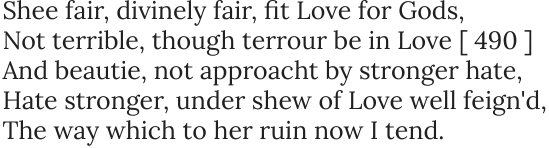
Milton emphasises the beauty of Eve that even Satan can admire her.
This could be seen as a reference to his masque Comus, where evil spirits forget their evil while watching the Lady.
Satan uses diaphora to emphasise her beauty, but an inverse of anadiplosis to show his hate, showing that his anger is too all consuming to focus on her beauty.
He says she is fit for Gods, highlighting his belief in his superiority - she can only be loveable if she is fit for Gods.
Rebellion
Eve aspires to be equal to man, which can be seen as a massive overreach as Milton believed women were naturally inferior as they were made for man.
‘Who can be ignorant that woman was created for man, and not man for woman?‘
Additionally, she echoes Satan’s beliefs that you cannot be inferior when free, she as she is a woman, and him as primogeniture exists in heaven and God’s son was favoured over him.
Therefore, both Satan and Eve oppose patriarchal ideas.
Milton also agreed with Satan, believing that everyone should be born free and Kings should not exist, suggesting it is only his own bigotry that stops him agreeing with Eve.
‘All men naturally were born free … born to command and not to obey‘.
Eve also agrees with early feminist ideas.
Milton emphasises the speed of her decision by quickly describing her plucking and eating the fruit, showing her as impulsive.
Milton uses pathetic fallacy to highlight the suffering of the world, similarly to the classical references he uses to describe creation where nature gives birth to earth.
Additionally, it shows that Satan’s persuasion worked, as she is considering becoming a God as he suggested.
This shows her as similar to him, as he also wished to be a God.
However, it also suggests she wouldn’t have eaten the apple if not for Satan’s persuasion, suggesting she cannot be fully blamed.
It also shows her unaware of the true consequences of her actions, unlike Adam, suggesting he is more to blame than her.
Adam eats the fruit against his better knowledge, unlike Eve, who eats it while not knowing death, suggesting he is more culpable in the situation.
Additionally, he was not persuaded by Eve, and therefore fully used his own free will in the situation.
However, this could also present that Eve, and therefore women, were the sole cause of the fall of mankind - Adam only ate the apple because she did.
Milton uses pathetic fallacy to highlight the suffering of the world, similarly to the classical references he uses to describe creation where nature gives birth to earth.
They seem to react worse to Adam’s fall, which could be due to the fact now both of them have fallen, or that the man fell.
This suggests that the woman is replaceable, as both Adam and Eve feared, showing that Milton believes women are less valuable.
This could reflect on him having 3 wives, 2 of which died in childbirth.
Additionally, this happens on line 999, an inversion of the devil’s number according to numerology.
Earlier in book 2 sin arrives on line 666, suggesting Milton agrees with numerology, perhaps seeing it as another scientific field to ‘justify the ways of God to man‘.
Eve argues that ideas of faith, and Eden, are weak if Adam is so fearful of them being easily dismantled.
Vertue unassayed echoes Milton’s belief that faith is not strong enough unless it can be challenged by different ideas, highlighting his beliefs in free speech from Areopagitica.
‘knowledge of good is … interwoven with the knowledge of evil.‘
However, Eve says this when attempting to convince Adam to allow her alone so she will overcome Satan, which she obviously doesn’t do.
Either Milton now disagrees with free speech, or believes women are too feeble to withstand the intellectual challenge that comes with free speech.
Eve uses diacope to compare the idea of Eden as a perfect paradise, and the place that they actually live.
Therefore, paradise cannot exist if it can be so easily be challenged and taken from them by Satan’s arrival.
He uses an interjection and an exclamation mark to show his distress at his fall from grace.
Could link to Milton being forced out of his role as Secretary of Tongues, arrested, and forced to write poetry.
Links to Milton writing as Satan as one of the best and most loved angels.
Could link to tragic stories, such as the Odyssey, which Milton would have been familiar with - Satan’s fall from a great height would be more dramatic.
The alliteration of ‘incarnate and imbrute’ highlights them.
Additionally, the word incarnation shows this as opposite to Jesus’ incarnation, Jesus becomes a man and Satan becomes a beast, highlighting his lower nature.
Additionally, ‘constraind‘ shows he believes it is God’s fault he does this, and not of his own free will, which is truly what God has granted him - Areopagitica link.
Evil
He uses an interjection and an exclamation mark to show his distress at his fall from grace.
Could link to Milton being forced out of his role as Secretary of Tongues, arrested, and forced to write poetry.
Links to Milton writing as Satan as one of the best and most loved angels.
Could link to tragic stories, such as the Odyssey, which Milton would have been familiar with - Satan’s fall from a great height would be more dramatic.
The alliteration of ‘incarnate and imbrute’ highlights them.
Additionally, the word incarnation shows this as opposite to Jesus’ incarnation, Jesus becomes a man and Satan becomes a beast, highlighting his lower nature.
Additionally, ‘constraind‘ shows he believes it is God’s fault he does this, and not of his own free will, which is truly what God has granted him - Areopagitica link.
Eve aspires to be equal to man, which can be seen as a massive overreach as Milton believed women were naturally inferior as they were made for man.
‘Who can be ignorant that woman was created for man, and not man for woman?‘
Additionally, she echoes Satan’s beliefs that you cannot be inferior when free, she as she is a woman, and him as primogeniture exists in heaven and God’s son was favoured over him.
Therefore, both Satan and Eve oppose patriarchal ideas.
Milton also agreed with Satan, believing that everyone should be born free and Kings should not exist, suggesting it is only his own bigotry that stops him agreeing with Eve.
‘All men naturally were born free … born to command and not to obey‘.
Eve also agrees with early feminist ideas.
Adam persuades Eve to have sex after they eat the apple, showing that they have now become sinful and lustful after consuming the apple.
Milton especially disliked lust, believing a major purpose of marriage was to avoid the sin.
This is especially due to Cavalier poets writing positive things about such sins, which he would have vehemently opposed, such as Suckling writing ‘Tis not the meat, but ‘tis the appetite Makes eating a delight‘.
‘now let us play‘ is contrary to Milton’s Calvinist values of the importance of work, especially as they have done nothing to deserve such fun.
Fire imagery is used, which could be seen as the fire of lust, but also the fire of hell that is consuming them as they have now fallen.
Eve shows her jealousy after eating the apple, showing that she is quickly becoming sinful after she has fallen.
Additionally, her opposal to Adam finding another Eve could portray her as anti-divorce, which Milton liked.
She also mimics wedding vows when she decides she will persuade Adam to also eat the apple, showing they shall be married and sin.
This could suggest she does not properly love Adam, as she is completely okay with condemning him to die alongside her.
Milton here outlines the contents of book 9, and tautologically describes the plot and compares it to plots of other classics, such as the Odyssey by Homer and the Aeneid by Virgil.
He uses plosive alliteration to highlight the harshness of the future events.
He calls it tragic, therefore comparing it to the Greek convention of tragic drama.
It is similar due to the dramatic fall - from Eden to current man, however it has two characters who must fall, and they do so for different reasons.
Truth
Satan questions the difference between God and Man, which could be seen as similar to Milton questioning the difference between Kings and Man in his On The Tenure of Kings and Magistrates.
He was against the great chain of being, as he believed all human beings were born free, but he does seemingly believe in the great chain of being as it relates to Gods and angels.
Satan here seems to doubt that God is above anyone, which could link to his own jealousy at God’s greater power, his focus is emphasised by a mesodiplosis like repetition.
Contrary to his assertion, Raphael told both Adam and Eve they would be allowed to eat the diet of angels if they remained obedient in book 5. Due to Eve’s actions, they will never be allowed to consume it.
God-like food likely is a reference to ambrosia, the food of the Gods in Greco-Roman myth.
Satan asserts that is the sun that creates energy for the world, and not God, however it was God who created the sun in Genesis 1.1.
However, this is a scientific truth, as all energy originates from the sun, as this is absorbed by plants.
Eve argues that ideas of faith, and Eden, are weak if Adam is so fearful of them being easily dismantled.
Vertue unassayed echoes Milton’s belief that faith is not strong enough unless it can be challenged by different ideas, highlighting his beliefs in free speech from Areopagitica.
‘knowledge of good is … interwoven with the knowledge of evil.‘
However, Eve says this when attempting to convince Adam to allow her alone so she will overcome Satan, which she obviously doesn’t do.
Either Milton now disagrees with free speech, or believes women are too feeble to withstand the intellectual challenge that comes with free speech.
Eve uses diacope to compare the idea of Eden as a perfect paradise, and the place that they actually live.
Therefore, paradise cannot exist if it can be so easily be challenged and taken from them by Satan’s arrival.
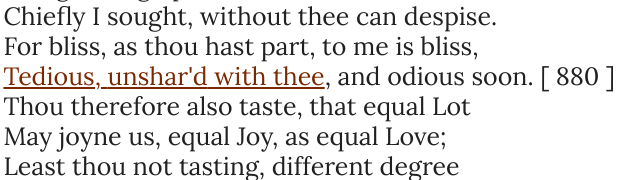
Eve says that the power she gains from eating the apple will only be good to her if Adam also eats apple.
This shows that Eve is expressing a masculine desire for company, which Milton believed was masculine.
This is shown by Eve wishing to be alone, while Adam does not want to in the beginning argument of the book.
Additionally, Milton believes the key purpose of marriage was to be ‘against the evil of a solitary life‘, but he believed this only benefitted men, showing he believed they were more important.
Milton argues that Adam specifically desires female companionship, though not simply for sex, to contrast arguments that his intellectual needs would be better suited by a male companion.
Additionally, Eve again strives for equality, which is a complete overreach and hubris as she is a woman.
Additionally, Adam would not be equal if the apple indeed gave them Godhood, as he is a man and would therefore be above her.
‘equal lot‘ suggests she simply wants them to have an equal fate, suggesting she has already understood that they will be punished together for eating the apple.
Satan shows his lying nature.
He claims that he freed ‘welnigh half‘, when before this was mentioned to be only a third in book 2.
He says ‘if they at least‘ referencing that he declared he was not created by God in book 5, but also admitted he was created by God in book 4, showing this as an insecurity of his.
Additionally, it shows he doubts God’s omnipotence.
Eve informs the snake that she cannot eat the tree, no matter the consequence.
This can be seen as dramatic irony - all audiences would know from the beginning of the story that she would indeed eat the apple.
She echoes Genesis 3.3, where God informs Adam and Eve they cannot eat from the tree, again showing that milton based this story on the original Bible story.
This being his only command highlights his belief in free will, which is how Milton perceives God.
Reason is our law is a reference to Paul’s remark in the Bible that gentiles lived outside Hebrew law, but still had their own laws.
This was a positive, as reason is supported by God.
jLoss
Milton shows how Adam freezes in shock and horror at her actions.
He also uses the garland to represent Adam’s changing emotions towards Eve.
Plosive alliteration of down dropped shows the strong shock he feels.
Additionally, the Garland made for Eve represented her as the most beautiful woman in his eyes, and him dropping this shows his love for her and her beauty is damaged by her action.
However, he still loves her too much to not fall with her, suggesting this may just foreshadow his fall alongside her.
Adam eats the fruit against his better knowledge, unlike Eve, who eats it while not knowing death, suggesting he is more culpable in the situation.
Additionally, he was not persuaded by Eve, and therefore fully used his own free will in the situation.
However, this could also present that Eve, and therefore women, were the sole cause of the fall of mankind - Adam only ate the apple because she did.
Milton uses pathetic fallacy to highlight the suffering of the world, similarly to the classical references he uses to describe creation where nature gives birth to earth.
They seem to react worse to Adam’s fall, which could be due to the fact now both of them have fallen, or that the man fell.
This suggests that the woman is replaceable, as both Adam and Eve feared, showing that Milton believes women are less valuable.
This could reflect on him having 3 wives, 2 of which died in childbirth.
Additionally, this happens on line 999, an inversion of the devil’s number according to numerology.
Earlier in book 2 sin arrives on line 666, suggesting Milton agrees with numerology, perhaps seeing it as another scientific field to ‘justify the ways of God to man‘.
Eve shows her jealousy after eating the apple, showing that she is quickly becoming sinful after she has fallen.
Additionally, her opposal to Adam finding another Eve could portray her as anti-divorce, which Milton liked.
She also mimics wedding vows when she decides she will persuade Adam to also eat the apple, showing they shall be married and sin.
This could suggest she does not properly love Adam, as she is completely okay with condemning him to die alongside her.
Milton emphasises the speed of her decision by quickly describing her plucking and eating the fruit, showing her as impulsive.
Milton uses pathetic fallacy to highlight the suffering of the world, similarly to the classical references he uses to describe creation where nature gives birth to earth.
Additionally, it shows that Satan’s persuasion worked, as she is considering becoming a God as he suggested.
This shows her as similar to him, as he also wished to be a God.
However, it also suggests she wouldn’t have eaten the apple if not for Satan’s persuasion, suggesting she cannot be fully blamed.
It also shows her unaware of the true consequences of her actions, unlike Adam, suggesting he is more to blame than her.
He uses an interjection and an exclamation mark to show his distress at his fall from grace.
Could link to Milton being forced out of his role as Secretary of Tongues, arrested, and forced to write poetry.
Links to Milton writing as Satan as one of the best and most loved angels.
Could link to tragic stories, such as the Odyssey, which Milton would have been familiar with - Satan’s fall from a great height would be more dramatic.
The alliteration of ‘incarnate and imbrute’ highlights them.
Additionally, the word incarnation shows this as opposite to Jesus’ incarnation, Jesus becomes a man and Satan becomes a beast, highlighting his lower nature.
Additionally, ‘constraind‘ shows he believes it is God’s fault he does this, and not of his own free will, which is truly what God has granted him - Areopagitica link.