Respiratory System 7: Respiratory System Conditions and Measurements
Respiratory System Conditions
Obstructive and Restrictive Respiratory Conditions
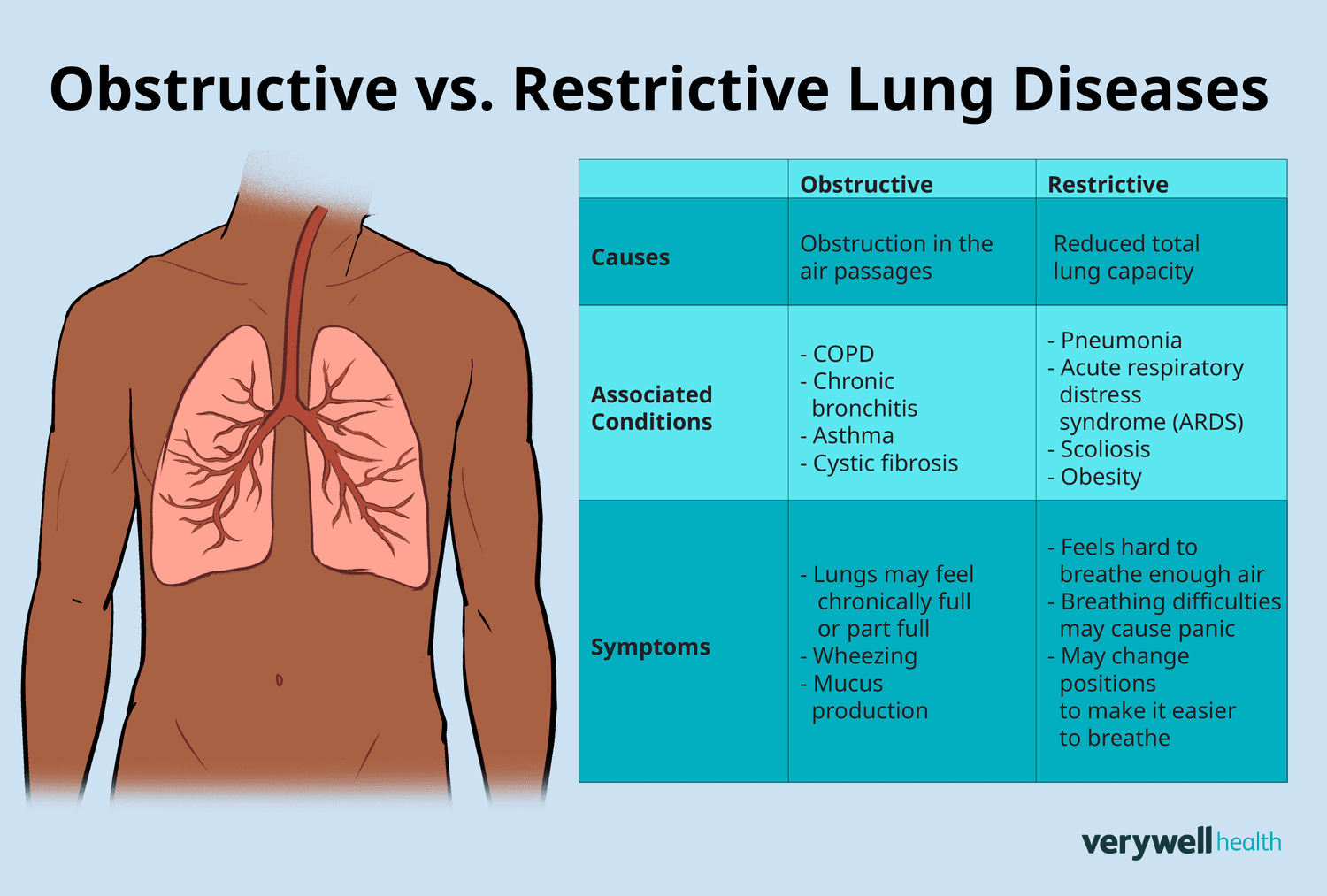
Obstructive Conditions:
Characterized by difficulty in getting air out of the lungs.
Examples: Asthma, narrowed airways, masses in the airways, damaged or diseased airways, and loss of lung tissue elasticity.
Reduced airflow during exhalation due to obstructions.
Accessory muscles are needed to force air out, which can cause bronchioles to collapse and trap air.
Normal Expiration:
Passive process relying on the inward recoil of the lungs and surface tension of alveolar water.
In obstructive conditions, the obstruction prevents passive exhalation.
Accessory muscles must be used to create more pressure to force air out.
Forcing exhalation can cause small airways to collapse, trapping air in the alveoli, reducing FVC and FEV1.
Restrictive Conditions:
Characterized by difficulty in getting air into the lungs due to decreased lung capacity.
Caused by issues affecting the ability to inflate the lungs, such as problems with the diaphragm, intercostal muscles, rib movement, pleural membrane integrity, or lung tissue compliance.
Examples: pneumothorax, mobility issues.
Restrictive conditions impair the ability to inflate the lungs and bring air in.
Lung measurement values are reduced due to the inability to fully inhale or exhale.
Factors Affecting Airway Integrity
Damaged airways are more prone to collapse during forced exhalation due to loss of elasticity and water surface tension.
Asthma: Narrowed airways due to smooth muscle activation make it difficult to exhale.
Factors Affecting Lung Movement
Diaphragm and external intercostal muscle function.
Rib movement.
Pleural membrane integrity and intrapleural space pressure.
Lung tissue compliance and elasticity.
Appropriate function of muscles, bones, joints, and pleural membranes.
Ventilation
Ventilation: The amount of air that can be moved in and out of the lungs for gas exchange over time.
Factors increasing ventilation:
Respiratory rate.
Lung inflation (using accessory respiratory muscles).
Peak Flow Measurement
Measures the maximum flow rate of air that can be exhaled.
Procedure: Breathe out as hard and fast as possible through a device that measures peak flow.
Factors affecting peak flow:
Age: Peak flow increases with age, then decreases.
Height: Taller individuals tend to have larger thoracic cavities and lung capacity.
Genetics, gender, and physiology.
Low peak flow indicates a potential obstructive respiratory condition.
Forced Vital Capacity (FVC)
FVC: The total volume of air that can be exhaled after a maximal inhalation.
Measured in liters.
Reflects the ability to both inhale and exhale.
Forced Expiratory Volume in One Second (FEV1)
FEV1: The volume of air that can be exhaled in the first second of a forced exhalation after a maximal inhalation.
Measured in litres.
FEV1/FVC Ratio:
In healthy individuals, FEV1 should be approximately 70-80% of FVC.
Example Calculation:
If FVC = 5 liters, then FEV1 should ideally be around 4 liters (80% of 5 liters).
To calculate without a calculator, convert to a fraction with a denominator of 100. E.g.
Clinical Significance:
Low FEV1 indicates a problem with airflow out of the lungs (obstructive condition).
Low FVC indicates a problem with the total volume of air that can be moved in and out (can be either obstructive or restrictive).
Interpreting FVC and FEV1 Measurements
FEV1 | FVC | Interpretation |
Low | Normal | Suggests an obstructive condition. |
Normal | Low | Suggests a restrictive condition. |
Low | Low | Could be either obstructive or restrictive, but likely obstructive because of limited airflow. |
Pneumothorax
A condition in which air leaks into the space between the lung and chest wall, causing the lung to collapse.
Consider whether pneumothorax is a restrictive or obstructive condition based on its effect on lung function and measurement values.