Sampling
POPULATIONS & SAMPLES:
Population
Entire set entities (individuals, cities, states, neighborhoods, schools, etc) In which we are interested
–“Residents of the United States”
–“Likely voters in the 2024 election”
–“Neighborhoods in Chicago”
–“Schools in Los Angeles County”
sample
A subset of entities from population
–The idea is to study a subset to make conclusions about the entire population
REPRESENTATIVENESS & GENERALIZABILITY
Representativeness
Refers to how similar the sample is to population in all respects relevant to the study
Generalizability
Refers to validity conclusions (generalizations) that can be drawn from studying sample
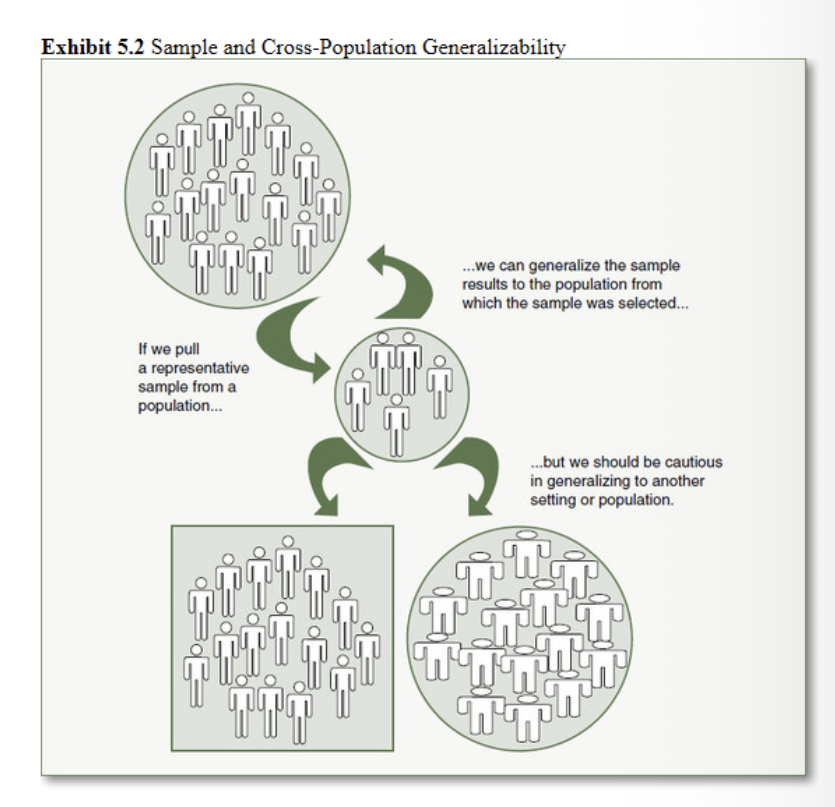
–Sample generalizability
–Cross population generalizability
TARGET POPULATION, SAMPLING FRAME, SAMPLE
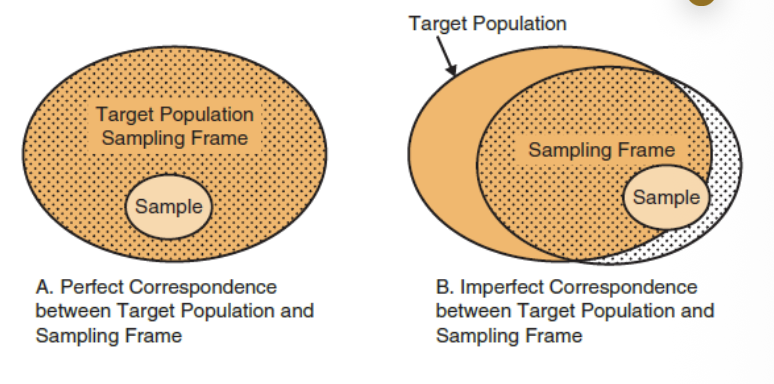
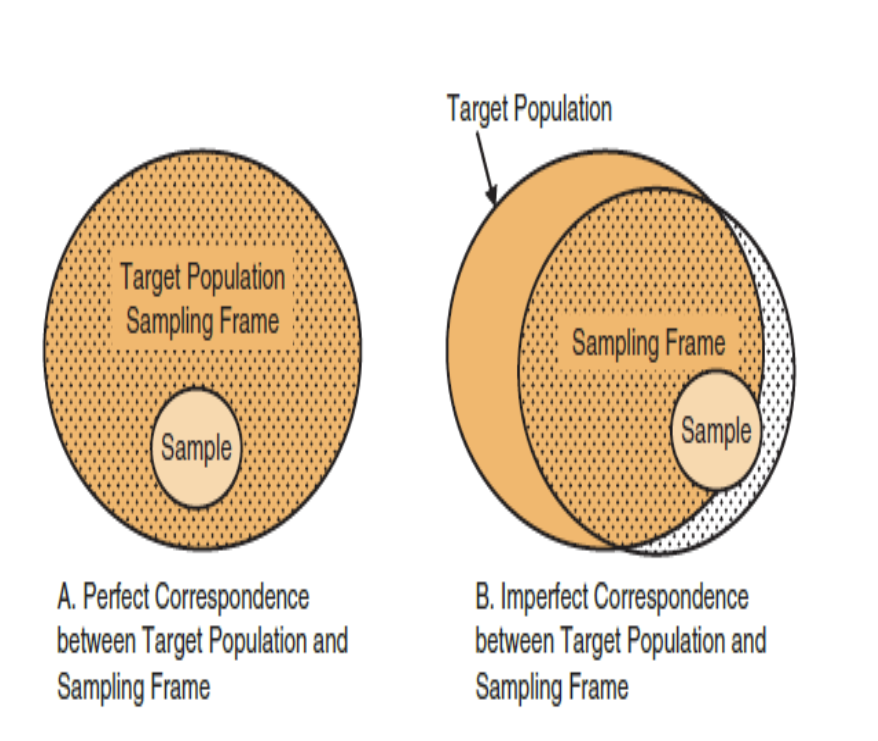
•Target Population: the population to which the researcher wishes to generalize.
•Sampling Frame: The list of cases/units that the researcher can sample from
•The cases/units the researcher selects from the sampling frame
2 SOURCES OF “ERROR”
•The sampling frame does not correspond to the population of interest
^even if you draw a representative sample, results can’t be generalized to population
•The sample is not representative of “sampling frame”
^even if sampling frame perfectly corresponds to pop. of interest. results can’t be generalized to population
SAMPLING METHODS:
RANDOM selection → key to representativeness & generalizability
Probability sampling
Each entity in the population has a known and non-zero probability of being selected in the sample
–Probability of selection is not related to anything we want to study. It is random.
Non-probablity sampling
probability of selecting each entity is unknown
–It may be related to something we want to study. It is systematic.
PROBABILITY SAMPLING METHODS:
Simple random sampling
Randomly select cases from a list of entities in the population
–e.g. Random digit dialing (phone surveys)
–Requires a full list of entities. Not always practical.
Systematic random sampling
–E.g. pick every 10th name from a list
–Produces a random sample unless list is sorted
Stratified random sampling
Sort into groups, randomly select an exact number from each group
–Proportionate: Pick the exact # from each group so that your sample has same proportions as population
–Disproportionate
•Useful for analyzing smaller subpopulations
Multi-stage cluster sampling (how MAJOR surveys are done)
elements are selected in two or more stages, with the first stage being the random selection of naturally occurring clusters and the last stage being the random selection of multilevel elements within clusters.
–Clusters: Naturally occurring aggregate groups
–Useful for when no complete list of population is available (many large scale populations)
SAMPLING ERROR cus. SYSTEMATIC ERROR:
Sampling error
differences in a value between the sample and the population
–Occurs even in random samples by chance
–Error in one sample depends on sample size
–Errors cancel each other out by averaging many random samples
Systematic error/bias
Difference between sample and population value due to non-random sampling method
–Larger sample doesn’t help
–Errors don’t cancel each other out
–E.g. non-response bias
SYSTEMATIC ERROR: EXAMPLE
•NCVS (National Crime Victimization Survey)
•Population: All U.S. households
•Sample: multi-stage cluster sample
•Variable: Burglary rates
Survey measure: “Has your household been burglarized in the past 12 months? (Y/N)”
•What if people who are burglarized are more likely to move to a safer neighborhood?
•Will the burglary rate be higher or lower than the true value?
SYSTEMATIC ERROR: RELATIONSHIP BETWEEN VARIABLES
•Studying public defenders. Is caseload related to job satisfaction?
•Population: Public defenders in LA County
•Sample: Simple random sample
•Measures:
–Caseload: “How many cases last month?”
–Satisfaction “Rate your level of satisfaction?”
•What if the public defenders with the highest caseloads are less likely to complete the survey?
•AND higher caseloads are related to lower satisfaction?
–Relationship will be weaker than true relationship
NON-PROBABILITY SAMPLING METHODS:
•Convenience sampling
–Choosing a sample based on what is convenient/available
•E.g. polling your friends
•Low likelihood of representative sample
NON-PROBABILITY SAMPNLING METHODS:
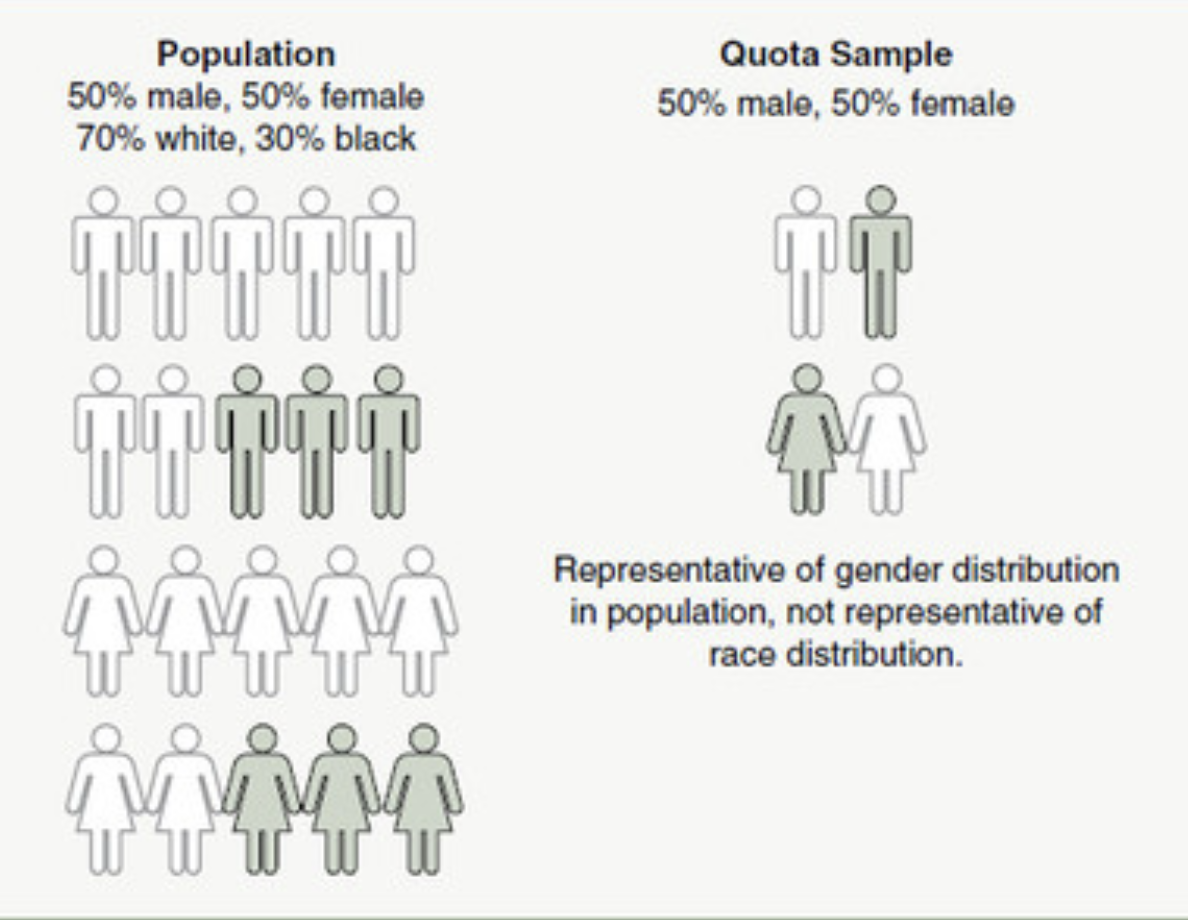
Quota sampling
A convenience sample but quotas ensure representativeness of some elements
“The problem is that even when we know that a quota sample is representative of the particular characteristics for which quotas have been set, we have no way of knowing if the sample is representative in terms of any other characteristics”
Purposive sampling
Also known as “judgement sampling”
because the researcher uses his or her own judgment about whom to select into the sample rather than drawing sample entities randomly.
each sample entity is selected for a purpose, usually because of the unique position of the sample entity.
–When might this be useful?
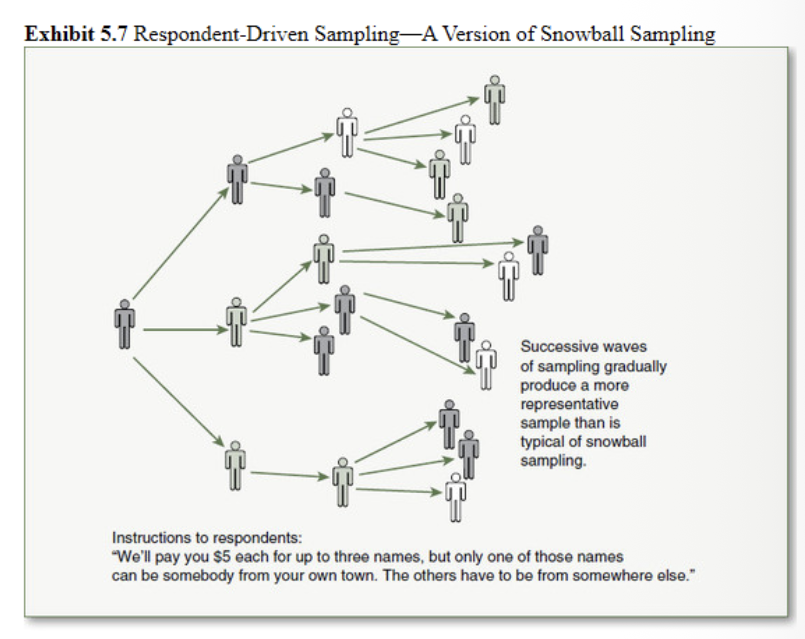
Snowball sampling
Identify one member of the population and speak to him or her, then ask that person to identify others in the population and speak to them, then ask them to identify others, and so on.
–“This technique is useful for hard-to-reach or hard-to-identify interconnected populations where at least some members of the population know each other, such as drug dealers, prostitutes, practicing criminals, gang leaders, and informal organizational leaders”
Probability sampling
•Probability of selection is known.
–Random and unrelated to variables of interest in study
Ideal for representativeness/ generalizabilityNecessary for deductive research/ research findingsMajor focus of quantitative research
Non-Probability Sampling
•Probability of selection is unknown
–May be related to variables of interest in study
Not necessarily generalizable findings
Often necessary for inductive research
Common in qualitative research
Sampling is the fundamental starting point in criminological research. Probability sampling methods allow researchers to use the laws of chance, or probability, to draw samples from populations and maintain a standard of representativeness that can be estimated with a high degree of confidence. A sample of just 1,000 or 1,500 individuals can easily be used to reliably estimate the characteristics of the population of a nation comprising millions of individuals.
The alternatives to random, or probability-based, sampling methods are almost always much less desirable, even though they typically are less expensive. Without a method of selecting cases likely to represent the population in which the researcher is interested, research findings will have to be carefully qualified. Unrepresentative samples may help researchers understand which aspects of a social phenomenon are important, but questions about the generalizability of this understanding are still left unanswered.
Social scientists often seek to generalize their conclusions from the population that they studied to some larger target population. The validity of generalizations of this type is necessarily uncertain, for having a representative sample of a particular population does not at all ensure that what we find will hold true in other populations. Nonetheless, the accumulation of findings from studies based on local or otherwise unrepresentative populations can provide important information about broader populations.
:
Sampling is usually necessary except in two conditions: (1) when the elements that would be sampled are identical, which is almost never the case, and (2) when you have the option of conducting a complete census of a population.
Nonresponse undermines sample quality: It is the obtained sample, not the desired sample, that determines sample quality.
Probability sampling methods rely on a random selection procedure to ensure there is no systematic bias in the selection of elements. In a probability sample, the odds of selecting elements are independent, equal, and known, and the method of selection is carefully controlled.
Simple random sampling and systematic random sampling are equivalent probability sampling methods in most situations. However, systematic random sampling is inappropriate for sampling from lists of elements that have a regular, periodic structure.
Other types of random sampling include stratified random sampling, which uses prior information about a population to make sampling more efficient, and cluster sampling.
Nonprobability sampling methods can be useful when random sampling is not possible, when a research question does not concern a larger population, and when a preliminary exploratory study is appropriate. However, the representativeness of nonprobability samples cannot be determined.
The likely degree of error in an estimate of a population characteristic based on a probability sample decreases as the size of the sample increases. Sampling error also decreases if the population from which the sample was selected is homogeneous.