Church floorplan/ architecture
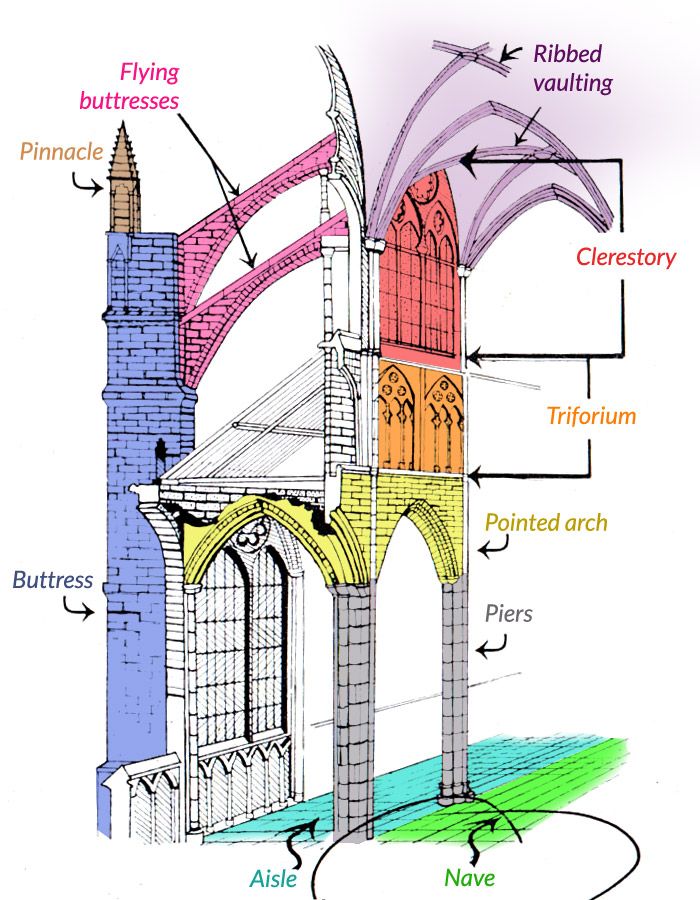
Aisle: The lateral space running parallel to the nave, allowing movement and access to chapels or altars without disturbing the main area.
Nave: The central part of a church or cathedral, extending from the entrance to the choir, usually flanked by aisles.
Buttress: A structure built against a wall to provide support, often seen in Gothic cathedrals to counteract lateral forces.
Piers: Vertical supports that can take the form of columns, often wider and more substantial, supporting arches and vaults.
Pointed Arch: An arch with a pointed top, a defining characteristic of Gothic architecture, allowing for taller structures and more light.
Triforium: A shallow gallery located above the nave and below the clerestory, often decorated with arcades of arches.
Pinnacle: A decorative element typically placed on top of a flying buttress or spire, pinnacles serve both an aesthetic purpose and help to stabilize the structure by directing the weight downward and outward.
Flying buttress: A support structure that transfers the weight of the roof and upper walls away from the main building and onto a separate support, allowing for larger windows and more verticality in Gothic cathedrals.
Clerestory: A row of windows located high in the nave, above the triforium, the clerestory allows natural light to illuminate the church interior while also providing a sense of height and openness in the overall architectural design.
Ribbed Vaulting: A structural element in Gothic architecture, ribbed vaulting consists of intersecting arch forms that create a framework for the ceiling, allowing for greater height and more ornate designs, while also distributing weight more effectively across the supporting walls. :