Macronutrients
Carbohydrates
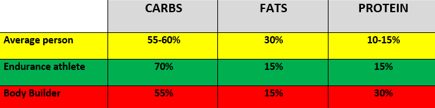
For typical person - accounts for approx. 55% of dietary intake
For endurance athletes - can increase to 70% of dietary intake
Role of carbs
Produces energy for ATP production
Can be broken down to produce ATP fast - meaning they are preferred energy source for high workouts
However, the amount of energy produced per 1 gram of carbohydrate is low
Carbs - Glucose - Glycogen
We eat carbs - they are digested and broken down into their simpler unit Glucose
Once in the form of glucose, there are two main fates
Glucose circulates the blood - providing fuel for the brain and immediate body function
Glucose can then be converted to glycogen and stored in the liver and muscles
Classifying carbs
Carbs can be classified depending on their Glycaemic index (GI)
GI relates specifically to how quickly the carbohydrate is broken down and enters the blood stream
Rates carbs on a scale from 0-100 (0 low - 100 high)
High GI - carbs broken down very quick, rapid release of glucose to bloodstream
Low GI - carb broken down slow, resulting in slow sustained release of glucose into bloodstream.
Fats
Typical person - approx. 30% of dietary intake
Athletes generally consume slightly less than 10-20% of dietary intake
Role of fats
Are a plentiful source of energy - high 'yield' - amount of energy produced is lots
Fats breakdown to produce ATP slow, so are better for mid intensity exercises
Insulates body and protects vital organs
Helps produce hormones
Free fatty acids - triglycerides
We eat fats, however they exist in the body as either:
- free fatty acids + triglycerides
Protein
Typical person - approx. 15% of dietary intake
For strength athlete - can increase to 30%
Role of protein
Growth and repair of muscle and connective tissue
Helps produce Red blood cells, hormones and antibodies
Protein only used for energy production in extreme cases
Athlete dietary considerations v typical person
Depending on the type of sport being played or event, diet needs to be modified e.g.
Endurance athlete: more total energy and carbs(preferred fuel source when exercising) can increase to 60-70% of dietary intake
Bodybuilders/power athletes: more total energy and protein (to produce high force and speed efforts which increased muscle mass is beneficial for). Increased protein and carbs consumed
Energy systems and fuel sources
how much each of these fuels are used by each system depends on:
Intensity of the exercise
Duration of the exercise
Fitness of athlete
At rest and low intensity
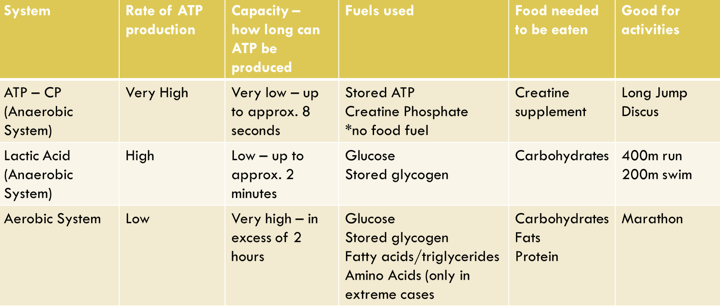
Aerobic system predominant - fuelled by both fats and glycogen
Fats are used as they breakdown slower and during low intensity exercise there is no need for ATP to be produced at quick rates
Increasing intensity
Oxygen cant be supplied to muscle cells quick enough to meet required energy, therefore lactic acid system predominant
Glucose main fuel source
At high intensity
Lactic acid system predominant system, produces energy quickly and fuelled by glucose can only produce ATP for limited amount of time due to fatiguing by product (lactic build-up)
Athletes exercising for longer than two minutes will switch to aerobic system
At maximum intensity
The ATP-CP system will be predominant( up to 8 seconds) as it produces energy the quickest, it is fuelled by stored ATP and creatine phosphate
If effort is max and goes for longer than 8 seconds, lactic acid system will become predominant, fuelled by glucose
OFF season v IN season nutrition
IN-season
Characterised by higher volume and high intensity physical activity due to
Higher % of carbs - high intensity training uses glycogen stores as a fuel source, therefore, carbs are essential
Higher % of protein - more muscle breakdown, protein is required to repair and rebuild muscle
Lower % of fats - fat is slow to breakdown and inefficient
Off-season
Characterised by less physical activity at lower intensities, nutritional considerations include
Lower % of carbs
Lower % of protein