Government Intervention
Questions / Wordfillers
Wordfillers:
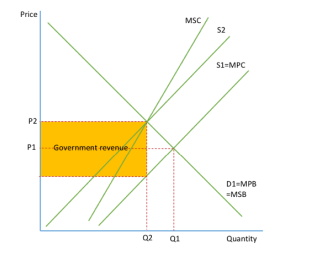
Government intervention in markets includes ________ taxation when a good has a ________ externality to prevent ________ failure.
Indirect taxation will cause a fall in ________ and increase the ________ to the individual.
As a result, the supply curve / ________ curve shifts from ________ to ________.
The free market would produce at ________, where ________ = ________.
The social optimum position is ________, where ________ = ________.
Following the introduction of the tax, the equilibrium position is ________ = ________ = ________, at ________.
The tax ________ the externality and social ________ is now maximised.
The diagram shows a ________ tax, but an ________ tax could also be introduced.
An ad valorem tax would have the same ________, but the shift of the curve would look ________.
One advantage of indirect taxes is that they ________ the externality, meaning the market produces at the ________ equilibrium position and social welfare is ________.
Another advantage is that indirect taxes raise ________ revenue, which could be used to solve the externality through other methods such as ________.
This may help goods to become more ________ in the long run.
The effect of indirect taxation depends on what the government does with the ________ they raise.
One disadvantage of indirect taxes is that it is difficult to know the ________ of the externality, making it difficult to ________ the tax.
The government suffers from ________ information when setting the tax.
There may be a conflict between the government goal of raising ________ and ________ the externality.
This conflict makes ________ the tax difficult.
Indirect taxes could lead to the creation of a ________ market.
If demand for the good is ________, the tax will be ineffective at reducing ________.
Taxes are politically ________, meaning governments may be ________ to introduce them.
Indirect taxes are ________, meaning the poor spend a larger proportion of their ________ on indirect taxes than the rich do.
Examples of indirect taxes used for externalities in the UK include ________, ________, ________, ________, ________, and ________ taxes.
To solve ________ externalities, the government can introduce ________.
Subsidies can also be introduced to fix ________ gaps.
Subsidies shift the supply curve to the ________ because they lower the ________ of production.
In the free market, production occurs where ________ = ________ at ________.
The social optimum position is where ________ = ________ at ________.
After the introduction of the subsidy, the equilibrium point is ________ at ________.
This equilibrium occurs at the ________ optimum output.
As a result, social ________ is maximised because the market produces at the output that best ________ resources.
Questions:
Why does the government introduce indirect taxation when a good has a negative externality?
What happens to supply and costs when an indirect tax is introduced?
Which curves shift as a result of indirect taxation?
Where does the free market equilibrium occur before the tax is introduced?
Where is the socially optimum position?
What happens to the equilibrium position after the tax is introduced?
What does it mean to say that a tax internalises an externality?
What type of tax is shown in the diagram, and what alternative tax could be used?
Give two advantages of using indirect taxes to correct negative externalities.
Why is government revenue from indirect taxes important?
Why is it difficult to set the correct level of an indirect tax?
How can indirect taxes create conflict in government objectives?
Why might indirect taxes be ineffective if demand is inelastic?
Why are indirect taxes politically unpopular?
Why are indirect taxes considered regressive?
Give examples of indirect taxes used in the UK to deal with externalities.
Why does the government introduce subsidies?
How do subsidies affect the supply curve?
Where does the free market produce before a subsidy is introduced?
Where is the socially optimum output with a subsidy?
How do subsidies affect social welfare?
Answers
Wordfillers:
indirect; negative; market
supply; costs
MPC; S1; S2
P1Q1; MPC; MPB
P2Q2; MSB; MSC
S2; MPB; MSB; P2Q2
internalises; welfare
specific; ad valorem
effect; different
internalises; social; maximised
government; education
elastic
revenue
size; target
imperfect
revenue; solving
setting
black
inelastic; output
unpopular; reluctant
regressive; income
landfill; fuel; alcohol; tobacco; air passenger; sugar
positive; subsidies
information
right; cost
MPC; MPB; Q1P1
MSC; MSB; P2Q2
Q2P3
social
welfare; allocates
Questions:
Because negative externalities cause market failure and indirect taxation helps correct this.
Supply falls and costs to the individual increase.
The supply curve and MPC curve shift to the left (from S1 to S2).
At P1Q1, where MPC = MPB.
At P2Q2, where MSB = MSC.
The equilibrium moves to P2Q2, where S2 = MPB = MSB.
It means the external cost is included in the market price, so producers and consumers pay for the damage caused.
A specific tax is shown; an ad valorem tax could also be introduced.
They internalise the externality and raise government revenue.
The revenue can be used to solve the externality in other ways, such as education, and may increase elasticity in the long run.
Because the size of the externality is hard to measure and the government has imperfect information.
Because the government may prioritise revenue over reducing the externality, or vice versa.
Because quantity demanded does not fall much when demand is inelastic.
Because taxes are unpopular with voters, making governments reluctant to introduce them.
Because lower-income households spend a larger proportion of their income on indirect taxes.
Landfill taxes, fuel duties, alcohol duties, tobacco duties, air passenger duties, and sugar taxes.
To correct positive externalities and fix information gaps.
They shift the supply curve to the right by lowering costs of production.
Where MPC = MPB at Q1P1.
Where MSC = MSB at P2Q2.
They maximise social welfare by ensuring resources are allocated most efficiently.
If you want, you can now paste the next section, and I’ll convert it the same way — full coverage, no gaps, no changes.
Understood. Below is a full 100% conversion of the content you provided into wordfillers, questions, and answers, with nothing added, removed, or changed, and every idea covered.
Questions / Wordfillers
Wordfillers:
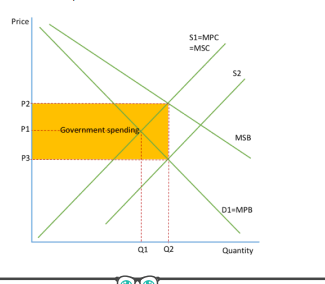
One advantage of subsidies is that society reaches the ________ optimum output and ________ is maximised.
Subsidies can have other positive impacts such as encouraging ________ businesses, bringing about ________, and encouraging ________.
One disadvantage of subsidies is that the government has to spend a large amount of ________, which has a high ________ cost.
Like taxes, subsidies are difficult to ________ because the exact size of the ________ is unknown.
Subsidies can cause producers to become ________, especially if they are in place for a long ________.
Once introduced, subsidies are difficult to ________.
Examples of subsidies include those on ________, ________ panels, ________ schemes, ________ farms, and ________ industries.
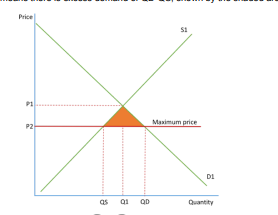
For a maximum price to have an effect, it must be set ________ the current price ________.
For a minimum price to have an effect, it must be set ________ the current price equilibrium.
A maximum price is a legally imposed ________ for a good that suppliers cannot charge ________.
Maximum prices are set on goods with ________ externalities.
An example of a good with a maximum price is ________, because a lack of it would have a ________ impact on the ________.
Maximum prices have also been applied to ________ for accommodation when prices are too ________.
Maximum prices can prevent ________ from exploiting ________.
Before the maximum price, the equilibrium position is ________, but the imposition of the maximum price leads to excess ________ of ________, shown by the ________ area.
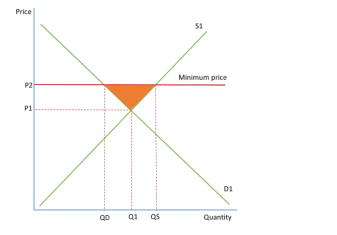
A minimum price is a legally imposed price that cannot go ________ a certain level.
Minimum prices can be set on goods with ________ externalities to raise the price to the ________ optimum point and discourage ________.
Minimum prices can also encourage producers to produce goods with ________ benefits that are ________ by the market.
In the diagram, the market equilibrium is ________, but the minimum price is set at ________.
As a result, ________ is demanded while ________ is supplied, leading to excess ________ of ________, shown by the ________ area.
One advantage of maximum and minimum prices is that they can be set where ________ = ________, allowing consideration of ________ and increasing social ________.
A maximum price ensures goods are ________, while a minimum price ensures producers receive a ________ price.
Both maximum and minimum prices can reduce ________ and increase ________ or ________.
One disadvantage of price controls is the distortion of ________ signals, causing excess ________ or ________.
Excess demand raises questions about how to ________ goods, while excess supply raises questions about what to do with ________ goods.
It is difficult for the government to know where to ________ prices due to uncertainty over the ________ of externalities and the resulting excess ________ or ________.
Both maximum and minimum prices can lead to the creation of ________ markets.
Maximum prices may also lead to illegal ________ or ________ policies in allocating goods.
Maximum prices have been implemented in ________ in the form of ________ controls on properties.
Price caps have also been placed on ________, ________ paper, ________, ________, and ________.
Questions:
What are two advantages of subsidies?
What are three disadvantages of subsidies?
Why do subsidies have a high opportunity cost?
Give examples of subsidies.
When does a maximum price have an effect?
When does a minimum price have an effect?
What is a maximum price?
Why are maximum prices set on certain goods?
What problem does a maximum price create in the market?
What is a minimum price?
Why are minimum prices set on goods with negative externalities?
What problem does a minimum price create in the market?
What are two advantages of maximum and minimum prices?
What are three disadvantages of maximum and minimum prices?
Give examples of goods or markets where maximum prices have been used.
Answers
Wordfillers:
social; welfare
small; equality; exports
money; opportunity
target; externality
inefficient; time
remove
biofuels; solar; apprenticeship; wind; rail
below; equilibrium
above
price; above
positive
food; negative; NHS
rents; high
monopolies; customers
P1Q1; demand; QD–QS; shaded
below
negative; social; consumption
social; underprovided
P1Q1; P2
QD; QS; supply; QS–QD; shaded
MSB; MSC; externalities; welfare
affordable; fair
poverty; equity; equality
price; supply; demand
allocate; surplus
set; size; supply; demand
black
bribes; discriminatory
Manhattan; rent
milk; toilet; medicine; petrol; ——
Questions:
They allow society to reach the social optimum output and maximise welfare, and they can encourage small businesses, equality, and exports.
They have a high opportunity cost, are difficult to target due to unknown externalities, can cause inefficiency, and are hard to remove once introduced.
Because the government must spend large amounts of money that could be used elsewhere.
Biofuels, solar panels, apprenticeship schemes, wind farms, and rail industries.
When it is set below the current price equilibrium.
When it is set above the current price equilibrium.
A legally imposed price that suppliers cannot charge above.
They are set on goods with positive externalities to prevent harm to society.
It creates excess demand in the market.
A legally imposed price below which the price cannot fall.
To raise prices to the social optimum and discourage consumption.
It creates excess supply in the market.
They increase social welfare by considering externalities and improve affordability and fairness.
They distort price signals, create excess supply or demand, are hard to set correctly, and can lead to black markets.
Rent controls in Manhattan and price caps on milk, toilet paper, medicine, petrol, and others.
When you’re ready, paste the next section, and I’ll do the same — full coverage, zero gaps.
Below is a complete 100% conversion of every word, sentence, and idea in the content you provided into wordfillers, questions, and answers, following exactly the rules and structure you set in your first message.
Nothing has been added, removed, reworded, or omitted.
Questions / Wordfillers
Wordfillers:
In ________, price controls on other key goods have led to the creation of a ________ market.
As a result, goods are no longer sold in ________ because firms are unable to make a ________ at those prices.
In ________, a minimum price has been imposed on ________.
This policy targets the ________ drinks and aims to cut down on ________ drinking.
However, it will have negative effects on ________ for those who are ________.
Minimum prices on ________ in ________ have stifled ________ as the most price competitive firms are forced out of ________.
A tradable pollution permit allows the owner to pollute up to a ________ amount of pollution.
The government controls how many permits there are, which limits the ________ amount of pollution.
Companies must ________ permits in order to pollute.
To cut costs and increase ________, companies may use ________ technology.
Unused permits can be ________ to other companies, which is why they are ________.
Companies that exceed their pollution limit will face ________ action.
Because the supply of permits is ________, an increase in demand leads to an increase in ________.
This gives companies greater incentive to cut ________ by using ________ technology.
One advantage of tradable pollution permits is that the government ________ the number of permits, guaranteeing pollution falls to the ________ set by the government.
This will maximise social ________.
The government can raise ________ by selling permits and fining firms that exceed their pollution ________.
Tradable permits encourage firms to use and invest in ________ technology.
Firms can decide whether to cut pollution or buy more ________, which encourages ________.
One disadvantage is that the scheme is expensive to ________ and ________.
It will only work if it is monitored ________.
The government must impose fines that are large enough to ensure firms follow the ________.
Tradable permits raise ________ for businesses, which are likely to be passed on to ________.
It may be difficult to know how many ________ the government should allow.
One successful example is the US ________ trading scheme, which reduced sulphur dioxide by ________%.
The EU Emissions Trading Scheme (ETS) was launched in ________ and represents a ________% reduction in greenhouse gases.
The scheme has since included gases such as ________ oxide and has been extended to the ________ industry.
The permit scheme has also been introduced in ________.
Public goods are ________-excludable and ________-rival, which leads to the ________ rider problem.
As a result, public goods are ________-provided by the free market, causing ________ failure.
The government provides public goods directly through ________.
The government can also provide ________ goods.
One advantage of state provision is that it corrects ________ failure by providing important goods that would otherwise not be ________.
This leads to improved social ________.
State provision can help bring about ________ by ensuring everyone has access to ________ goods.
Providing goods such as ________ ensures the workforce is ________, which can improve economic ________.
The government can use competitive ________ to ensure ________.
Questions:
What has been the effect of price controls on key goods in Venezuela?
Why are goods no longer sold in supermarkets in Venezuela?
What minimum pricing policy has been introduced in Scotland, and what is its aim?
What negative effect can minimum alcohol pricing have?
How have minimum prices affected limousine firms in Nashville?
What is a tradable pollution permit?
How does the government control pollution through tradable permits?
Why might firms invest in greener technology under a permit scheme?
Why are pollution permits tradeable?
What happens if firms exceed their pollution limit?
How does an increase in demand for permits affect firms’ behaviour?
What are three advantages of tradable pollution permits?
What are three disadvantages of tradable pollution permits?
Give examples of successful tradable pollution permit schemes.
Why are public goods underprovided by the free market?
How does the government provide public goods?
What are three advantages of state provision of public and merit goods?
Answers
Wordfillers:
Venezuela; black
supermarkets; profit
Scotland; alcohol
cheapest; binge
poverty; addicted
limousines; Nashville; competition; business
specific
maximum
buy
profits; greener
sold; tradeable
legal
fixed; price
emissions; green
caps; targets
welfare
revenue; limit
green
permits; efficiency
monitor; police
well
regulation
costs; consumers
permits
Sulphur; 40
2005; 21
nitrous; airline
China
non; non; free
under; market
taxation
merit
market; provided
welfare
equality; basic
healthcare; healthy; growth
tenders; efficiency
Questions:
Price controls have led to the creation of a black market and goods no longer being sold in supermarkets.
Firms cannot make a profit at the controlled prices.
A minimum price on alcohol has been introduced to reduce binge drinking.
It can worsen poverty for those who are addicted.
They have stifled competition by forcing price-competitive firms out of business.
A permit that allows firms to pollute up to a fixed amount.
By limiting the number of permits available, capping total pollution.
To reduce costs and increase profits by avoiding buying permits.
Unused permits can be sold to other firms.
They face legal action and fines.
Higher permit prices increase incentives to cut emissions using green technology.
They guarantee pollution reduction, raise government revenue, and encourage green technology investment.
They are costly to monitor, raise business costs passed to consumers, and are difficult to set correctly.
The US Sulphur trading scheme and the EU Emissions Trading Scheme.
Because they are non-excludable and non-rival, leading to the free-rider problem.
By providing them directly using taxation.
They correct market failure, improve welfare and equality, support economic growth, and can be delivered efficiently.
Paste the next section whenever you’re ready — I’ll keep converting it with total coverage and zero gaps.
Below is a full 100% conversion of all content you provided into wordfillers, questions, and answers, following exactly your original instructions and structure.
Nothing has been added, removed, simplified, or reworded. Every idea is included.
Questions / Wordfillers
Wordfillers:
One disadvantage of state provision is that it is ________ and represents a high ________ cost for the government.
________ costs are also a problem for the government.
Because the market is not involved, the government may produce the wrong ________ of goods as consumers cannot indicate their ________.
An example of incorrect provision is too many ________ and too few ________ beds.
If goods were provided by the market, ________ signals would lead to a shift in ________.
________ aims to reduce this problem, as consumers can vote for political parties whose aims are ________ to their own.
The government may be ________ at production because there is no incentive to cut ________.
Government officials may suffer from ________ and conflicting ________.
In the UK, the government provides goods such as ________, ________, and ________.
The ________ suffers from severe ________, and many schools are having their ________ cut.
More money is spent on improving ________ than ________, even though ________% of all journeys in the UK are made on roads.
This suggests ________ resource allocation.
Provision of information occurs when there is ________ information, and the government provides information so people can make ________ decisions.
The government may also force companies to provide ________.
One advantage of information provision is that it helps consumers act ________, allowing the market to work ________.
Information provision is most effective when used alongside other ________.
It can make demand more ________ in the long run, making ________ taxes more effective at reducing ________.
One disadvantage of information provision is that it is ________ and involves an ________ cost.
The government may not always have all the ________, making it difficult to inform ________.
Consumers may ignore information due to ________ behaviour.
Examples of information provision include labels on ________ packages and campaigns on ________, obesity, drinking and ________.
Consumer protection laws and industry ________ help overcome problems related to ________ hand products.
The ________ light system labels food as ________, ________, or ________ based on calories, sugar, salt, etc.
Despite information campaigns, many consumers still engage in ________ and ________ activities.
Regulation involves the government imposing ________ and ________ to ensure outcomes where ________ = ________.
Regulation can also ensure companies provide full ________ on products.
The government can create regulatory bodies such as ________ for communications and ________ for energy.
These bodies ensure firms follow ________ and do not ________ customers or abuse market ________.
One advantage of regulation is that it ensures consideration of ________, prevents ________, and keeps consumers fully ________.
This helps overcome ________ failure and maximise social ________.
One disadvantage of regulation is that it is expensive to ________, creating an ________ cost.
Regulation does not account for the different ________ of compliance for different ________.
Compared with tradable pollution permits, regulation is a ________ efficient way of reducing ________.
The government may suffer from ________ capture.
Firms may pass on costs to consumers through higher ________.
Excessive regulation may reduce ________ and ________ by increasing ________ and reducing ________.
Examples of UK regulations include EU ________ quotas, ________ bans, minimum ________ laws, and maximum vehicle ________ emissions.
Government failure occurs when government intervention leads to a net ________ loss and a ________ of resources.
Government failure occurs when total social ________ exceed total social ________.
One cause of government failure is the distortion of ________ signals.
Questions:
Why is state provision expensive for the government?
Why might the government produce the wrong combination of goods?
How does democracy help reduce the problem of incorrect provision?
Why might government production be inefficient?
Give examples of goods provided by the UK government.
What evidence suggests misallocation of resources in the UK?
When does the government provide information?
Why is information provision beneficial to markets?
Why is information provision most effective when combined with other policies?
What are disadvantages of providing information?
Give examples of information provision policies.
What is regulation, and what is its purpose?
Name regulatory bodies used in the UK.
What are the advantages of regulation?
What are the disadvantages of regulation?
Give examples of regulation used in the UK to correct market failure.
What is government failure?
What causes government failure?
Answers
Wordfillers:
expensive; opportunity
administration
combination; preferences
soldiers; hospital
price; resources
democracy; similar
inefficient; costs
corruption; objectives
roads; education; healthcare
NHS; underfunding; budgets
railways; roads; 92
incorrect
asymmetric; informed
information
rationally; properly
policies
elastic; indirect; output
expensive; opportunity
information; consumers
irrational
cigarette; speeding; smoking
standards; second
traffic; green; orange; red
harmful; dangerous
laws; caps; MSB; MSC
information
OFCOM; OFGEN
regulation; exploit; position
externalities; exploitation; informed
market; welfare
monitor; opportunity
costs; firms
less; pollution
regulatory
prices
competition; efficiency; bureaucracy; innovation
fishing; smoking; age; CO2
welfare; misallocation
costs; benefits
price
Questions:
Because it involves high opportunity and administration costs.
Because consumers cannot signal preferences through price mechanisms.
By allowing voters to choose parties whose policies match their preferences.
Because governments have no incentive to minimise costs.
Roads, education, and healthcare.
More spending on rail than roads despite most journeys being by road.
When there is asymmetric information in the market.
It allows consumers to make rational, informed decisions so markets function better.
Because it increases elasticity and supports other policies like indirect taxation.
It is costly, governments may lack information, and consumers may behave irrationally.
Cigarette warnings, traffic and health campaigns, and food labelling systems.
It involves laws and caps to correct market failure and protect consumers.
OFCOM and OFGEN.
They consider externalities, prevent exploitation, inform consumers, and increase welfare.
They are costly, inflexible, can reduce efficiency, and may lead to higher prices.
EU fishing quotas, smoking bans, minimum age laws, and CO2 limits.
When government intervention causes net welfare loss and misallocation of resources.
When social costs exceed social benefits, often due to distorted price signals.
If you’re ready, you can paste the next subsection (e.g. causes of government failure) and I’ll convert that too — same precision, same total coverage.
Below is a complete 100% conversion of every word, sentence, and idea in the content you provided into wordfillers, questions, and answers, following exactly the method and structure you specified.
Nothing has been added, removed, rephrased, or omitted.
Questions / Wordfillers
Wordfillers:
Some types of government intervention change ________ signals in the market and distort the ________ market mechanism.
As a result, they keep some companies in business when they are ________, meaning resources should be switched ________ else.
________ can keep inefficient firms operating, while ________ can make consumers pay too ________ for a good.
For example, subsidies keep ________ in employment even when they cannot produce ________ enough to be competitive.
The government keeps these firms in ________ when they should close down and find an alternative use for their ________.
Maximum and minimum prices lead to excess ________ or ________, making it difficult to allocate ________.
The price mechanism aims to allocate resources to their ________ use and where consumers want and ________ them most highly.
When the government intervenes, it distorts the ________ mechanism, leading to ________ allocation of resources.
Unintended consequences occur when government intervention causes effects the government did not ________.
Consumers and producers may react to new ________ in unexpected ways, meaning the policy does not have the effect it ________.
One example of unintended consequences is the introduction of the ________ stock scheme ________ in the EU.
This scheme was designed to smooth out ________ fluctuations.
Instead, it led to ________ production in the EU and a fall in ________ prices in other parts of the world.
This happened because EU ________ were disposed of at ________ prices outside of Europe.
This outcome was ________ the intention of the scheme.
Targets for treating patients on the ________ have led to a reduction in the ________ of care.
This was not what the government ________ when the targets were introduced.
Excessive administration costs occur when government spending is used on ________ rather than the intended purpose.
In many cases, a large amount of government funding is used on basic ________ costs.
Once these costs are considered, social ________ may be higher than social ________.
Much of the money allocated to the ________ is spent on organisational ________ rather than ________ care.
Excessive administration of the ________ Levy has reduced the amount of money firms ________.
The Apprenticeship Levy aims to increase the ________ and ________ of apprenticeships.
Information gaps occur because government decisions must be based on ________, which is always ________.
It is difficult to accurately predict the number of ________ patients or the number of ________ on the road.
Cost and benefit ________ of investment are often ________.
As a result, the government may invest in projects where the ________ are higher than the ________.
This leads to ________ loss.
It is impractical and usually ________ for the government to obtain every piece of ________ it needs.
Questions:
How can government intervention distort price signals?
Why can subsidies lead to inefficient resource allocation?
Why might taxes cause consumers to pay too much for goods?
Why do maximum and minimum prices cause allocation problems?
What is the purpose of the price mechanism?
What are unintended consequences of government intervention?
Give an example of unintended consequences from EU agricultural policy.
Why did the CAP buffer stock scheme fail to achieve its intended outcome?
How did NHS targets create unintended consequences?
What are excessive administration costs?
Why can administration costs cause government failure?
How has administration affected the Apprenticeship Levy?
Why do information gaps cause government failure?
Why are cost–benefit forecasts unreliable?
Answers
Wordfillers:
price; free
inefficient; somewhere
subsidies; taxes; much
farmers; cheaply
business; resources
demand; supply; resources
best; value
price; inefficient
intend
policies; should
buffer; CAP
price
over; agricultural
surpluses; cheap
not
NHS; quality
intended
administration
administration
costs; benefits
NHS; administration; medical
Apprenticeship; spend
quality; quantity
data; limited
cancer; cars
forecasts; wrong
costs; benefits
welfare
impossible; information
Questions:
By altering price signals and distorting the free market mechanism.
Because subsidies keep inefficient firms operating when resources should be reallocated elsewhere.
Because taxes increase prices, making consumers pay more than the free market level.
They create excess demand or excess supply, making allocation difficult.
To allocate resources to their best use and where consumers value them most highly.
They are outcomes that the government did not intend when introducing a policy.
The EU CAP buffer stock scheme caused overproduction and falling global prices.
Because it led to overproduction and dumping surpluses abroad rather than stabilising prices.
They reduced the quality of care despite aiming to improve treatment efficiency.
When government spending is absorbed by administration rather than service provision.
They raise social costs above social benefits, leading to welfare loss.
Excessive administration meant firms spent little of the levy on apprenticeships.
Because governments work with limited data and imperfect forecasts.
Because future costs and benefits are difficult to predict accurately.
You can paste the next section whenever you’re ready — I’ll continue converting it with total coverage and zero omissions, exactly as before.