Lecture Notes CHEM20100
Yellow= topic of lecture/ notes
Red= extra info, own questions
Blue= definitions
Green= exam hints / important to remember
Purple=
Written Exam: 55
5 lab reports: 30%
3 tutorial sessions: 15% they have a short quiz at the end, weeks 4,8 and 12.
5 lab reports: 30% - 5 lab reports: 30% - 5 lab reports: 30% - 5 lab reports: 30% - Learning Outcomes:
On completion of this module, you will be able to confidently convey the following content in written and verbal form using equations and diagrams to further illustrate these concepts:
- Identify, distinguish and illustrate covalent, metallic, and ionic bonding and hybridisation
- Predict the geometry of complexes, assign oxidation states and balance redox equations in acidic and basic conditions
- Describe the basic concepts of the electrochemical cell, such as half-reactions and cell potential
- Classify solid-state structures, describe cubic (ccp) and hexagonal close packing (hcp) and simple cubic, body-centred cubic and face-centred cubic structures and coordination numbers.
- Describe trends in the periodic table and the classification of elements as metallic, metalloid or non-metallic
- Discuss how elements are found in nature, how they are extracted and their practical applications
- Indicative Module Content:
Part I: Electronic theory of chemistry [7 lectures plus 1 workshop]
Initial lectures will cover atomic theory, atomic orbitals (s, p, d) as wavefunctions, quantum numbers, and orbital hybridisation. We then consider these principles in the context of molecular geometry, VSEPR theory and molecular orbital theory of diatomic molecules. We examine the concept of electronegativity and bond polarity, before considering oxidation states. We build up on this to further consider redox reactions, before applying this to systems such as electrochemical cells.
Part II: Introduction to structural and solid state chemistry [7 lectures plus 1 workshop]
Here, we begin with the basics of the solid state, considering crystalline solid classification. We consider what is meant by a crystal and the concept of a lattice. We explore the unit cell and how we may build up common cubic and hexagonal structures. Our goal is to build our understanding of why materials adopt different crystal structures. Finally, we consider radius ratio rules and lattice energies.
Part III: Chemistry of the main group elements [7 lectures plus 1 workshop]
Our final part of the course takes a journey through the periodic table, where we focus on s and p-block (d-block will be covered in detail in our sister course CHEM20400, and these courses form the basis for deeper enquiry in 3rd and 4th year). We begin with hydrogen and its compounds, before exploring the extraction of group and group 2 metals. This also provides us an opportunity to revisit the more practical applications of electrochemical cells, covered in Part I of the course. Subsequent lectures take a similar systematic approach to considering groups 13-18. We consider diagonal relationships and trends in properties in the periodic table.
These three topics are complemented by a set laboratory skills practical classes, where you will put into practice the fundamental and underpinning concepts we cover in class together.
- - - - - - - - - - Lecture 1- The Electronic Theory of Chemistry
Atomic theory, atomic orbitals (s,p,d) as wave functions, quantum numbers
exam hints
VSEPR theory, practice!
Redox reactions
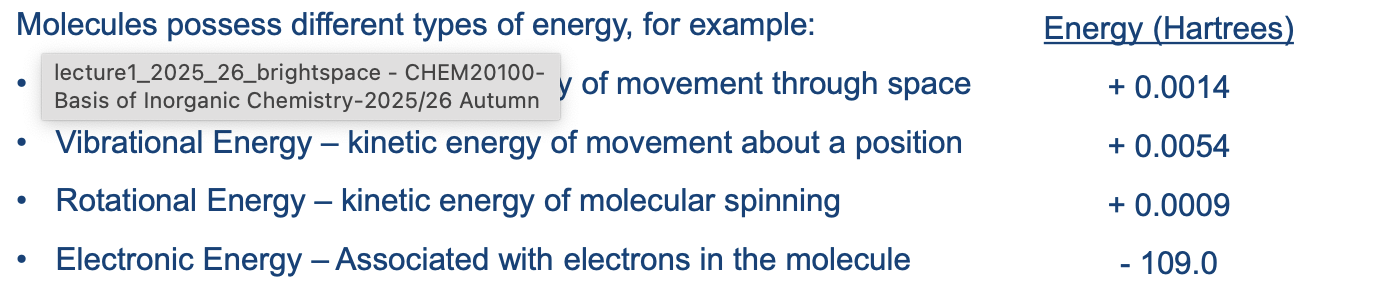
Translational energy - It is the kinetic energy associated with the straight-line (linear) motion of a particle (like a molecule or atom) as it moves from one place to another.
Vibrational energy levels are farther apart than translational/rotational ones, so they need higher energy (IR light, heat at high temps) to excite.
- - - - - - - - - - Rutherfords Scattering Experiment (1909)
Performed by Ernest Rutherford, with Geiger & Marsden.
They directed a beam of α-particles (helium nuclei, 2+2+ charge) at a very thin gold foil.
A zinc sulfide screen was placed around the foil to detect scattered α-particles (they gave tiny flashes of light when struck).
📌 Expectations (based on Thomson’s "plum pudding model")
At the time, people thought atoms were a diffuse cloud of positive charge with electrons embedded.
Prediction: α-particles should mostly pass through with very small deflections (like bullets through a soft target).
📌 Observations
Most α-particles passed through the foil without deflection → atoms are mostly empty space.
Some α-particles were deflected by small angles.
A tiny fraction (~1 in 8000) bounced back at large angles (>90°).
📌 Conclusions
The atom is mostly empty space.
The positive charge and most of the mass are concentrated in a tiny, dense core → the nucleus.
Electrons occupy the empty space around the nucleus.
⚛ Impact
Overturned the plum pudding model.
Led to the nuclear model of the atom:
Dense, positively charged nucleus at the center.
Electrons orbiting around it.
This became the foundation for Bohr’s model and later quantum mechanics.
Almost all the mass of the atom is concentrated in the nucleus
The diameter of the atom, ca. 10-10 m ( = 0.1 nm = 1 Å) is huge compared to the diameter of the nucleus, ca. 10 -15 m (1 fm).
The nucleus contains the protons and neutrons The electrons occupy the large space between nuclei. The electron and proton charges should attract each other:
PROBLEM
(i) if the electrons are static they should be pulled into nucleus
(ii) if the electrons are moving they should produce radiation
Are electrons electricity?
- electrons themselves are not "electricity," but the movement of electrons is what we call electricity.
Current electricity → continuous flow of electrons (like in a wire or circuit).
Static electricity → build-up of electrons in one place (like rubbing a balloon on your hair).
- - - - - - - - - - Emission Spectra
An emission spectrum is the set of wavelengths (colors) of light that a substance emits when its atoms or molecules go from a high-energy state back to a lower-energy state.
- - - - - - - - - - 🔹 How it happens
An atom absorbs energy (heat, electricity, or light).
One of its electrons gets excited to a higher energy level.
When the electron falls back down, it releases a photon of light.
The photon’s energy = difference between energy levels, so only certain wavelengths appear.
- - - - - - - - - - 🔹 Types of emission spectra
Line spectrum (discrete):
Sharp, colored lines at specific wavelengths.
Each element has a unique “fingerprint.”
Example: Hydrogen gas shows distinct red, blue-green, and violet lines.
Continuous spectrum:
All wavelengths in a range (like a rainbow).
Example: White light from a hot filament.
Band spectrum:
Closely spaced lines appearing as bands (from molecules with vibrational/rotational transitions).
- - - - - - - - - - 🔹 Why important?
Helps identify elements in stars (astronomy).
Basis of flame tests in chemistry.
Led to quantum theory (Bohr explained hydrogen’s emission spectrum using quantized orbits).
- - - - - - - - - - what determines what type of emission spectrum released?
Atomic vs. molecular structure
Atoms
Have discrete energy levels for electrons.
When electrons jump between these levels → line (discrete) emission spectrum.
Example: hydrogen shows sharp spectral lines (Balmer series).
Molecules
Have additional vibrational and rotational energy levels.
Transitions can occur not only electronically but also vibrationally/rotationally → band spectrum.
- 2. Physical state of the source
Gas phase:
Particles are far apart → collisions are rare → sharp line spectra.
Liquid or solid phase:
Particles interact strongly → energy levels broaden → continuous or band spectra.
- 3. Energy applied to the system
Higher energy excitation can access higher energy states → additional lines appear.
If energy is applied broadly (like a hot filament), many states are excited → continuous spectrum.
- 4. Type of radiation emitted
Electronic transitions → usually visible/UV lines (line spectra).
Vibrational/rotational transitions → IR region (band spectra).
✅ Summary Table
Factor | Effect on emission spectrum |
|---|---|
Atom vs molecule | Atom → line; molecule → band |
Physical state (gas/liquid/solid) | Gas → sharp lines; solid/liquid → broadened/continuous |
Energy of excitation | Higher energy → more lines/bands |
Type of transition | Electronic → visible/UV; vibrational → IR; rotational → microwave |
- - - - - - - - - - Quantum numbers
The angular momentum quantum number, l
The magnetic quantum number, m
The spin quantum number, s or m, little s - this is independent of other quantum numbers, it’s only plus a half or minus a half.
wave behaviour
intensity of light = amplitude squared.
intensity of light = amplitude squared. - intensity of light = amplitude squared. - intensity of light = amplitude squared. - intensity of light = amplitude squared. - intensity of light = amplitude squared. - intensity of light = amplitude squared. - intensity of light = amplitude squared. - intensity of light = amplitude squared. - intensity of light = amplitude squared. - intensity of light = amplitude squared. - The Photoelectric effect
Wave/ particle duality of light
Wave/ particle duality of light - Wave/ particle duality of light - Wave/ particle duality of light - Wave/ particle duality of light - Wave/ particle duality of light - Wave/ particle duality of light - Wave/ particle duality of light - Wave/ particle duality of light - Wave/ particle duality of light - Wave/ particle duality of light - Lecture 2 - Dr Negahdar
Intro to Orbital Hybridisation.
Orbital hybridisation is the mixing of atomic orbitals to form new hybrid orbitals.
Ex: CH4 degenerate sp3
Valence bond theory- explains how the atomic orbitals of the dissociated atoms combine to give individual chemical bonds when a molecule is formed.
Antibonding orbitals -