Educational Audiology Exam
LRE: Least restricted environment: as much involvement in the general education classroom to join their peers without limiting their educational goals and progress.
Language-rich environment with the best placement for DHH children
FAPE (Free Appropriate Public Education): any child has access to education without parents having to pay, under IDEA
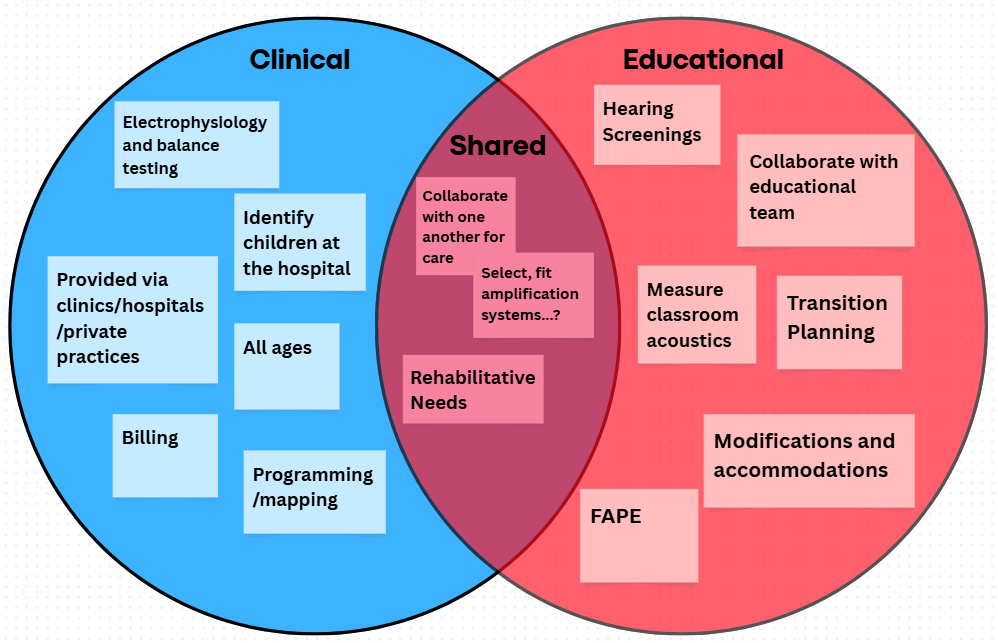
EA: Educational audiologist
Defines what an EA does (via IDEA):
identify, determine range/nature, and degree of HL
provision of habilitative activities (speech-reading/lip-reading, speech conservation, auditory training, etc.)
creation of prevention of HL programs and counseling children, parents, and teachers
determine need for amplification, select and fit, and evaluate the effectiveness of amplification.
LEA: Local education agency
Public school district, charter, Part C provider (birth-2 years)
IEP: Individualized education plan via IDEA
Receives funding
Present levels (strengths/weaknesses, results of evaluations), special factors (communication plan), annual goals, accommodations/modifications, transition plan, service delivery, placement in LRE, meeting minutes
Direct Services: Minutes of direct contact with the student, which are documented and delivered on a scheduled basis
Holistic Approach: incorporates aspects from analytic, synthetic, and pragmatic approaches = improvement of overall communication skills, psychosocial aspects of HL, education of SO
Hierarchy of Auditory Skills
Detection
Listening walks
Discrimination
games with 2 different sounds
long vs short, loud vs quiet
Identification
treasure hunt for single-word items
multiple vs single syllable
Comprehension
talking, introducing new ideas
Indirect Services: more consultative, spontaneous, on-call, or by request
40% of DHH individuals have a co-morbid diagnosis
Special Factors:
Communication Plan: for DHH students to ensure the child receives education in their native language
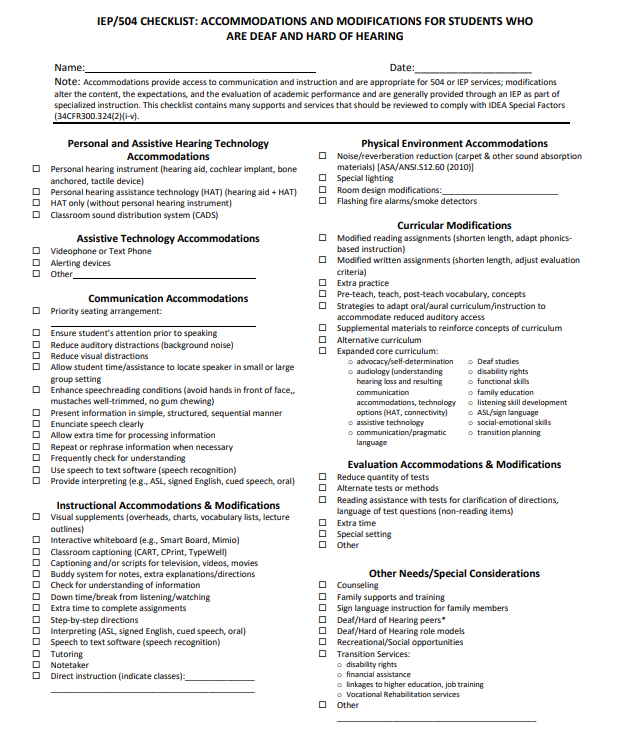
determine appropriate accommodations
Language factors (Spanish, ASL, AAC)
All education options (placement-LRE)
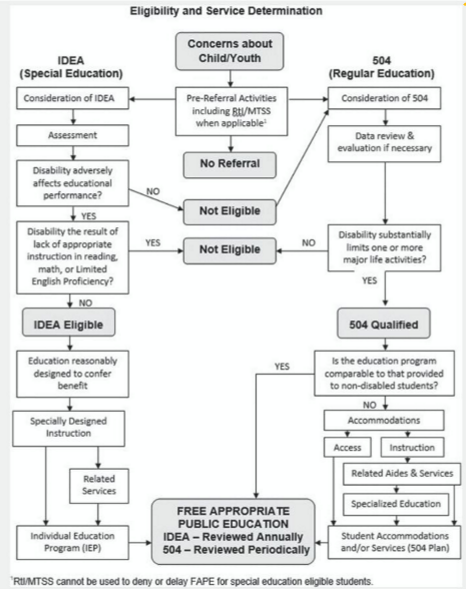
504 Plan
assessed without mitigating measures (that level the playing field like amplification)
revisited every year but re-evaluated every 3 years
general education teachers/classroom
major life activities
IFSP: Individualized family service plan
Part C (Early Intervention) of IDEA
Teaching models, focus on routines related to the child’s disability
45 days from date of referral to evaluation and determination
Present Levels: strengths and weaknesses, health, communication, motor, cognitive
Goals, Minutes, Transition
Reviewed every 6 months for annual reassessment
IDEA: individuals with disabilities education act
requires the existence of a disability that adversely affects educational performance, necessitating special education and related services
Related service: EA, ToSDHH, SLP, OT, PT, SPED
ADA: americans with disabilities act
prohibits discrimination in any state or local government entity
equal access for all individuals within these entities who may be experiencing difficulties connected to broader definitions of disabilities, including students under the IDEA
what 504 falls under from the Rehabilitation Act of 1972
RTI (response to intervention): identify students who are making inadequate progress and provide them with evidence-based support for learning and/or behavior needs in the general education classroom
A framework before the initiation of a special education referral to ensure that the learning problem is not a result of a lack of appropriate instruction.
Levels of intervention used before IEP
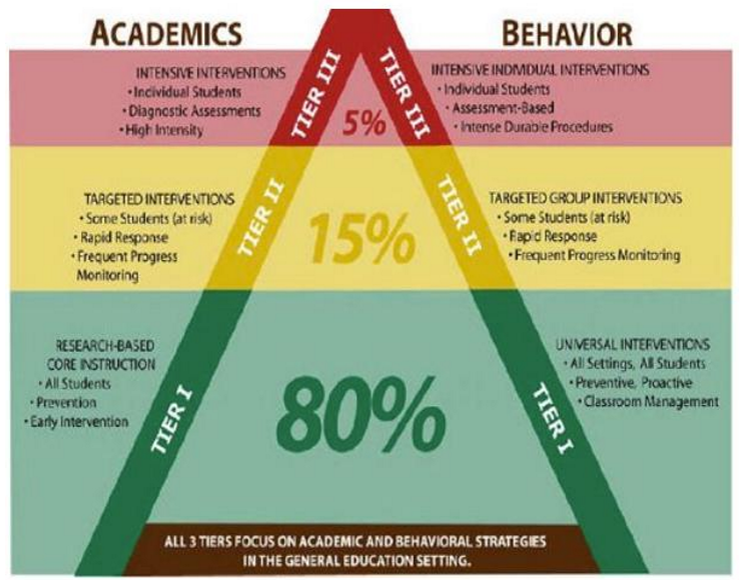
Tier I: Core Universal Interventions (All students)
General classroom communication accommodations
Frequent check-ins for understanding
HL prevention education and staff awareness
Classroom audio distribution system
Tier II: Targeted Group Interventions
Testing/exam accommodation and modifications
Note-taking support
RM HATs
Priority seating
Tier III: Intensive Individualized Interventions (All students require special education with an IEP)
Including Tier I and 2 interventions plus….
individualized instruction and accommodations
Expanded core curriculum: addresses areas that are either not typically taught or require specific and direct instruction. The tool is designed to assist with program development in: extracurriculars, advocacy, career education, audiology, functional skills, technology, etc.
team meetings, expanded training and consultation
Classroom Acoustics
35 dBA is the ambient noise level for unoccupied classrooms and RT of 0.5 sec
5 Acoustic Factors
background noise
SNR
Children with HL require +20 to 30 dB SNR (more than ELL kids)
Typical classrooms have +5 to -7 dB SNR
Recommended +15 dB SNR
Unoccupied ambient noise= 35 dBA
Occupied classroom 55-60 dB
RT
target: 0.6-0.7 sec, but reality is 0.4-1.4 sec
A square room, more occupancy, smaller room/ceiling size, soft surfaces, and carpet reduce RT
Speech Transmission Index: includes RT and background noise in how well a person can hear via combining the level of the talker’s voice at various distances and locations within a classroom
The higher the number: 0.76-1.0 (excellent: listening environment)
Opposite of RT
Bad RT negatively affects speech intelligibility
Speaker-listener distance and directionality
Incidental learning with an omnidirectional hearing aid
interaction amongst the 4 above variables

Universal design/benefit with more daylight in a classroom increases test scores, and also benefits of better visual cues for DHH students
Hearing Screening:
K, 1, 3, 5, at 20 dB HL at 1, 2, and 4 kHz
Once in middle school and twice in high school (ie. 7, 9, 11)
at 20 dB HL at 1, 2, 4, and 6 k Hz
Recommend otoscopy, DPOAEs, PTAs, and Tymps (if not passed AUD, always with K and 1)
500 Hz is often not screened because of upward spread of masking makes it difficult to understand in background noise (low hums of outlets and 35 dB A of unoccupied classrooms)
8% will not pass initial screening and of that 8%, 6% will not pass follow-up screening
Sensitivity: the ability of the screening procedure to IDENTIFY the TARGET population ACCURATELY (hit rate)
true positive/(true positive + false negative)
Specificity: the ability of the procedure to NOT IDENTIFY/PASS those who DO NOT have the DISORDER
true negative/(true negative+false positive)
Why are major life activities important?
Impacting caring for one’s self, performing manual tasks, concentrating, speaking, hearing, communicating, walking, sleeping
Feature | IFSP | IEP | Section 504 Plan |
|---|---|---|---|
Full Name | Individualized Family Service Plan | Individualized Education Program | Section 504 Accommodation Plan |
Law | Part C of Individuals with Disabilities Education Act (IDEA) | Part B of Individuals with Disabilities Education Act (IDEA) | Section 504 of the Rehabilitation Act of 1973 (ADA) |
Age Range | Birth to age 3 | Ages 3–21 | Any age in K–12 schools receiving federal funds |
Primary Focus | Child development and family support | Educational performance and special education needs | Equal access to education |
Who Qualifies? | Infants/toddlers with developmental delays or diagnosed conditions | Students meeting IDEA disability criteria and needing special education | Students with a disability that substantially limits a major life activity |
Services Provided | Early intervention services | Special education and related services | Accommodations and modifications |
Goals Written For | Child and family | Student | Typically, accommodations rather than measurable annual goals |
Where Services Occur | Natural environments (home, daycare, community) | School setting | General education setting with supports |
Review Frequency | Every 6 months; annual update | At least annually | Periodic review (often annually) |
Overarching differences between HAT and when you would choose which
EduMic: Oticon and Cochlear CIs
Pro: cheap, lightweight, can connect to multiple students
Con: Cannot change the volume on mic
MiniMic2+: Cochlear CIs
Pro: small, lightweight, cheap, pair to many devices
Con: sound is poor, not designed for classroom
Roger: Phonak and AB
Pro: adaptive sound, connects to most devices, easy to use
Con: expensive, bulky, can be confusing to connect
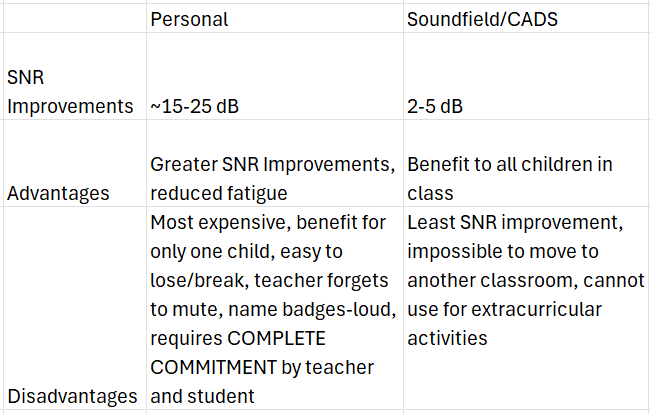
Personal HAT system:
Pro: reduce background noise, improve clarity (no distance factor), reduced fatigue
Con: costly, easy to lose and break, changes as HAs change
Soundfield HAT system:
Pro: benefits all students, most inexpensive, good parent participation
Con: residual distance, increased RT, benefit only in the classroom
ASSESSMENTS AND PROTOCOLS
Proxy-Assessments: SIFTER, TEACH/PEACH
SIFTER: screening instrument targeted at educational risk in the way they perform in class academically, with attention, communication, class participation, and behavior.
Self-Assessments: Quality of life, LIFE-R, CPQ, Vanderbilt Fatigue Scale
Vanderbilt Fatigue scale of occurrence of listed statements/experiences can be self or proxy
Classroom participation questionnaire about communication preferences and how you communicate in class
Listening fatigue
Symptoms: slumped or slouching, irritability, ignore/not paying attention, requires more repetition in school, difficulty concentrating and following directions, headaches
Informational guidance
Phase I: understanding basic parameters, implications of the hearing condition
Phase II: information about communication, programs, and education
F2F support, Deaf mentors, PIP
Education, technologies, and accommodations
Personal Adjustment Counseling: developing positive attitudes, self-determination, and addressing feelings, beliefs, and behaviors.
cope with the emotional and psychological impact of HL
DIFFERENCES BETWEEN EAs and CAs:
HAT Systems
Troubleshooting
Transmitter: (HAT system)
power/batteries
Check the microphone (inserted into the jack)
Receiver: (Boot/Roger 21 or hearing device)
power/batteries
headphones (inserted into the jack)
switch out to different headphones
Verify if the boot is completely inserted
Case Studies:
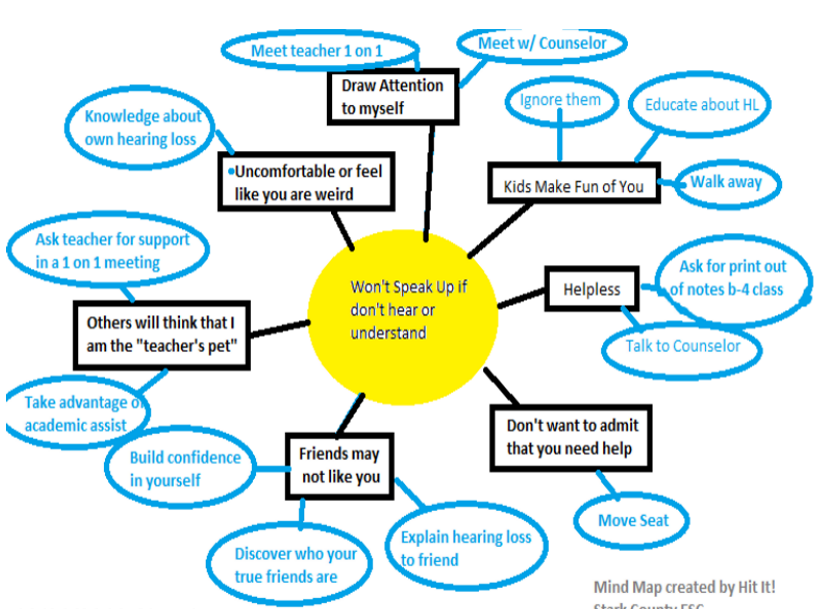
Ways to encourage autonomy with the use of HAT:
Participation/socialization
Reward System
Give and Take: aim for 1 class/subject
Asking questions of why not
Introducing conversations
Utah Law for DHH