The Cerebral Cortex and the Neocortex
Conscious awareness of oneself, both internal and external, is a reflection of cortical expression
The cerebral cortex is a 600 grams grey sheet that constitutes 40% of brain weight and contains 25 BILLION neurons
The neurons weigh about 180 grams, the glial cells and blood vessels weigh 420 grams
Cerebral cortices are 1.5 - 4.5 mm thick with a surface area of 2200 cm-sq
It is divided into a 6 layered neocortex that is organized into Brodmann’s scheme where he numbered areas based on the cytoarchitecture differences, which are called Brodmann numbers
Organization of the Neocortex
The Neocortex is organized into 6 horitizonal laminae / layers oriented parallel to the cortical surface
The basic functional units of the cerebral cortex are physiologically defined vertical, 3-dimentional slabs (0.5 mm in width)
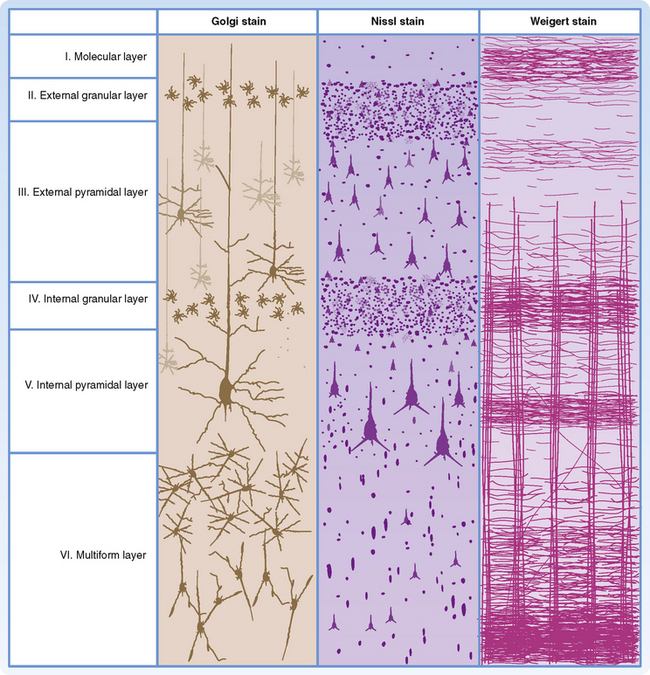
The main INPUTS to the cortex are from the thalamus that pass through the internal capsule and terminating at layers 1 through 4
The main OUTPUTS out of the cortex are sent through layers 5 and 6 and they mostly descend through the internal capsule and go to various subcortical structures/ sites
Types of Neocortex
There are 3 types of neocortexes in the brain: Primary / Receptive Cortex, Secondary Association Cortices and Tertiary Cortices
Primary / Receptive Cortex
Includes the: Primary Motor Cortex, Primary Somatosensory Cortex, Primary Visual Cortex and the Primary Auditory Cortex
Directly receives thalamic input
Damage to these areas can produce a loss of modality
Secondary Association Cortices
Includes the: Motor Association Cortex, Somatosensory Association Cortex, Visual association Cortex and Auditory Association Cortex
Responsible for the further processing, integration, and interpretation of information from the primary cortex
Damage can produce agnosia
Tertiary Cortices
Involved with higher-order functions related to reasoning, thought and language