Chapter 6.2
Input Space Partitioning
Combination Strategies Criteria
Combination of Partitions:
Selection of blocks from multiple partitions simultaneously.
Example: Test case requires satisfaction of block 1 from q2 and block 3 from q3.
All Combinations: Using all possible combinations of partitions can be impractical.
Criterion 6.1: All Combinations Coverage (ACoC)
Definition: All combinations of blocks from all characteristics must be covered in tests.
Example: If three partitions with blocks [A, B], [1, 2, 3], [x, y], ACoC needs twelve tests:
(A, 1, x), (B, 1, x), (A, 1, y), (B, 1, y),
(A, 2, x), (B, 2, x), (A, 2, y), (B, 2, y),
(A, 3, x), (B, 3, x), (A, 3, y), (B, 3, y)
Test Count Formula: , where is the number of blocks in partition . In this case the number of test would be
Criterion 6.2: Each Choice Coverage (ECC)
Definition: One value from each block for each characteristic must be included in at least one test.
Example: Using three blocks from previous example, valid tests like (A, 1, x), (B, 2, y), and (A, 3, x) can constitute ECC.
Minimum Tests Required: or in other words, the number of tests is the number of blocks in the largest characteristic.
Criterion 6.3: Pair-Wise Coverage (PWC)
Definition: Each block from every characteristic must be paired with blocks from other characteristics.
Example Combinations:
(A, 1) (B, 1) (1, x)
(A, 2) (B, 2) (1, y)
(A, 3) (B, 3) (2, x)
(A, x) (B, x) (2, y)
(A, y) (B, y) (3, x)
(3, y)
Minimum Test Count Formula: At least
In this case we have max(|A| |B|, |A| |C|, |B| |C|)
= max(2×3, 2×2, 3×2)
= max(6, 4, 6)
= 6
Criterion 6.4: T-Wise Coverage (TWC)
Definition: Values from each block for each group of characteristics combined.
Implication: If , this is just all combinations.
Cost Consideration: TWC can become expensive very quickly for the number of test cases.
Examples:
T=1 → Each Choice Coverage (ECC)
T=2 → Pair-Wise Coverage (PWC)
T=Q( | Q = number of characteristics) → All Combinations Coverage (ACoC)
Criterion 6.5: Base Choice Coverage (BCC)
Definition: A base choice block selected for each characteristic to form base tests.
Pick a base choice, change one characteristic at a time for all other tests
Example: Given the following blocks and characteristics
A = [a1, a2]; B = [b1, b2], C = [c1, c2, c3]; D = [d1, d2], we have
Base
a1 b1 c1 d1
A
a2 b1 c1 d1
B
a1 b2 c1 d1
C
a1 b1 c2 d1
C
a1 b1 c3 d1
D
a1 b1 c1 d2
Test Count Formula: where is the number of characteristics and is the number of blocks in the characteristic.
In this case: 1(base) + [(2-1) + (2-1) + (3-1) + (2-1)]
= 1(base) + (1+1+2+1)
= 6
Criterion 6.6: Multiple Base Choice Coverage (MBCC)
Definition: More than one base choice for each characteristic may be selected, forming multiple base tests.
Example: Given the following blocks and characteristics
A = [a1, a2]; B = [b1, b2]; C = [c1, c2, c3]; D = [d1, d2]
Two base tests: a1, b1, c1, d1; a2, b2, c2, d2
Tests from a1, b1, c1, d1
Base
a1 b1 c1 d1
C
a1 b1 c2 d1
A
a2 b1 c1 d1
Tests from a2, b2, c2, d2
Base
a2 b2 c2 d2
C
a2 b2 c1 d2
D
a2 b2 c2 d1
Test Count Formula: where is # of base tests, is # of characteristics, is # of blocks in the characteristic, and is the number of base choices selected for the characteristic.
In this case:
M = 2
Q = 4 (A, B, C, D)
B = {2, 2, 3, 2}
m = {1, 1, 1, 1}
Number of tests =
= 2 + 2((2 - 1) + (2 - 1) + (3 - 1) + (2 - 1))
= 12
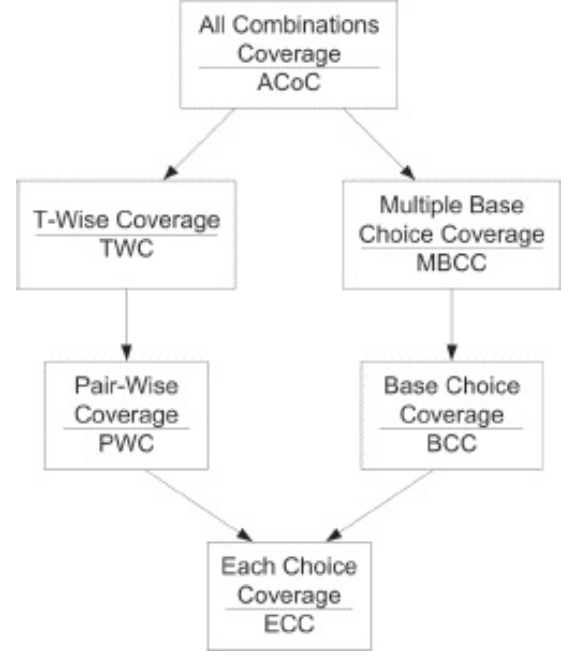
ISP Partitioning Combination Strategy Criteria Subsumption