Lec 9: BOA and OAE Applications
Clinical Applications of Behavioral Observation Audiometry (BOA) and Otoacoustic Emissions (OAEs) in Pediatrics
Overview of Pediatric Hearing Assessment Techniques
Developmental Timeline and Testing Gaps:
Newborn to 4-5 Months: Electrophysiological assessments like ABR (Auditory Brainstem Response) and ASSR (Auditory Steady-State Response) are primarily used as infants at this age sleep frequently.
5 to 9 Months: This represents a "gap" in formal testing. It becomes difficult to keep infants asleep for electrophysiological tests, yet a large proportion (up to 12 months) are not developmentally ready for Visual Reinforcement Audiometry (VRA).
7-9 Months and Up: VRA can be attempted, but success is hit-or-miss until roughly 12 months.
BOA's Role: BOA helps fill the gap between 5 and 9 months by providing Minimum Response Levels (MRLs) rather than true thresholds.
Behavioral Observation Audiometry (BOA) Protocol
Formal vs. Informal BOA:
Formal BOA: Conducted in a controlled environment (e.g., Royal Children’s Hospital) using two clinicians and calibrated stimuli.
Informal BOA: Used in challenging clinical situations (e.g., Children’s Surgical Center in Cambodia) using toys or phones to observe any reaction to sound, primarily to rule out profound deafness.
The Two-Clinician Setup:
Tester 1 (Presenter): Positioned behind the infant to avoid visual cues. They present the stimulus for 2-3 seconds, measure intensity using a Sound Level Meter (SLM), and provide social reinforcement if the child turns.
Tester 2 (Observer/Distractor): Sits in front of the infant. Their role is to keep the child in a "nice response state" (ready but not over-stimulated) and observe subtle behavioral changes like eyes widening or stilling.
Stimulus Characteristics:
Ascending Technique: Start at the level expected for normal hearing at that age and increase in roughly steps.
Time Gaps: Maintain long intervals of silence between presentations to allow the room to reset and the child to process the sound.
MRL (Minimum Response Level): BOA provides MRLs, which are super-threshold levels, not true hearing thresholds.
Infant Behaviors and Response Categories
Reflexive Responses:
Auro-Palpebral Reflex (APR): A brainstem reflex elicited by loud sounds (), resulting in a reflexive eyelid blink. Facial nerve activity causes this closure.
Moro Reflex: Found in babies under 4-6 months. Stimulus (sound or sudden movement) causes the baby to spread arms/legs and bring them back.
Startle Reflex: General bodily jump in response to sudden stimuli.
Arousal Behaviors (Positive):
Movement increase, smiling, eyes widening, increased sucking rate, or vocalizations.
Quieting Behaviors (Negative):
Stilling, holding breath, reduced sucking rate, or reduced vocalization.
Localization Development:
3 Months: Unsteady; moves towards sound in the horizontal plane only.
5 Months: Straight-line localization (horizontal then vertical).
6 Months: Moves head and eyes in an arc-like movement.
8 Months: Fully developed localization; head moves directly to the source.
BOA Instrumentation and Frequency Correspondence
Noisemakers:
Manchester Rattle: Very high frequency, roughly when shaken softly.
Squeaky Frog/Toy: High-pitched, but lower than the rattle.
Shaky Egg: Mid-to-high frequency.
Chime Bars: Frequency-specific (e.g., Note B), but difficult to present at very soft levels.
Drum: Used for APR; provides a broadband loud stimulus ().
Live Voice:
"Ba Ba Ba": Low frequency, captures energy from nasal murmurs.
"Shhh": High frequency, with energy above .
Expected MRLs for Normal Hearing Infants
Age Range | Expected MRL (dBA) |
|---|---|
0–4 Months | (sometimes ) |
4–6 Months | |
6–9 Months | |
12 Months | Approaching behavioral thresholds |
Note: High-frequency improvement is typically faster than low-frequency improvement in infants.
Otoacoustic Emissions (OAEs) in Pediatrics
TEOEs (Transient Evoked OAEs): Used frequently in newborn screening (Victoria, Australia) because they are fast and provide a "Pass/Refer" result. They can rule out all but a mild hearing loss ( or better).
DPOEs (Distortion Product OAEs): Common in clinical diagnostics. They provide frequency-specific information. The main distortion product formula is . They are generally present if hearing is or better.
Clinical Considerations:
Middle Ear Status: Requires clear middle ears. If Type B tympanograms are present, OAEs will be absent.
Pressurized DPOEs: Used for Type C tympanograms to compensate for negative pressure and attempt to elicit a response.
Amplitudes: Infant OAE amplitudes are significantly larger than those in adults, making them easier to record if the child is still.
Auditory Neuropathy: Diagnosed when ABR is absent/abnormal but OAEs are present (indicating normal cochlear hair cell function but faulty nerve transmission).
Interpretation and Triage
Diagnostic Power of Combining Tests:
BOA and OAEs are used together for children who cannot perform VRA (e.g., ASD, developmental delay).
If BOA MRLs are normal and OAEs are present, clinicians can often rule out significant loss and schedule a distant review.
If results are inconsistent or show elevated MRLs/absent OAEs, a sedated ABR at a tertiary center (e.g., Royal Children’s) is the last resort.
Reporting Phrases:
"Minimum response levels obtained via BOA suggest no worse than a [Mild/Moderate] hearing loss."
"Absent DPOEs across 1-6 kHz suggest cochlear dysfunction in the high frequencies."
Case Study: Kirby
Patient Profile: 9 months old.
Risk Factors: Aminoglycoside antibiotics (10 days), Special Care Nursery (2 weeks).
Symptoms: Limited babbling, not turning to sound, prefers solitary play.
Test Results:
VRA: Could not be conditioned.
Tympanometry: Type A (Normal).
OAEs: Absent DPOEs bilaterally (1-6 kHz).
BOA: Normal MRLs in the lows ( for "ba ba ba"); elevated in the highs ( for "shhh" and "rattle").
Conclusion: Results suggest a potential high-frequency hearing loss. Management involves an ASAP review for further VRA attempts to establish true thresholds.
BOA & Paediatric OAE Applications Notes
Learning Outcomes
BOA:
Recall basic auditory sensitivity across the first months of life
Follow the steps to conducting BOA
Justify what test stimuli are chosen and how they are presented
Interpret BOA test results and recognise what other information is required for interpretation
Describe why BOA has limitations as a hearing threshold measurement technique
OAE applications:
Justify when OAEs are of clinical relevance in paediatric populations and what hearing conclusions may result
How you can implement this knowledge into your clinical practice:
Recognise when BOA might add useful information to the test battery, and use past BOA results to inform future clinical testing and management
Recognise situations in which OAEs could be useful in a paediatric appointment and interpret OAE results in conjunction with other tests.
Behavioural Observation Audiometry (BOA)
What is BOA?
BOA is:
A behavioural assessment technique used mainly in infants/young children
Used when formal threshold testing is not possible
Used to obtain minimum response levels (MRLs)
NOT a true threshold test → A suprathreshold assessment only
Why BOA is Needed
Gap Between Electrophysiological Testing and VRA
Electrophysiological assessment
Possible in very young infants.
Problem
Once infants reach:
~4–5 months and older
It becomes difficult to:
Keep them asleep during ABR/ASSR appointments.
VRA
Can usually start from:
~7–9 months onward
However:
Many infants are not developmentally ready for VRA before 12 months.
Therefore:
There is a testing gap approximately between:
5–6 months to 8–9 months
BOA helps fill this gap.
Formal vs Informal BOA
Formal BOA
Usually involves:
Two clinicians
Structured presentation of sounds
Observation of infant responses
Can involve a formal BOA room setup.
Informal BOA
Examples:
Playing favourite songs/videos
Using phone sounds
Observing spontaneous reactions to sounds
Used especially:
When children are difficult to test
When VRA unsuccessful
In ASD/developmentally delayed children
Importance of BOA
Rule out profound deafness
Rule out significant hearing loss
Provide information about responses to sound
Help determine urgency of review
Help reduce parental concern
Infant Responses to Sound
Infants respond differently to sound compared with:
Older children
Adults
Infants:
Often do not respond behaviourally to soft sounds
Require louder sounds to elicit behavioural responses
May still have normal hearing despite lack of response to softer sounds
Infant development from 0-9 months
behaviours in response to hearing sound
1. Reflexive
Auro-palpebral Reflex (APR)
Brainstem reflex
Elicited by loud sound
Causes reflexive eyelid closure/blink
Mediated via facial nerve
Examples of stimuli:
Loud clap
Dog bark
Sudden loud sound
Moro Reflex
Occurs in infants:
< 4–6 months
Triggered by:
Loud sound
Sudden movement
Feeling of falling
Response:
Arms/legs extend outward
Then come back inward
Other Reflexive Responses
General Startle
Eye-turn
2. Arousal
Positive/additive behaviours:
Smile
Increased movement
Eye widening
Increased sucking rate
Vocalisations
3. Quieting
Negative/reduced behaviours:
Stilling (Reduced movement)
Holding breath
Reduced sucking rate
Reduced vocalisations
Auditory Localisation Development
~ 3 Months
horizontal plane movement (unsteady)
~ 5 Months
Straight line localisation
Horizontal then vertical localisation
~ 6 Months
Arc-like head and eyes movement toward sound
~ 8 Months
Localisation should be fully developed
Direct head and eyes turns to sound source
Hearing sensitivity
As children develop, there are improvements in:
behavioural thresholds
thresholds in noise
frequency discrimination
temporal discrimination
localisation
Key elements of auditory processing
Infant Behavioural Responses vs Age
As age increases (by age 12 months):
Behavioural responses improve
Gradual improvements in showing their sensitivity to sounds to within ~10 dB of ‘real’ thresholds
High frequency improvement is faster than low frequency improvement
Maturation of brain structure and function depends on
Experience
Interaction with the environment
A newborn with normal hearing may:
Ignore 20 dB sounds behaviourally
Need 70–100 dBA sounds to react
Parents may incorrectly think:
Infant cannot hear
Clinicians may need to counsel parents regarding this.
Expected response lv./MRLs of normal hearing

Stimuli
Noisemakers = equipment of known frequency/pitch
Live voice
Live Voice Stimuli
“mm”
Low-frequency stimulus
Nasal murmur
Good for low-frequency hearing assessment
“sh”
Mid/high-frequency stimulus
Most energy above 4000 Hz
Good for high-frequency hearing assessment

Noise Makers
Manchester Rattle
Contains grains
Soft shake corresponds to ~8000 Hz
Louder shaking lowers frequency emphasis
Drum
Low-frequency stimulus
Squeaky Toy/Frog
Higher-frequency stimulus
Not as high as rattle
Shaky Egg
Mid/high-frequency
Can be tricky
Chime Bars
Frequency-specific stimuli

BOA set up
Tester 1
Present sound stimulus
Observe responses
Reinforce responses
Measure sound levels using sound level meter
Tester 2
Distract infant appropriately
Maintain response state
Observe subtle responses — Communicate with tester 1
Presentation Guidelines
Stimuli should be randomised
Avoid habituation
Present stimuli for 2–3 seconds minimum
Leave long silent gaps between presentations

Positioning
Tester 1:
Positioned behind infant
Infant should not see tester in peripheral vision
Air Movement
Infants may respond to:
Air movement
Non-auditory cues
Clinician should minimise these cues.
Ascending Technique
Procedure:
Start around expected normal-hearing response level for age
Present stimulus
If no response:
Wait for silence
Increase intensity
First response level = MRL
No strict dB step size:
~10 dB increases suggested
Sound Level Meter
Settings:
FAST
dBA
Placed near tester 1 for easy access.
Important!!

Auro-palpebral Reflex (APR) Testing
Procedure
Use drum + drumstick
Single loud bang
Aim:
~70–100 dBA (Normal APR range)
Important
Warn caregiver beforehand:
Avoid caregiver startling
Prevent invalid infant response interpretation
APR Interpretation
Normal:
Loud sound elicits blink reflex
APR behaves like reflex result:
~15 dB sensation level
Example:
90 dB drumbeat → blink
Suggests at least one ear hears:
75 dB or better
Can help:
Rule out profound hearing loss
Situations Where BOA is Used
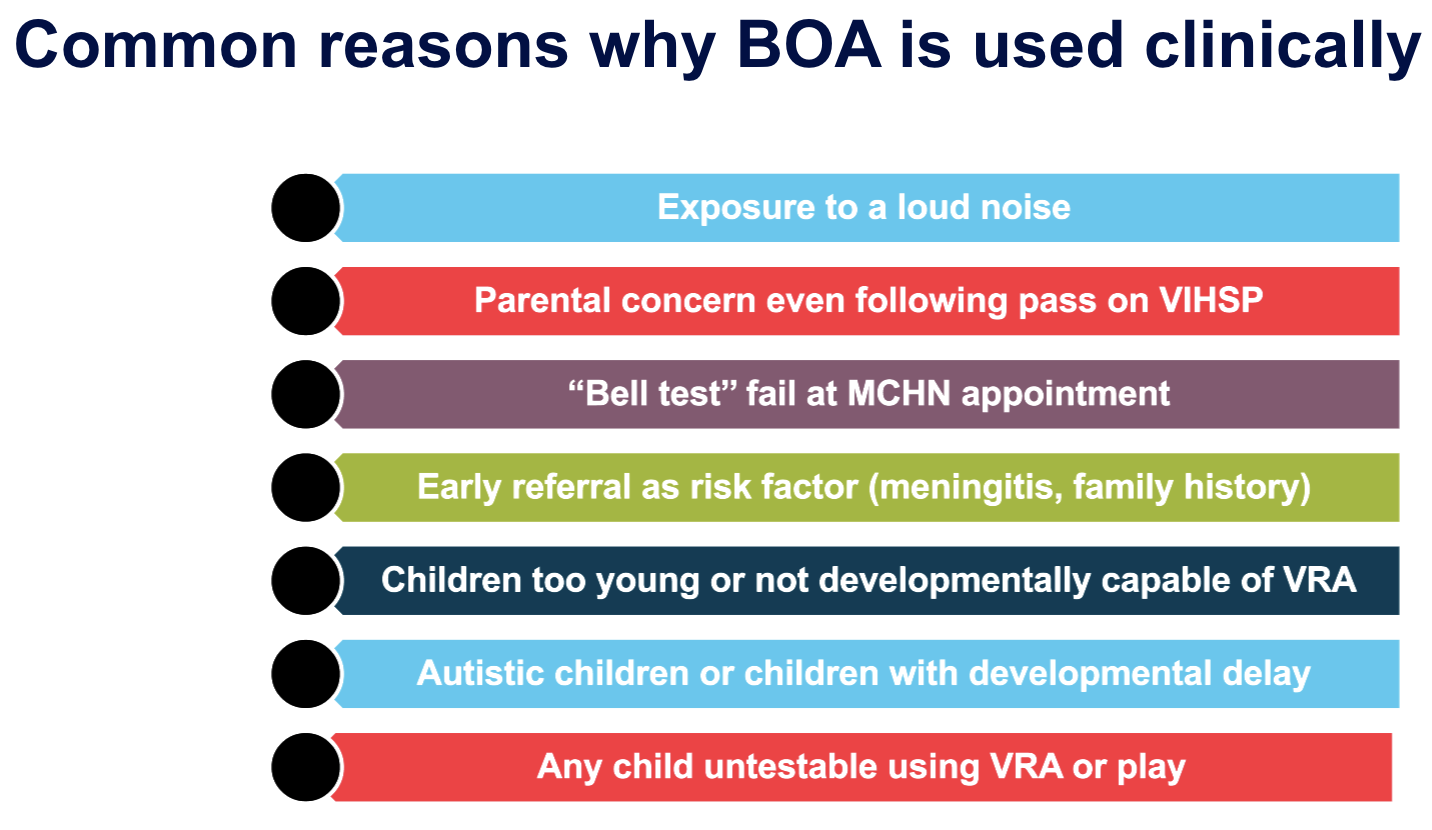
Parent Concerns
Examples:
Loud wedding exposure
Concern despite passing newborn screening
Maternal Child Health Referrals
Failed “Bell test” (Bell test considered invalid/unreliable)
Early referal as Risk Factors for Hearing Loss
FH/ meningitis
Missed electrophysiological assessment window
Children Not Ready for VRA
Too young
Developmentally delayed
ASD
Cannot condition for VRA

BOA + OAEs
BOA and OAEs complement each other.
Together they can:
Rule out significant hearing loss
Eliminate all but mild loss in some cases
Referral for Sedated ABR
Consider when:
BOA abnormal/inconsistent
OAEs abnormal/inconsistent
VRA unsuccessful
Thresholds still required
BOA Interpretation
BOA can:
Rule out hearing loss greater than MRLs obtained (in at least one ear)
Suggest elevated hearing levels
Suggest possible frequency configuration
Elevated responses for one frequency range, when responses at other frequency ranges were at expected levels → hearing loss in a particular frequency range
BOA cannot:
Provide true thresholds
Reliably comment on hearing in separate ears
Correct localisation to stimuli on each side is possible even if unilateral loss
ability to localise can give a bit more confidence that hearing is similar between ears

BOA Management Principles
Children are rarely discharged based only on BOA.
Usually:
Additional testing needed
Follow-up/review needed

Informal BOA
informally observe response to sound
Useful when:
Child running around
Cannot sit for VRA
Difficult to condition
Common Informal BOA Method
Play favourite sound/video:
Very soft volume
Observe reaction
Examples:
Favourite YouTube videos
Cocomelon
Clinical Value
Can:
Reduce clinician / parental concern
Determine urgency of review
Support referrals to other developmental pathways
Paediatric OAEs
Used in:
Newborn hearing screening
Infant diagnostic batteries
Difficult-to-test children
Complementary assessment tool
TEOAEs vs DPOAEs
TEOAEs
Faster
Often used in screening
Can provide quick pass/refer result
DPOAEs
More frequency-specific
Provide detailed frequency information
OAEs in Newborns
Advantages:
Babies quiet/still
Easier to test
Large OAE amplitudes in newborns
Important Limitation
A newborn can:
Pass newborn screening
Have present OAEs and ABR
Still have mild sensorineural hearing loss
Screening primarily targets:
Moderate or greater hearing loss
OAEs in Infant Diagnostic Test Batteries
Reliably recordable
OAE amplitude in normally hearing newborns is greater
Confirm the ABR, tympanometry and other frequency-specific test results (i.e. ASSR)
Presence of OAEs in the absence of an ABR (or grossly abnormal ABR) is suggestive of auditory neuropathy
OAEs in Difficult-to-Test Children
Obtain a non-behavioural assessment of cochlear function in children who are unable to complete behavioural testing
A broad understanding of a child’s likely hearing ability → determine the urgency of review timeframes
TEOAEs Present → rule out worse than mild hearing loss (>35 dB)
DPOAEs Present → rule out worse than moderate hearing loss (>45 dB at tested frequencies)
Run tymps prior to OAE testing
Type B → OAEs expected absent / not useful
Type C → Pressurised DPOAEs
Tricky for very active children as they need to be still and silent
watch the OAE screen as it records
watch their favourite TV show on mute
OAE Interpretation
Signal-to-Noise Ratio (SNR)
Criterion:
≥6 dB difference required
Noise Floor
High noise floor:
Invalid test
Responses may be hidden under noise
Possible causes:
Child movement
Environmental noise
Kirby Case Study
History
9-month-old Kirby:
Aminoglycoside antibiotics ×10 days
Special care nursery ×2 weeks
Limited babbling
Not turning to sounds
Appears to ignore sounds
Red Flags
Aminoglycoside exposure
Limited babbling
Not turning/responding to sounds
SCN admission
Testing
VRA
Attempted but:
Child would not condition
Tympanometry
Results:
Type A bilaterally
DPOAEs
Results:
Absent bilaterally 1–6 kHz
Interpretation:
Suggest possible hearing loss
Cannot diagnose hearing loss using absent OAEs alone
BOA Findings
Responses
Head turns present
Age-appropriate localisation
Interpretation
Low frequencies:
Within expected levels
High frequencies:
Elevated MRLs
Suggestive of:
Possible mild high-frequency hearing loss
Reporting Language
Recommended wording:
“Suggests”
“Potential”
“Elevated hearing levels”
Avoid:
Definitive diagnosis
Defining conductive vs sensorineural loss at this stage
Management
Review ASAP
Continue attempting VRA
Obtain true thresholds over multiple sessions if needed