Topic 5 (part 2) - In person Lecture
Define respiration
process that provides energy for life - a sequence of events that results in the exchange of O2 and CO2 between the external environment and the animal + its mitochondria within its cells
what is respiration’s purpose in organisms?
purpose of respiration is gas exchange of O2 and CO2 → receives oxygen from the environment and removes carbon dioxide from blood
Fick’s law of diffusion:
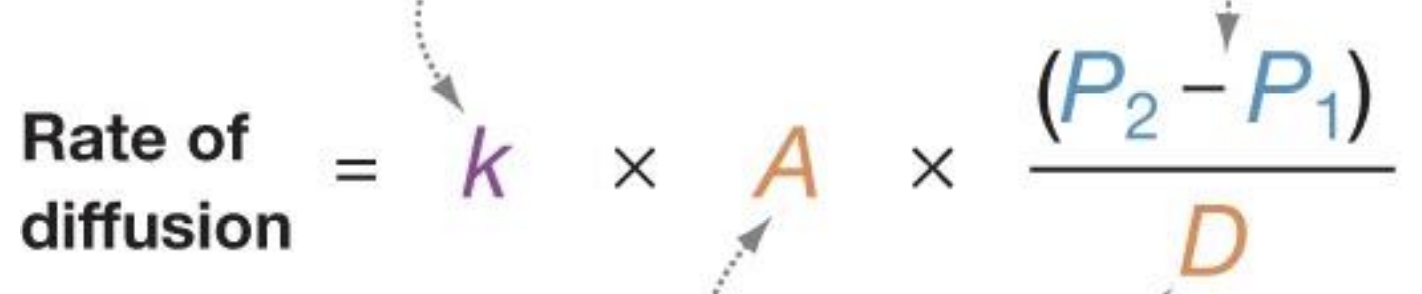
k - diffusion constant
intrinsic property of the gas that relates to how well it can move through the membrane
independent of specific pressure difference or thickness of the membrane
depends on solubility of the gas and temperature
A - area for gas exchange
(P2-P1) - difference in partial pressure of gas on either side of barrier to diffusion
D - distance → thickness of barrier to diffusion
How to increase/decrease the rate of diffusion based on the parameters in the equation
increasing:
diffusion constant of gas is large/high
surface area of membrane is large
difference in partial membrane of gas is high on either side of membrane
diffusion distance across membrane is small
decreasing:
what diffusion constant of gas is small/low
surface area of membrane is small
difference in partial membrane of gas is low on either side of membrane
diffusion distance across the membrane is large
Graham’s law:

diffusion constant looks at intrinsic gas properties of solubility and molecular weight → based on Graham’s Law
MW - molecular weight
\left(MW\right)^{0.5}=\sqrt{\left(MW\right)}
rate of diffusion for gases can also increase when:
solubility of a gas in medium is high
molecular weight of a gas decreases
liquids - solubility is a more significant factor than molecular weight / air - molecular weight is the more significant factor than solubility
what is ventilation
the active movement of respiratory medium (air/water) across respiratory surface
What are the three types of ventilation?
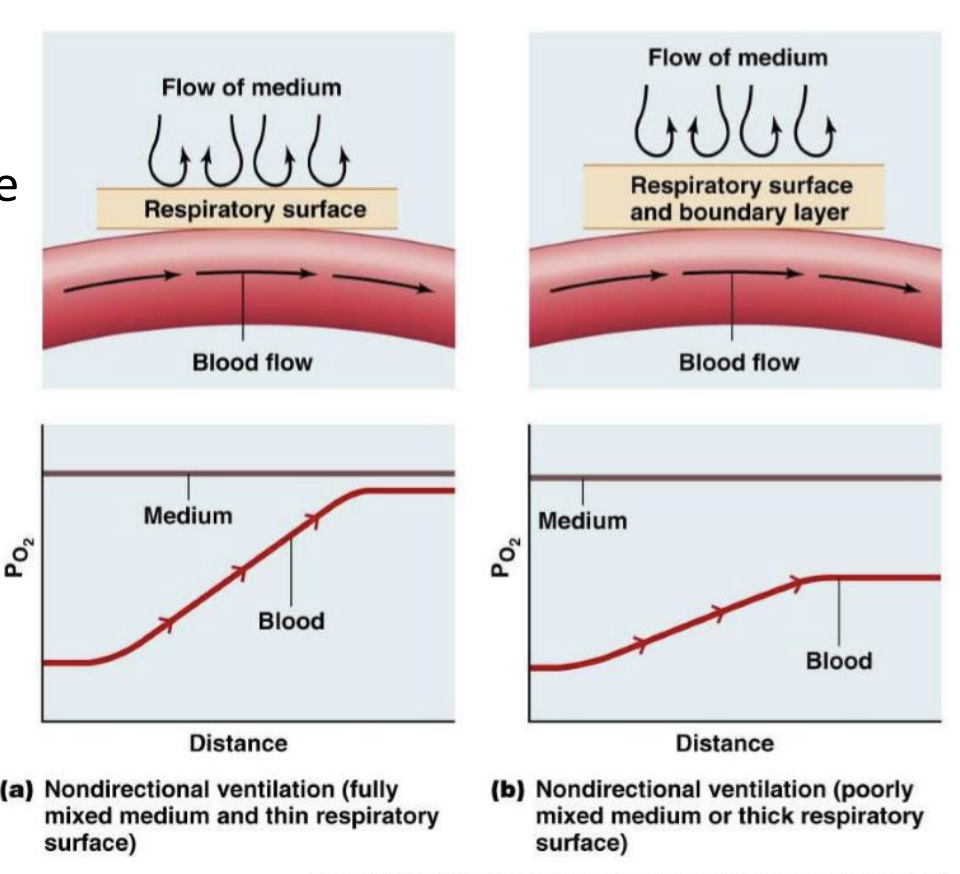
non-directional - medium flow past the respiratory surface in an unpredictable pattern
animals that use cutaneous respiration (i.e. earthworms, frogs, lungless salamanders) or wave their external gills directly into the environment medium → are examples that follow this ventilation pattern
unidirectional - medium moves through respiratory system in one direction - passes over gas exchanges before exiting through a separate pathway
seen in fishes with internal gills (teleost/elasmobranch gills) + avian lungs
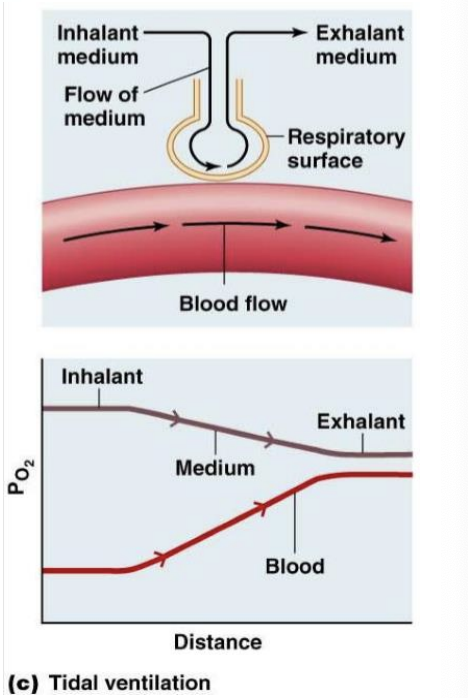
tidal - medium moves in and out of respiratory chamber in a back and forth movement
seen with lungs of mammals, insects, most reptilians (non avian - except crocodilians), air breathing amphibians, air breathing fish
Non-directional ventilation:
partial pressure of oxygen in blood leaving the gas exchanger can approach the partial pressure of oxygen in the medium - if the medium is very well mixed
anything that increases diffusion distance - decreases the oxygen exchange efficiency and reduces the partial pressure of oxygen in the blood leaving the gas exchanger
Tidal ventilation:
when an animal breathes in - incoming fresh medium mixes with stale medium left from previous breath in respiratory cavity
partial pressure of oxygen in respiratory cavity is lower than that of the external environment
oxygen diffuses into blood flowing along the gas exchange surface
partial pressure of oxygen in the blood exits the gas exchange surface in an organism - will be approximately in equilibrium with the exhaled medium (if diffusion distance across respiratory surface is small)
Uni-directional ventilation:
blood can flow in two ways relative to the flow of the medium
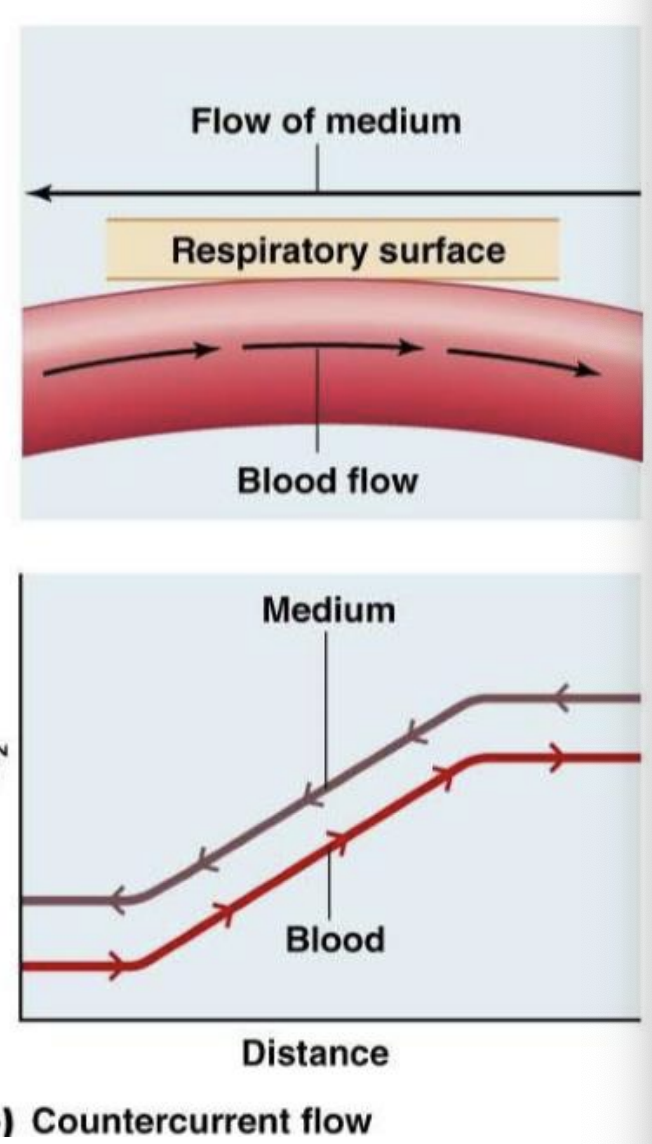
countercurrent flow - opposite direction along the gas exchange surface
crosscurrent flow - at a perpendicular direction
countercurrent flow - medium starts with high partial pressure of oxygen and decreases steadily as it gives up oxygen along the exchange surface
blood starts with low partial pressure of oxygen and steadily increases as it picks up oxygen while flowing in opposite direction to medium
medium always has a higher partial pressure of oxygen than blood flowing next to it - creates a small but continuous diffusion gradient across the entire exchange surface (key to efficiency)
crosscurrent flow - medium starts with high partial pressure of oxygen and decreases steadily as it give up oxygen along exchange surface
blood starts with low partial pressure of oxygen and steadily increases as it picks up oxygen from different parts of the medium - blood’s partial pressure of oxygen can rise to a level higher than the final partial pressure of the medium
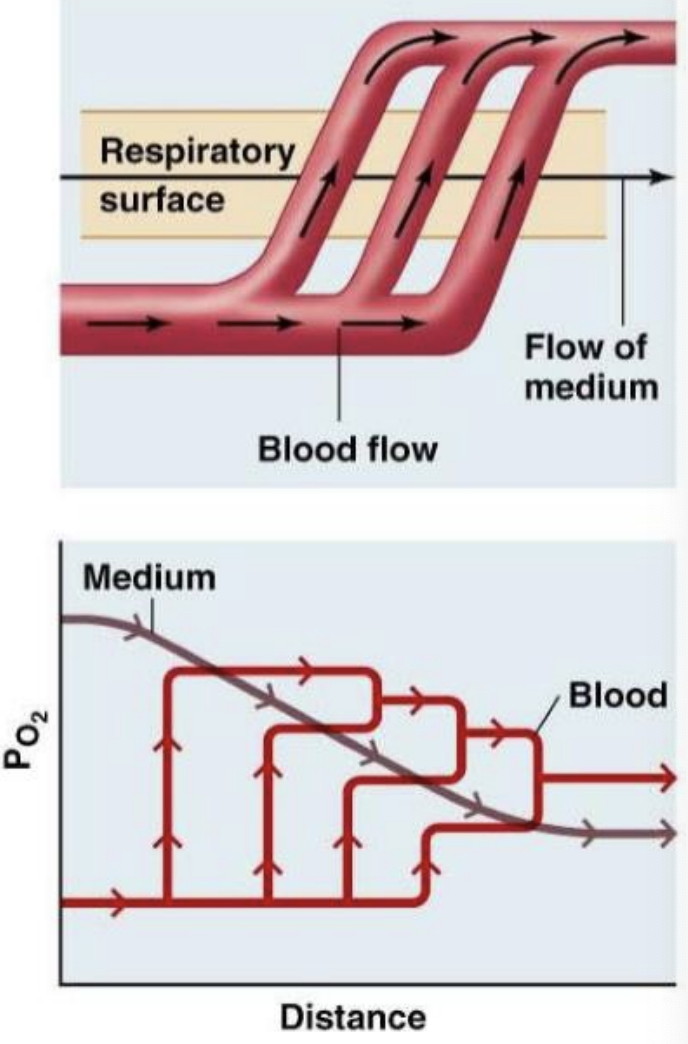
Which of these flow systems is more efficient at gas exchange
countercurrent exchange is more efficient at gas exchange - maintains a consistent diffusion/thermal gradient along the entire exchange surface rather than allowing it to drop quickly like in crosscurrent flow
Boyle’s Law - states that in a closed space pressure and volume are inversely related
meaning if volume decreases = pressure increases - vice versa
Fish’s gills
elasmobranchs - most species of sharks, skates and rays → used buccal pump for gill ventilation
mouth opens → buccal cavity expands in volume → decreases pressure inside the cavity
water rushes/is sucked into buccal cavity → occurs through the mouth and spiracles (nostril-like structures on top of head)
mouth and spiracles close - muscles surrounding buccal cavity contract → decreases volume of cavity + increase pressure inside → forces water past gills and through external gill slits
buccal pump → a dual-pumping mechanism in which buccal cavity alternates suction/force phases → to move water unidirectionally over the gills (even if the animal is stationary)
gills in teleost (bony) fish - located in opercular cavities
are protected by flap-like operculum (provides better protection of gills compared to more exposed gills seen in elasmobranchs)
4 gill arches in each opercular cavity - provide structural support for two rows of gill filaments (i.e. primary lamellae) that project from each gill arch in a v-shape
each filament is covered with rows of interdigitated folds called secondary lamellae → perpendicular to the filament
secondary lamellae are thin-walled + highly vascularized → acts as a main respiratory surface
uses a buccal-opercular pump for gill ventilation - requires buccal (mouth) and opercular (gill cover) action in tandem to drive water in a continuous unidirectional flow across internal gills
Ventilatory cycle of teleosts
mouth opens / opercular valve closed - buccal cavity expanded + opercular cavity expands
expansion creates negative pressure - drawing water into the mouth from the outside
mouth closes / opercular valve closed - buccal cavity is compressed + opercular cavity is expanded
negative pressure in opercular cavity helps move water from buccal cavity to gills
mouth closed / opercular valve opens - buccal cavity is compressed + opercular cavity compresses
compression of both buccal cavity + opercular cavity force water over the gills and out
mouth opens / opercular valve opens - buccal cavity expands + opercular cavity compressed
gas exchange is effective at fish gills:
lamellae have a very thin membrane → small diffusion distance
lamellae provide very large surface area for gills
large partial pressure gradient of gas between water column and capillaries inside lamellae
fish gills - use a countercurrent exchange system → where blood flow through capillaries in secondary lamellae is in the opposite direction to water passing through gills
oxygen extraction from water can be high as 70-80%
counter current exchange system is a good way to compensate with an oxygen deprived environment → but air holds significantly more oxygen than water
why crosscurrent is less efficient:
inefficiency in oxygen extraction - if blood + water flowed in the same direction it would reach to equilibrium + oxygen diffusion would stop → lower oxygen saturation levels in the blood - insufficient for metabolic needs of most fish
low oxygen concentration - water contains much less oxygen than air - in order to survive fish need an extremely efficient method to extract the maximum amount of oxygen possible
Ram ventilation
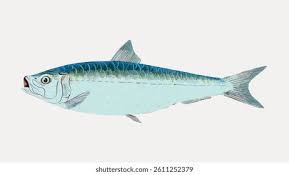
method of respiration where fish (i.e. teleost fish - tuna, salmon, flounders, cod, herring + tiger shark) swim forwards with their mouths open to force water across their gills, facilitating oxygen uptake without active pumping
some sharks (tiger sharks) can breathe by alternating between buccal pumping → swimming at low speeds + ram ventilation → swimming at higher speeds
some sharks (i.e. great white, whale shark, hammerhead + mako) don’t have buccal muscles → have to be ram ventilators - need to keep moving forward in order to breathe (if they stop they will drown)
advantages:
fish can prioritize more energy into their swimming muscles instead of their buccal or opercular muscles → enhances their speed
increase flow rate of water over gills as fish swims faster → increased oxygen uptake to meet higher metabolic needs of fish
disadvantages:
some obligate ram ventilators must swim continuously to breath for survival
opening mouth results in increased drag on fish → affects locomotion - increases the resistance against the water and slows the fish down (drag is minimized if they have a streamlined body - designed to minimize water resistance [drag])
Air breathing fish
mudskippers - spend more time on land than in water - some species spend 90% of their time out of the water
absorbs oxygen through their skin (cutaneous respiration) + through the lining of their mouth + throat → both contain a high density of blood capillaries
modified gill chambers - helps trap pockets of air + water while on land → prevents the gills from collapsing and allows for gas exchange
electrical eels
have extensive folds in mouth - highly vascularized for substantial aerial gas exchange (aerial gas exchange → exchange oxygen + carbon dioxide directly with the atmosphere)
highly vascularized → has an exceptionally high density or concentration of blood vessels (i.e. - arteries, veins, capillaries)
armored catfish
highly vascularized stomach that is used for gas exchange after gulping air
can survive 30 hours out of the water if enough oxygen is stored in their stomachs
bichirs
uses a pair of lungs that are highly vascularized for gas exchange
are facultative air-breathers - possesses both gills + specialized organ to breathe air (typically only does one when necessary)
can access surface air to breathe when the water they inhabit is poorly oxygenated
lungfish - most developed air-breathing organ of any fish
have complex highly vascularized lungs → covered in folds + pockets that increase their surface area
most lungfish species have two symmetrical lungs (except Australian lungfish → only has one lungfish)
Respiration in Insects
tracheal system - a complex network of tubules that insects use in order to breathe
large tracheae is connect to spiracles
spiracles - openings on the surface along the abdomen where oxygen enters and CO2 leaves
spiracles can be closed using valves to reduce water loss → allows insects to live in dry areas
rise in CO2 in the tracheal system causes spiracles to open
air sacs are reservoirs (pushes air through tracheal tubes when contracted)
tracheal tubes + tracheoles are tubes that carry air throughout the body directly to cells and tissues (i.e. muscles)
gases are moved largely by muscle contractions in their abdomen and around their spiracles → no blood flow is needed to transport gases
*air is not circulated by the insects blood - respiratory + circulatory systems are separate
Respiration in Amphibians + non-avian reptiles
frog lungs are not as efficient as fish gills:
new air that is inhaled mixes with the old air that is already in the lung (note: tidal ventilation is not as efficient in gas exchange compared unidirectional ventilation)
the lungs have a relatively smaller surface area
oxygen levels are much higher in the air (about 21% oxygen level) than in water (1% oxygen level) → lungs do not have to be as efficient as gills
why non-avian reptiles have more efficient lungs than frogs
non-avian reptiles are generally more active than amphibians - require more oxygen
lungs of non-avian reptiles contain a larger surface area compared to the lungs of amphibians
why non-avian reptiles cannot use cutaneous respiration like frogs
cannot rely on their skin for respiration (like amphibians) due to dry scaly skin → water tight to avoid water loss
Human Respiratory system
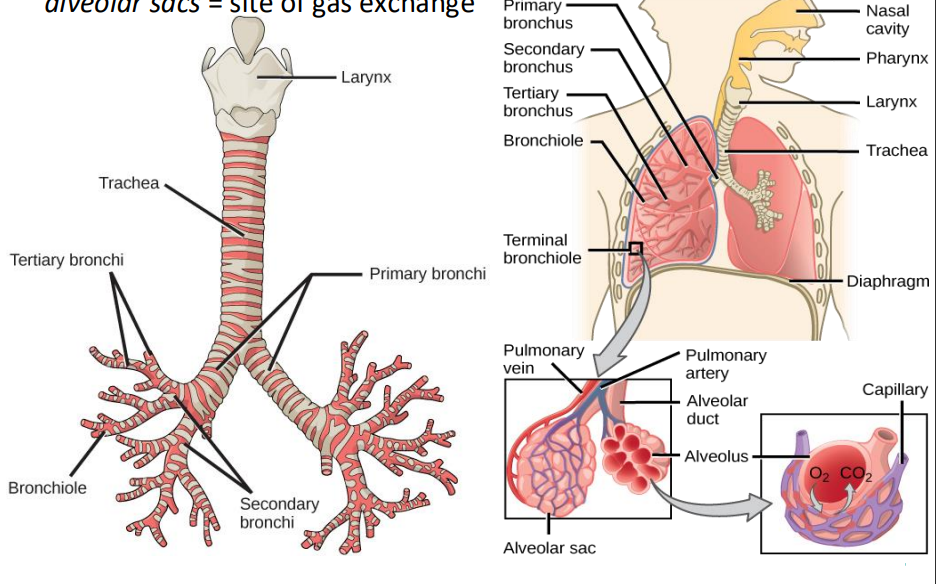
purposes of the C-shaped hyaline cartilaginous rings - trachea:
keeps the trachea open during breathing (prevents collapsing) so oxygen can reach the alveoli
rings are incomplete (c-shaped) instead of complete (o-shaped) so that the esophagus can expand during peristalsis as food or liquid moves through it
peristalsis - series of involuntary, wave-like muscle contractions that propel food, fluids, waste through the digestive tract
how gas exchange is very effective at the alveoli based on Fick’s law
alveoli + capillaries are one cell layer thick → have a small diffusion distance
alveoli provide very large surface area for lungs
large partial pressure gradient of gas between inside of alveoli and capillaries
Respiration in birds
Identify: trachea, primary bronchus, ventrobronchus, dorsobronchus, parabronchi, anterior air sacs, posterior air sacs (do not need to know the name of the air sacs, posterior and anterior is good)
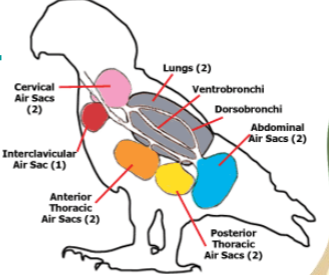
unidirectional air flow through respiratory system
lungs are almost completely rigid + undergoes little change in volume during breathing
birds require two cycles of breathing (inhalation + exhalation) to move air through its respiratory system
they inhale by expanding the volume of its chest because of contracting rib (intercostal) muscles + muscles attached to the sternum (breastbone)
*birds do not have a diaphragm like mammals do
expansion of chest volume causes increase in volume of air sacs while pressure within them decreases → causes air to rush in along its partial pressure gradient
pathways of first + second of inhalation and exhalation:
first inhalation
anterior + posterior air sacs expand
air travels through trachea → splits into left + right primary bronchi
air then travels down each primary bronchus and primarily into posterior (rear) air sacs
first exhalation
chest compresses while anterior + posterior air sacs compresses → volume in air sacs decrease + pressure increases
air moves along partial pressure gradient from posterior sacs into lungs where gas exchange occurs
second inhalation
anterior + posterior air sacs expands
air moves from lungs into anterior sacs
second exhalation
anterior + posterior air sacs compress
air moves from anterior sacs back into trachea and expelled from the system
how avian respiratory system is more efficient at gas exchange over mammalian respiratory system:
unidirectional nature - higher oxygen content that can diffuse into blood and reach tissues
wall of lungs cannot collapse in on themselves → does not require residual air since avian lungs are more rigid
residual air - approx 1-1.2 L of air that permanently remains in the lungs even after a maximum forced exhalation - prevents the alveoli (air sacs) from collapsing + keeps it inflated
mechanism eliminates the need to mix fresh air with old air in lungs → ensures a constant supply of oxygenated air across the respiratory surface
mixing of air reduces the partial pressure of oxygen and increases the partial pressure of carbon dioxide within the alveoli → reduces efficiency of gas exchange in accordance to Fick’s law
air capillaries in walls of parabronchial system having much larger overall surface area than alveoli found in mammalian respiratory system