Theories of Cognitive Development BB
Jean Piaget
Proposed that children move through four stages of cognitive development:
Sensorimotor
Preoperational
Concrete operational
Formal operational
Influenced by biological ideas
Early work with Alfred Binet on intelligence tests, which informed his theories on how children think.
Lev Vygotsky
Emphasized the role of social interaction and cultural context in cognitive development.
Introduced concepts like the Zone of Proximal Development.
General Concepts
Cognitive Structures
Schemes: Mental frameworks or patterns of thought that organize knowledge and guide behavior.
Operations: Mental actions that follow logical rules, emerging in more advanced stages of development.
Cognitive Processes
Organization: The natural tendency to integrate particular observations into coherent and interconnected knowledge systems.
Adaptation: The process of adjusting to the environment, consisting of two complementary processes:
Assimilation: Incorporating new information into existing schemes.
Accommodation: Modifying existing schemes or creating new ones to fit new information.
Equilibrium: A state of cognitive balance; achieved when assimilation and accommodation work together effectively to understand the world.
Characteristics of Piaget’s Stages
Each Stage is qualitatively different
Stages build upon each other
Stages follow an invariant sequence
Stages are universal and apply to all individuals, regardless of cultural or social background, emphasizing the inherent nature of cognitive development.
Sensorimotor Period (Birth until 2 years)
Stage 1: Reflexes (birth to 1 month)
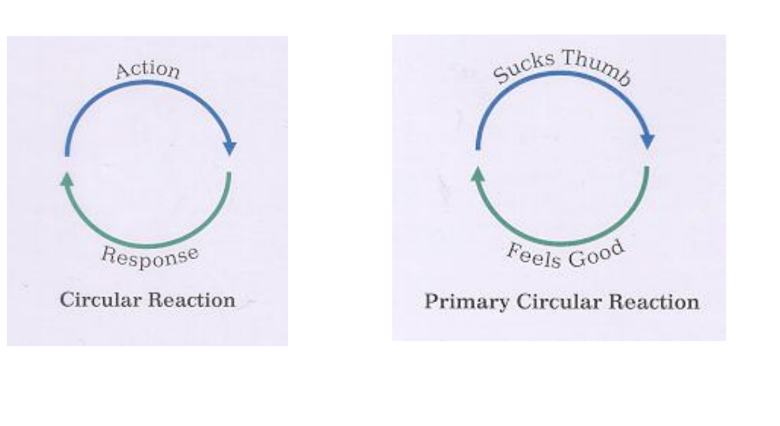
Stage 2: Primary Circular Reactions (1 to 4 months)
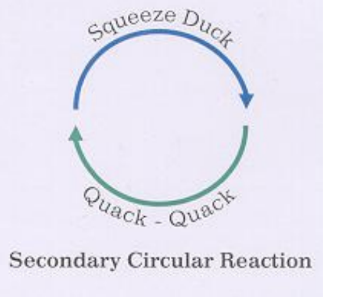
Stage 3: Secondary Circular Reactions ( 4 to 8 months)
Stage 4: Coordination of secondary circular reactions (8 to 12 months)
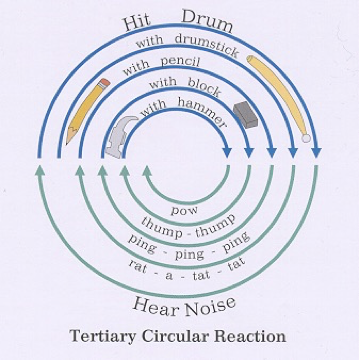
Stage 5: Tertiary Circular Reactions (12 to 18 months)
Stage 6: New means through mental combinations (18 months to 2 years)
In this stage, children begin to use their minds to manipulate situations and create solutions, demonstrating more complex problem-solving abilities.
Primary Circular Reactions: (1 to 4 months) - In this initial stage, infants engage in repetitive behaviors centered around their own body, such as sucking their thumbs or cooing, which help them learn to coordinate their movements and understand their own actions.
Secondary Circular Reactions:
(4 to 8 months) - In this stage, infants focus on the effects of their actions on the external environment, such as shaking a rattle to produce sound, which fosters an understanding of cause and effect.
Tertiary Circular Reactions:
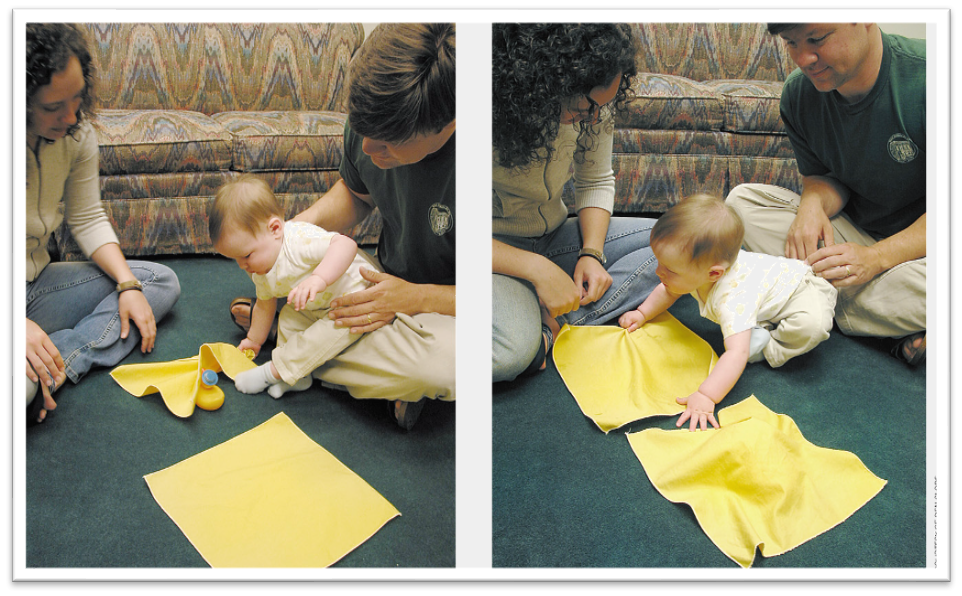
Object Permanence: Out of sight, out of mind
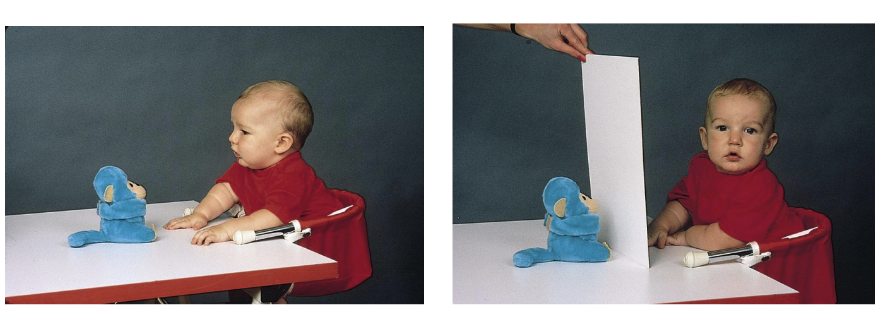
Piaget’s A- not- B Error
Preoperational Period (2-7 years)
Egocentrism
Animism
Intuitive reasoning
Rigidity of thought
- centration
-states vs transformations
-lack of reversibility
Three Mountain Problem
A classic task used by Piaget to demonstrate children's lack of perspective-taking, as they often struggle to identify what a person on the opposite side of the mountains can see.

Preoperational period (2-7years)
Egocentrism
During this stage, children focus primarily on their own point of view and have difficulty understanding that others may have different perspectives or experiences.

Examples from Piaget showing both animism and egocentrism in a pre-operational child:

Conservation
Conservation of liquids

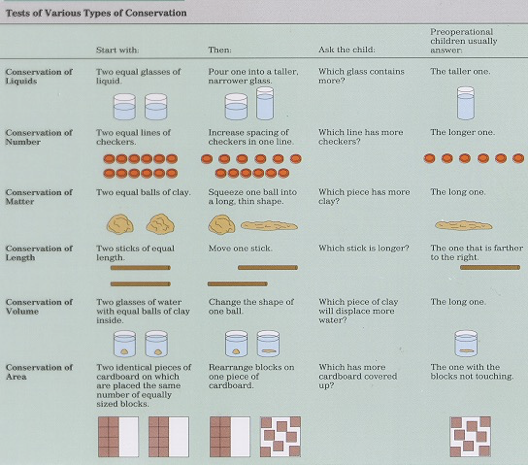
A child may believe that a tall, narrow glass holds more water than a short, wide glass, despite both containing the same volume. This misunderstanding illustrates a lack of conservation, where the child cannot recognize that the amount of liquid remains unchanged regardless of the container's shape. In terms of egocentrism, a pre-operational child might assume that everyone else sees the world exactly as they do, such as believing that if they cover their eyes, others cannot see them either.
Period of Concrete Operations (7-11 years)
Conservation
justification
resistance to counter suggestion
Can deal with multiple dimensions