Developing Operation Sense
Key Aspects to Developing Operation Sense
Recognizing real-world settings for each operation
Awareness of models and properties
Recognizing relationships among operations
Understanding the effects of an operation
Having conversations with students can help them understand this
A Model for Introducing Operations with Word Problems
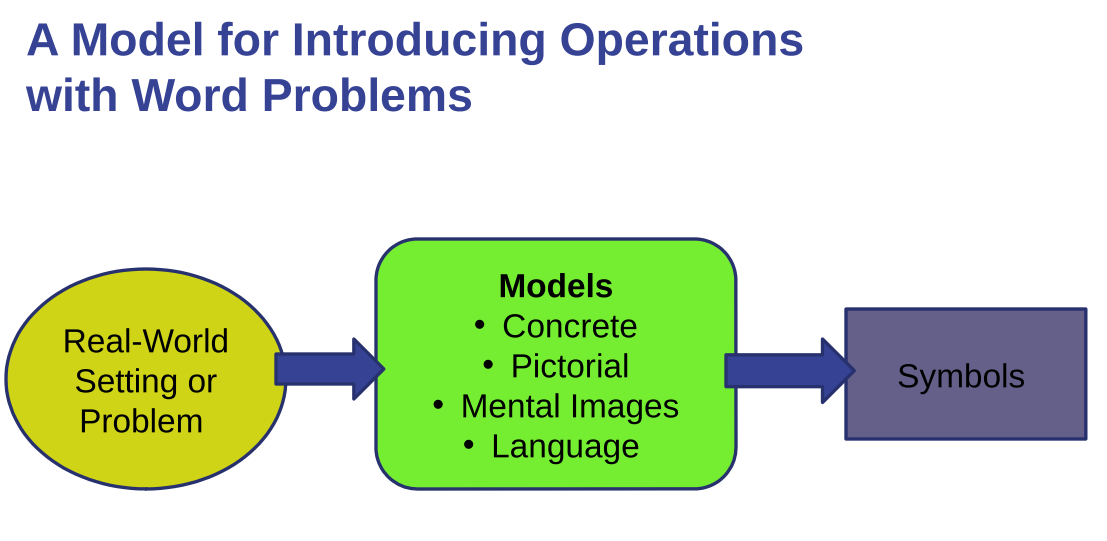
Word Problems
Should come from familiar real-world experiences
Everyday classroom opportunities
Calendar
Morning routine
Classroom events
Children’s Literature
Allow children to make decisions about sharing and distribution of classroom materials.
Avoid pressure to memorize basic facts!
Meaning develops over time
Refrain from using “keyword” strategies
because the words can be used in different ways to mean different things
Types of Addition and Subtraction Word Problems
Join and Separate: action words
Part-Part-Whole and Compare: no action words/action words don’t affect the quantities
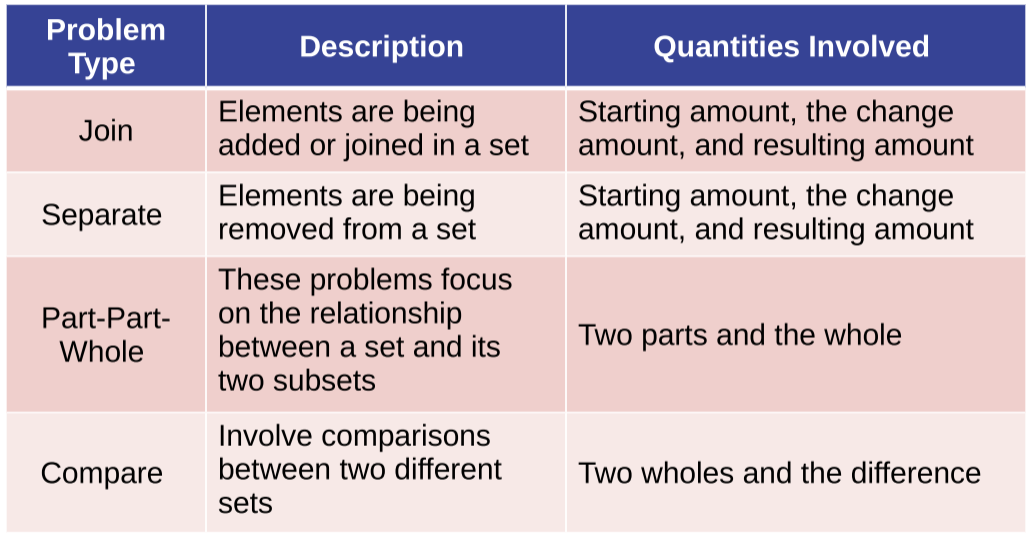
Examples of Problem Types
Be able to tell what type of problem one is and be able to write a problem when given a type
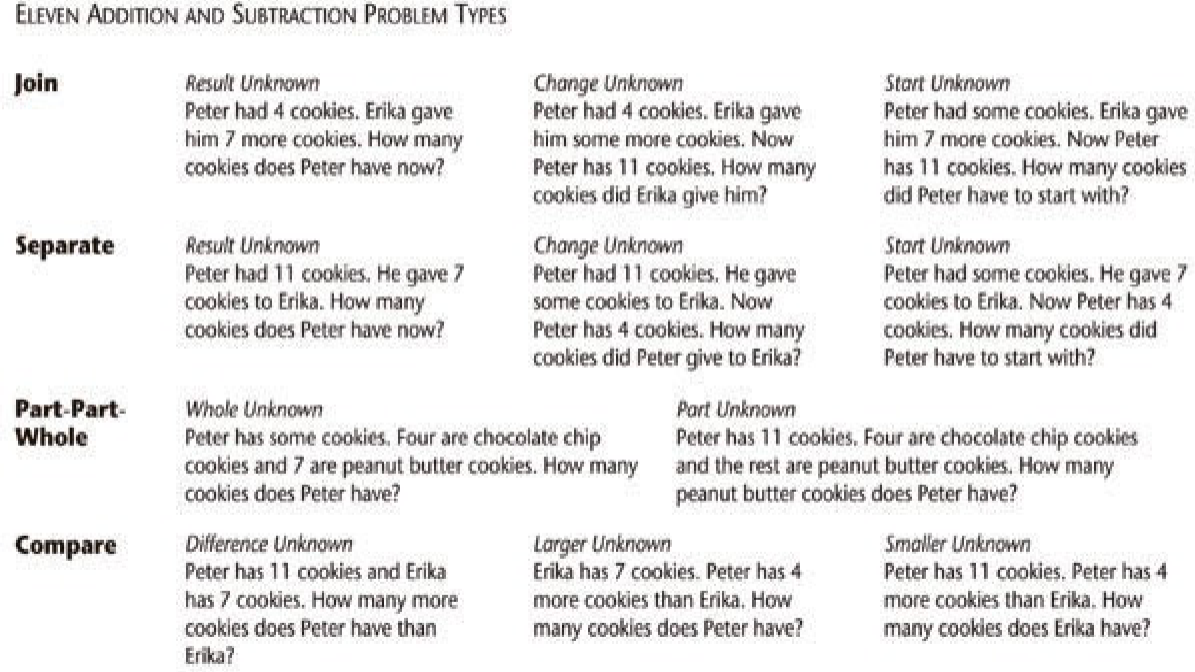 Join:
Join:
start quantity, change quantity, end quantity
Join: Result Unknown (JRU)
Join: Change Unknown (JCU)- not telling what the change is explicitly
Join: Start Unknown (JSU)- not telling what you’re beginning with
Separate:
Separate: Result Unknown (SRU)
Separate: Change Unknown (SCU)- not telling what the change is explicitly
Separate: Start Unknown (SSU)- not telling what you’re beginning with
Part-Part Whole:
there are no action words
whole unknown: the whole (end part) is unknown
part unknown:
Compare:
Difference Unknown: create a train and see the difference between the two trains
Larger Unknown
Smaller Unknown
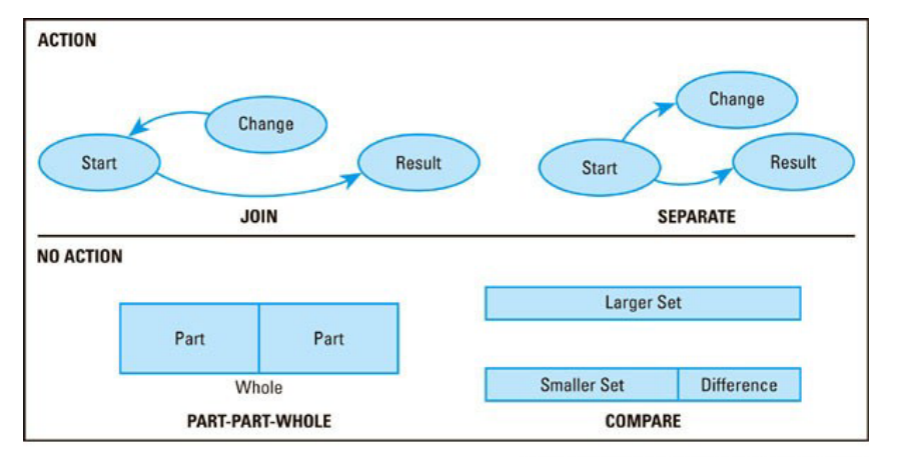
Structure of Addition and Subtraction Problem Types
can use an organizational map with students, especially if they’re struggling
Strategies Children Use to Solve Story Problems
Direct Modeling: representing quantities with concrete objects
Counting Strategies:
counting on, counting back, skip counting
Derived Facts: to build on or modify facts that are already known
Recall: retrieving facts already known to solve the problem quickly
Inverse operations: something that will undo what is done— addition and subtraction, multiplication and division.
Transition from Adding to Multiplying
use the phrase “groups of” to indicate creating a number or equal groups
understanding the meaning of each quantity
communicative property: you can change the order of the numbers and get the same answer
The associative property states numbers can be regrouped with addition or multiplication, and the answer will not change.
The commutative property states the numbers can change positions with addition or multiplication, and the answer will not change.
multiplication: factors
addition: addends
Types of Multiplication Word Problems
Equal Groups Problems: Based on making a certain number of equal–sized groups. The numbers in the problem represent:
Number of groups
Size of the groups
Total number of objects
Area and Array Problems:Involve finding the area of a rectangular region or finding the total number of objects in a rectangular array.
Multiplicative Comparison Problems: Involve comparing two quantities multiplicative.
How many times as much one quantity is compared to another quantity
“twice as much, — times more”
Combination Problems (Cartesian products): Involve different combinations that can be made from sets of objects.
how many different types of sundaes can be made with the 3 different toppings and 3 different flavors?
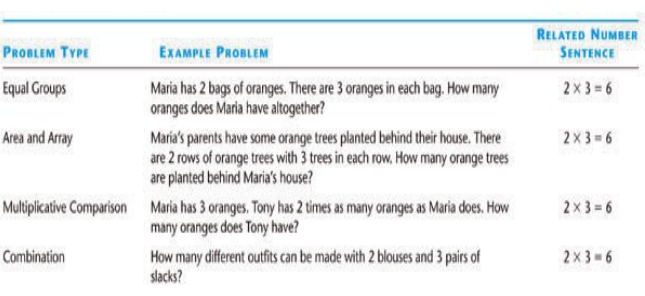 Types of Multiplication Problems
Number of groups: 2 bags of oranges
Size of the groups: 3 oranges in each bag
Total number of objects: unknown, total size we are looking for
always trying to find an unknown number of objects
Types of Division Word Problems
Equal Groups Problems: Involve splitting a larger group into several smaller groups. Numbers in the problem represent:
Number of groups
Size of the groups
Total number of objects
Partitive Division Problems – the total number of objects is partitioned into a specific number of groups.
Measurement Division Problems – the total number of objects is measured out into groups of a certain size.
Area and Array Problems: Involve finding one of the dimensions of a rectangular region or of a rectangular array when the total area or total number of objects in the arrangement is given.
Multiplicative Comparison Problems: Involve comparing two quantities multiplicative.
Combination Problems (Cartesian products): Involve different combinations that can be made from sets of objects.
moving where the unknown is
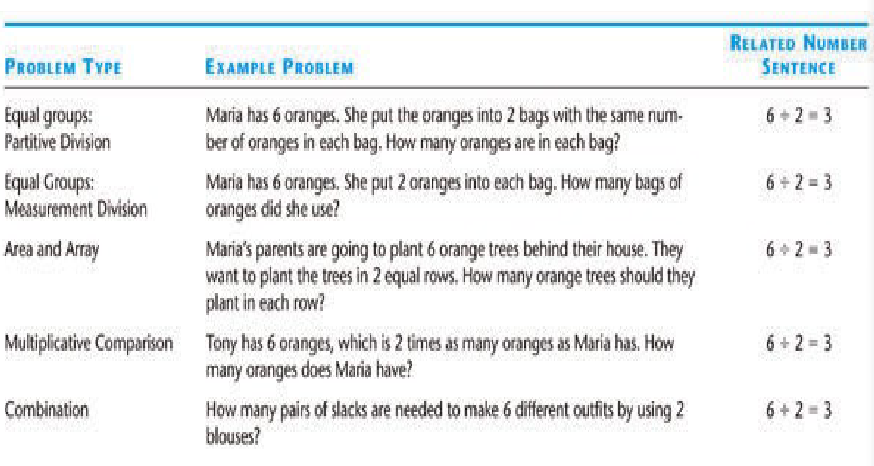
Division Problem Types
6 oranges: total
2 bags: number of groups
number of oranges in the bag: unknown
in every problem, you’re solving for the size of the group
Avoiding Misconceptions and Dead Ends
Misconceptions and instructional “dead ends” with multiplication and division:
“Multiplication makes bigger”
“Division makes smaller”
Division means only fair shares (or partitive division)
Modeling Multiplication and Division:
Developmental levels in understanding multiplication
Problem: “If 8 plates hold 4 cookies each, how many cookies are on all the plates?”
Level 1:A child sets out 8 plates, puts 4 cookies on each plate, and counts the total number.
Level 2: A child makes 8 groups of 4 without using separate objects for plates.
Level 3: A child makes one group of 4 and recounts it 8 times, keeping track of how many groups have been counted by using fingers or another memory device.
CRA:
concrete: using physical objects
representation:
abstract: thinking in their heads, skip-counting
Advanced levels include
Counting by fours
Counting on when they cannot recall the next multiple (4, 8, …9, 10, 11, 12)
Adding fours
Using derived facts: using what you know to figure out another fact
the video of the boy doing 12×6 and taking 12×5=60 and adding on 12 to figure it out.
For the Test:
know the types of problems and their structures
be able to create your own problems